





Fossil Vertebrate Identification Guide for the Calvert Cliffs of Maryland and the Horsehead Cliffs of Virginia.
Besides the countless shark fossils found in the Miocene deposits of the Chesapeake bay, other vertebrates are also found.
The Calvert and Choptank seas of the Miocene were home to numerous Cetacea (whale and dolphin type animals), Seals, Turtles, Salt water Crocodiles, and even Manatees.
Some of the cetacea include the bizarre Shark Toothed Whale, while others include some of the first
Baleen whales, the great plankton feeders.
Besides for the marine vertebrates, fossilized remains of land animals are also found. These are from the short time periods when the sea levels regressed.
Land animals would live on the land.
When the waters would rise again, sometimes the remains of these land animals would fossilize. They are rarely
found and scattered in thin layers of the Calvert Cliffs.
Based on the fossil finds, this area was much warmer than today.
Animals that one wouldn't think of are found here, from the common Peccaries, to Camels, Llamas, Rhinocerases,
Mastodons, Wolves, and even animals like the strange Bear Dog lived here!
There's more than just shark teeth to be found!
Click on the type of vertebrate fossil or scroll down to browse:
Or go back to the
MAIN Calvert Cliffs Page
Land Mammals

 Mammal tooth
Marine Mammals I - Pinnipeds - Seals & Sea Lions
 Seal Fossils
Marine Mammals II - Cetacea - Whales / Dolphins
Go to top of Cetacea Section
 Ear Bones
 Cetacean Bones
 Cetacean Bones
 Cetacean Bones
 Cetacean Bones
 Odontocete
 Mysticeti
Reptiles (Crocodiles, Turtles)
 Crocodiles
 Turtles
Bony Fish
 Bony Fish
Land Mammal Fossils
The Calvert, Choptank, and St. Mary's Formations are Marine in nature. However, although rarely, land mammals are found in these formations. These fossils may have come from lag deposits during marine transgessions, where a carcass would float out to sea and be buried in sediments by the slowly rising sea levels.
Land animal fossils represented at the Calvert cliffs are diverse and include Peccaries, Tapirs, Early Horses, Rhinos, Bear Bogs, Camels, and Gomphothere elephants.
If you happen to find a land mammal fossil, I would suggest verifying it is a miocene land mammal fossil and then contacting the Calvert Marine Museum, as most land mammal fossils found here are scientifically valuable due to their rarity.

Gomphothere elephant on display in the Museum national d'Histoire naturelle in Paris. These animals lived in the Calvert Cliff area in the Miocene.
Peccary Fossils

Image of a Peccary by:
Chrumps [GFDL, CC-BY-SA-3.]
The peccary is a small pig-like animal that belongs to a different family than pigs. They have no visible tail and have very short ears. Today, there are three living species of peccaries. They range from the Southwest United States into Mexico, Central America, and parts of South America.
Although land mammal fossils are rare, pecceries are the most common land mammal finds in the Calvert Cliffs. Perhaps they preffered to live along the coastal waters? Mostly isolated teeth are found. Occasionally a bone or jaw section is found. The genus Cynorca, Desmathyus, and Prosthenops have all been reported from the Calvert Cliffs.
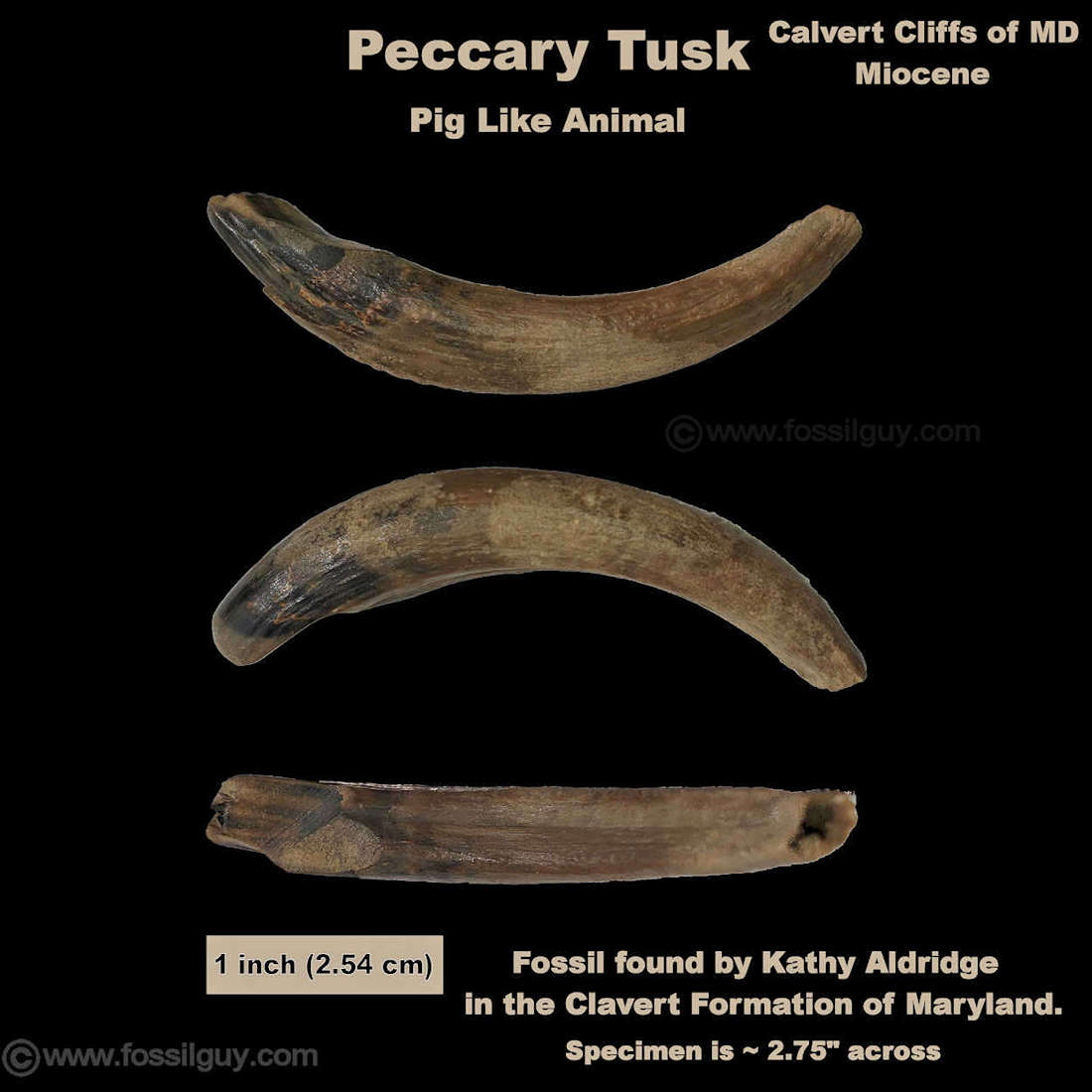
This is a tusk from a Peccary. The grooves in the top view show that it was probably naturally worn down while the Peccary was still alive.
Peccaries have 4 small tusks (2 top and 2 bottom) in their mouths that help them crush seeds and dig roots. This specific fossil was found by Kathy Aldridge and is used here
with her permission.

This is a molar from a Peccary. Fossil found by Paul "Matt" Blomgren.
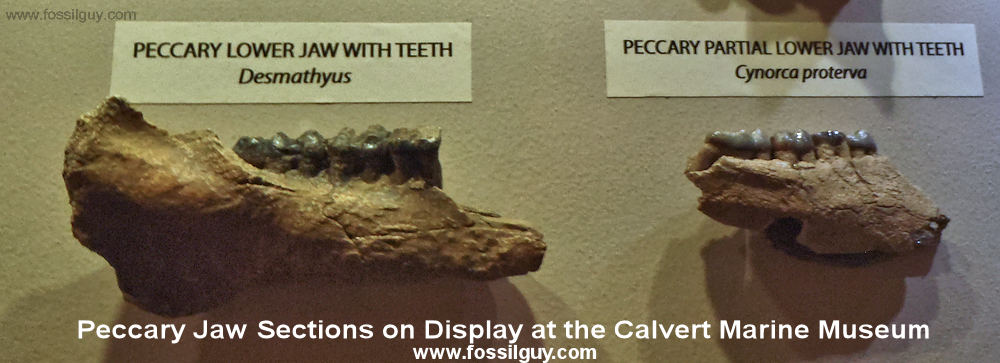
These are two Peccary jaw sections on display at the Calvert Marine Museum in Solomons, MD.
Mammal Tooth - It may be an early Miocene deer tooth

Fossil mammal tooth from the Calvert Cliffs of Maryland. Fossil found by Paul "Matt" Blomgren.
After passing this tooth around to various paleontologists that specialize in miocene mammals, the best guess is this
tooth is from an early Miocene deer.
Pinniped Fossils - Seals / Sea Lions
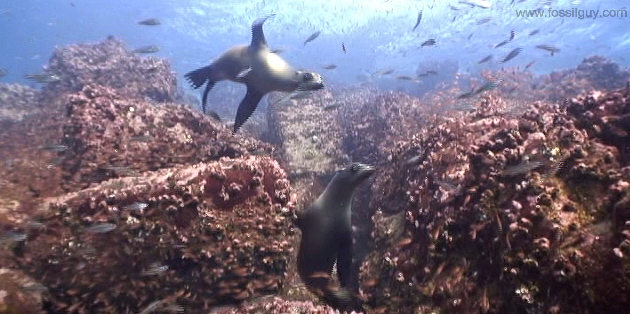
Sea Lions at the Galapagos
Pinnipeds are rarely found at the Calvert Cliffs. If found, the fossil is usually an isolated tooth. Although identification of a fragment to the genera level is near impossible, more substansial fossil finds at the cliffs reveal a few early seals at the cliffs: Leptophoca lenis, Prophoca. and Monotherium.

A Sea Lion colony just outside of Cabo San Lucas, Mexico
Seal Tooth
Seal teeth are usually easy to identify. Although hard to find, seal molars have a distinctive shape.
The only thing they are sometimes confused with are fox molars.
A few fox tooth positions superficially look like seal teeth.
Fox teeth do not have cusps on both sides of the tooth and they have more of a blade-like look.
There are no fossil foxes at the Calvert cliffs, however, modern ones sometimes die and rot, the teeth stain and superficially resemble fossils.
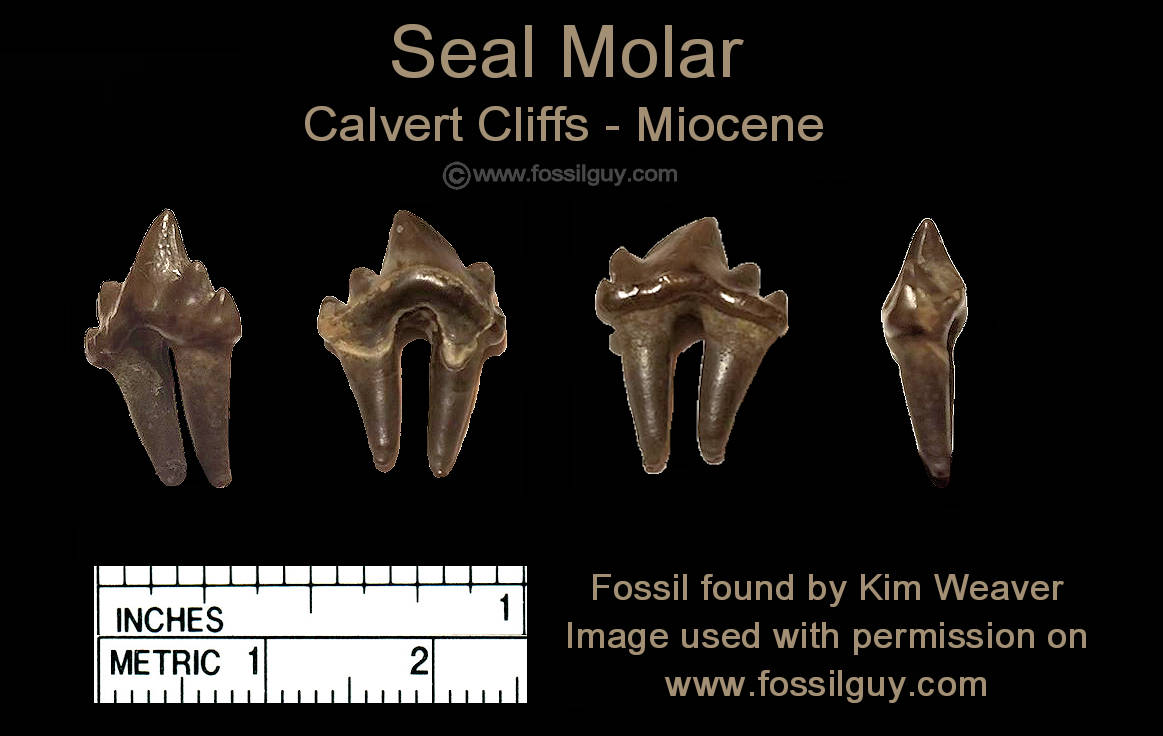
This is a seal molar found at the northern part of the Calvert Cliffs.

This is a water worn seal molar. Although quite worn, the features can still be seen, such as the cusps.
Seal Cervical Vertebra
Seal vertebra look very different than Cetacea vertebra. The one imaged below is a seal cervical vertebra.
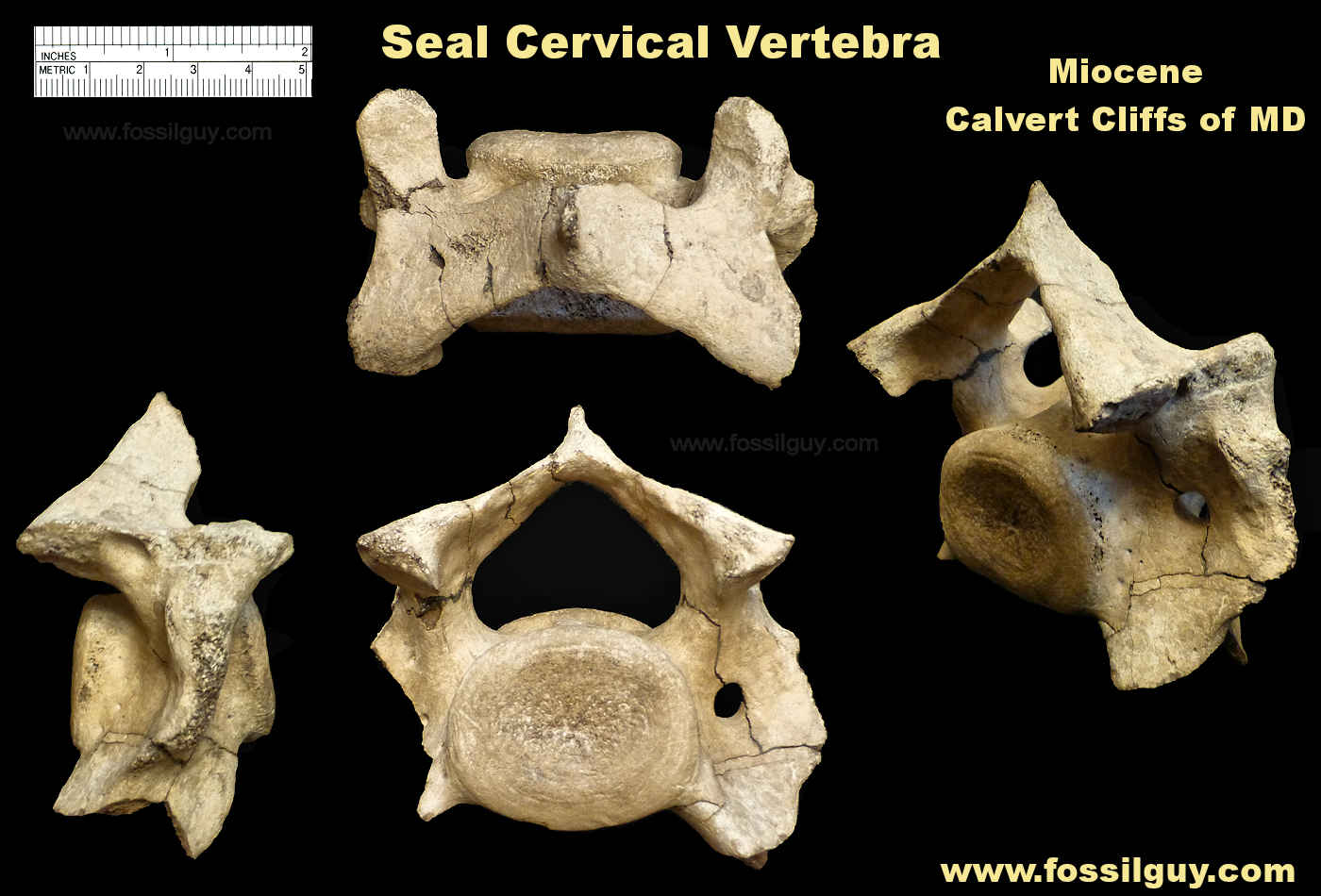
This is a good example of a seal cervical vertebra from the Calvert Formation. They look VERY different than cetacean vertebrae
It was found shattered on the beach (I recovered 8 pieces), with suprisingly no matrix attached, which is odd because it was very fresh, as the pieces would have washed away in mere hours with the incomming tide.
Seal Arm Bones
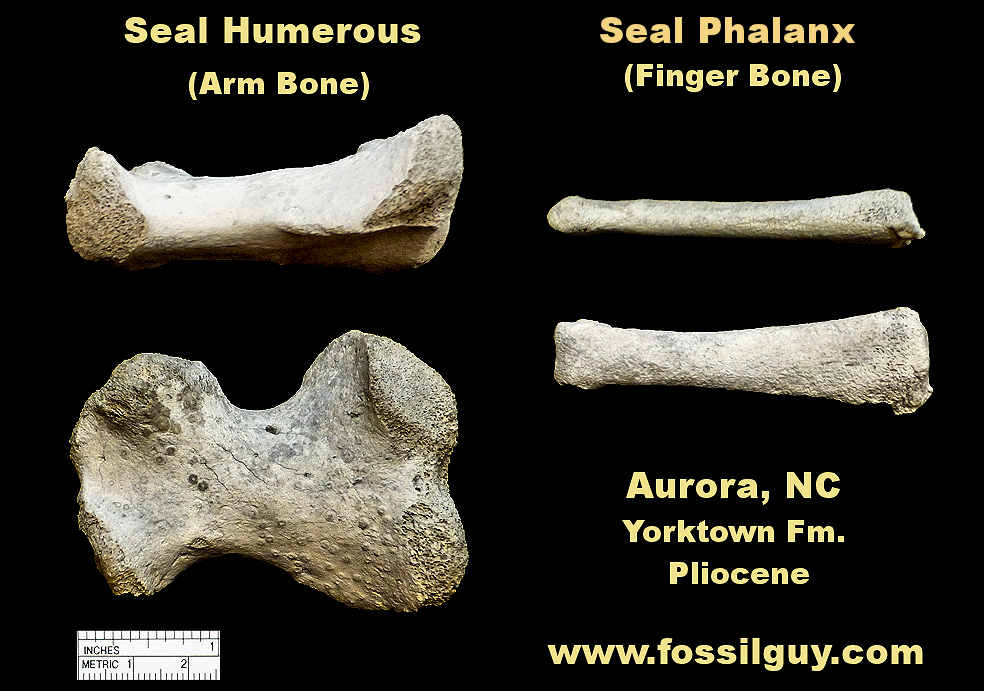
This is an example of a seal humerus (arm bone) and a seal phalanx (finger bone).
These are from Aurora, North Carolina. They are shown here for identification purposes, as one can find the
same seal fossils at the Calvert Cliffs.
Cetacean Fossils - Dolphins / Whales
Cetaceans are Whale and Dolphin like animals. These are by far the most common vertebate fossils found at the cliffs besides sharks teeth. The Miocene seas hosted a vast diversity of cetacea, far greater than todays diversity. New ones are still being discovered at the Calvert Cliffs. Cetaceans are broken into two groups:
Odontocetes - Toothed Whales:
These include any whales with teeth, from small dolphins to the large Sperm Whale.
Mysticetes - Baleen Whales:
These are the large filter feeding whales. They do not have teeth, but instead have wide jaws of Baleen that filters plankton out of the water. Some of the earliest Baleen whales come from the St. Marys Formation of the Calvert Cliffs.
Unfortunately, unless a complete skull or ear bones are found, it's incredibly difficult, if not impossible, to determine the genus or species of cetacean fossil found. Because of this, the fossil identifications below are grouped into types of fossils, not genera.

Cetacean skeleton on display at the Museo de La Baleena, La Paz, Mexico.
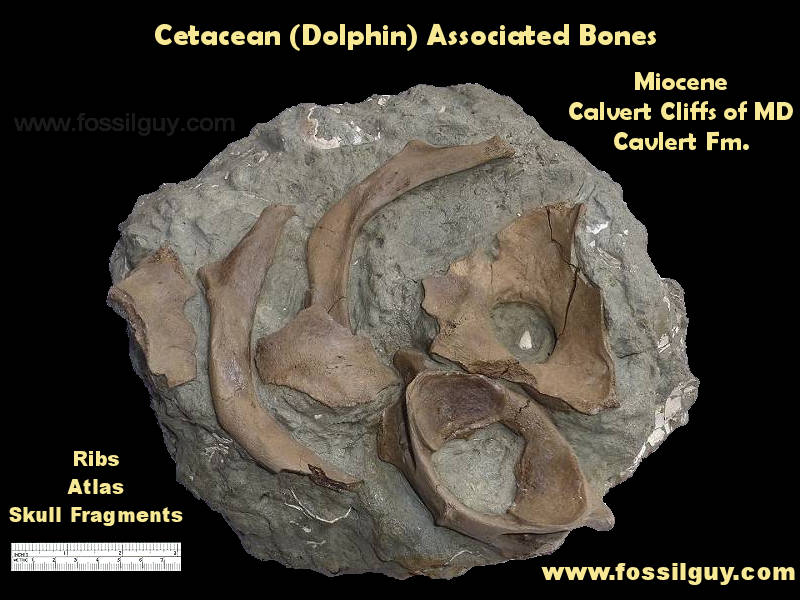
These are a chunk of associated fossil bones from a dolphin like cetacean. There are two rib sections, one atlas vertebra, and some fragments of skull. It was found in a fallen chunk of cliffs. No other parts of it was found in the area of the fall.
It was found during a
November 2013 Trip.
The video in the trip report has it shown as found and a prep sequence.
Ear Bones
The two ear bones are the Periotic and the Tympanic Bulla. These bones are very dense and often survive fossilization. At the cliffs, the Periotics appear survive erosion better and are more common. They look like odd shaped pebbles. Usually, they become so water eroded that they become difficult to distinguish from a regular pebble.
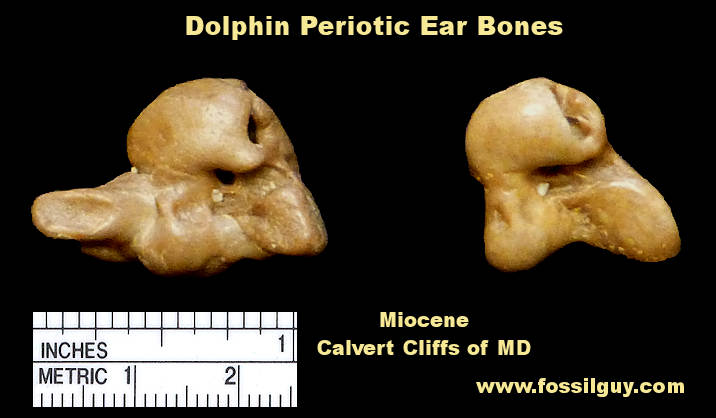
These are dolphin periotic ear bones. They are VERY dense and survive fossilization easily.
Epiphysis disks - "Cookies"
Epiphysis are often found at the calvert cliffs.
They are soft cartilaginous ends on a bone.
As the animal ages, the cartilage epiphysis ossify into bone and fuse onto the bone ends. If the animal dies while still a juvenile, the epiphysis are not yet fused and often fall off the bone and can be found as isolated fossils.
Vertebral centrum epiphysis are the most commonly found epiphysis. They are kind of like end caps on the vertebra that ossify as the animal ages. The Invertebral disc (cushioning pad) would sandwich between these.
Epiphysis from vertebrae are thin, round, and look like a cookie, hence the nickname. Vertebral centrum epiphysis disks from juvenile cetacea vertebrae are usually 1/2 - 3 inches across, but due to their thinness, are often found broken.
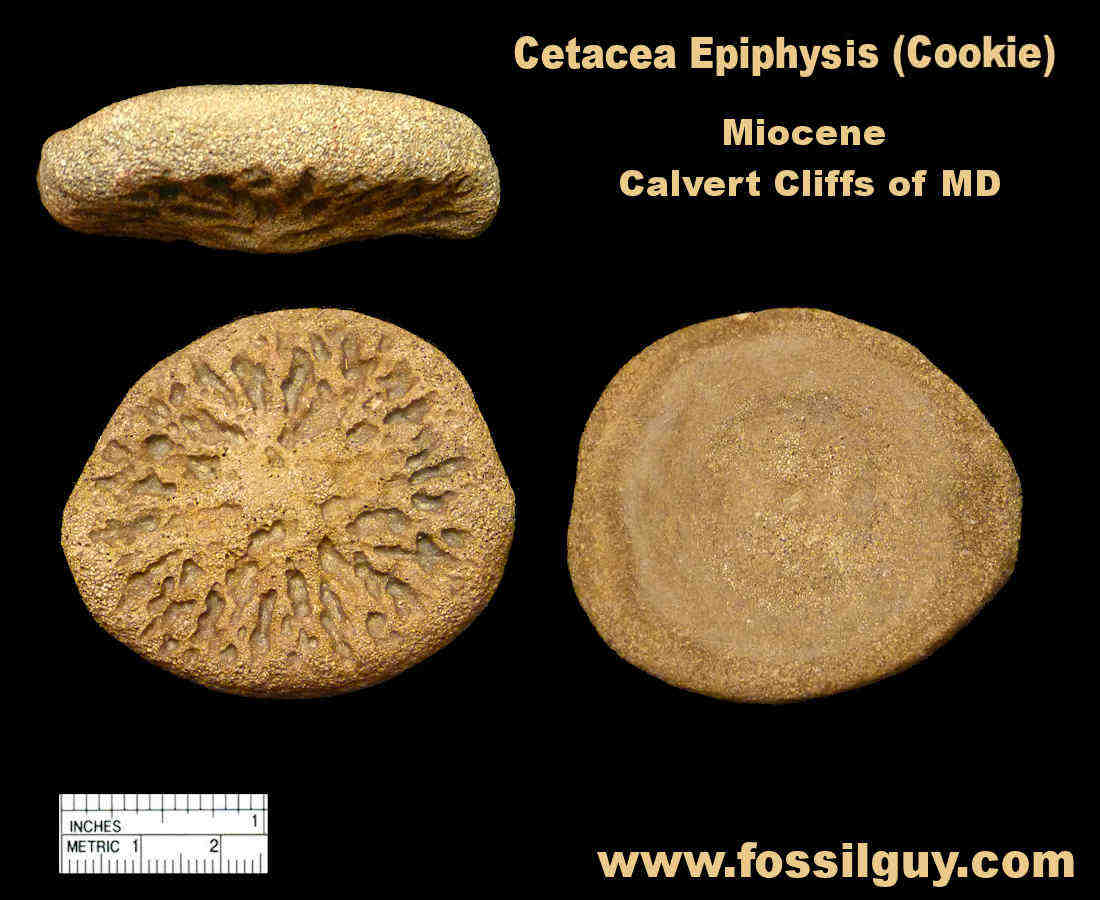
This is a good example of an isolated vertebral centrum epiphysis or "cookie."
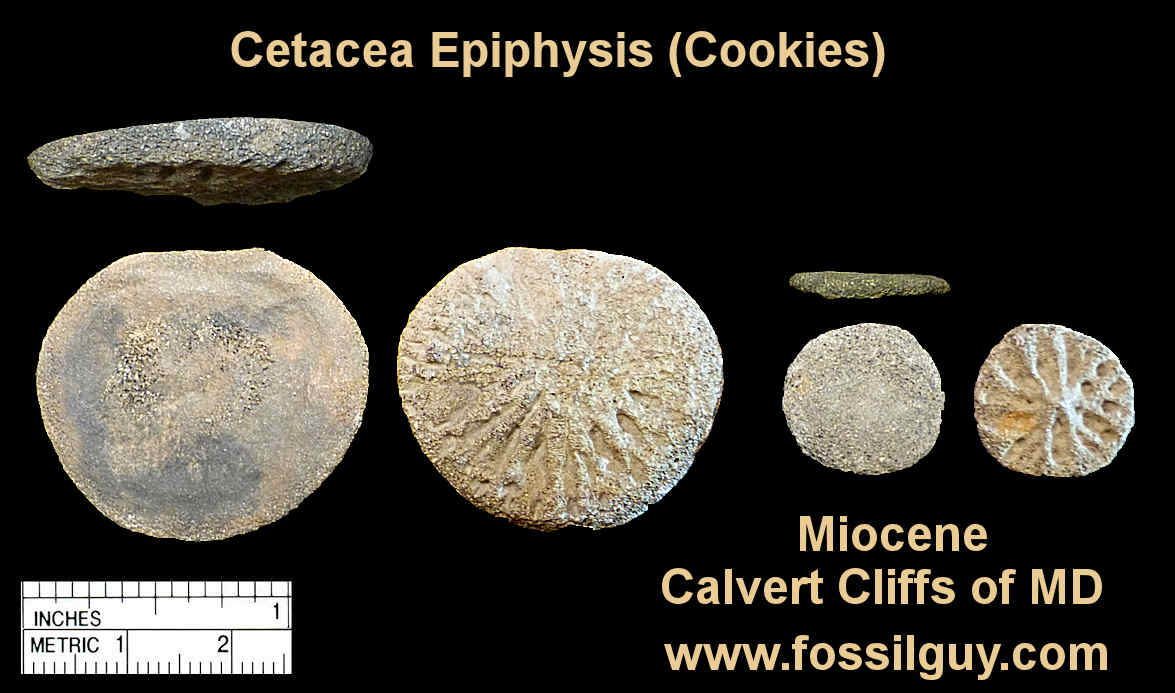
These are two other fossil "cookies" for comparison
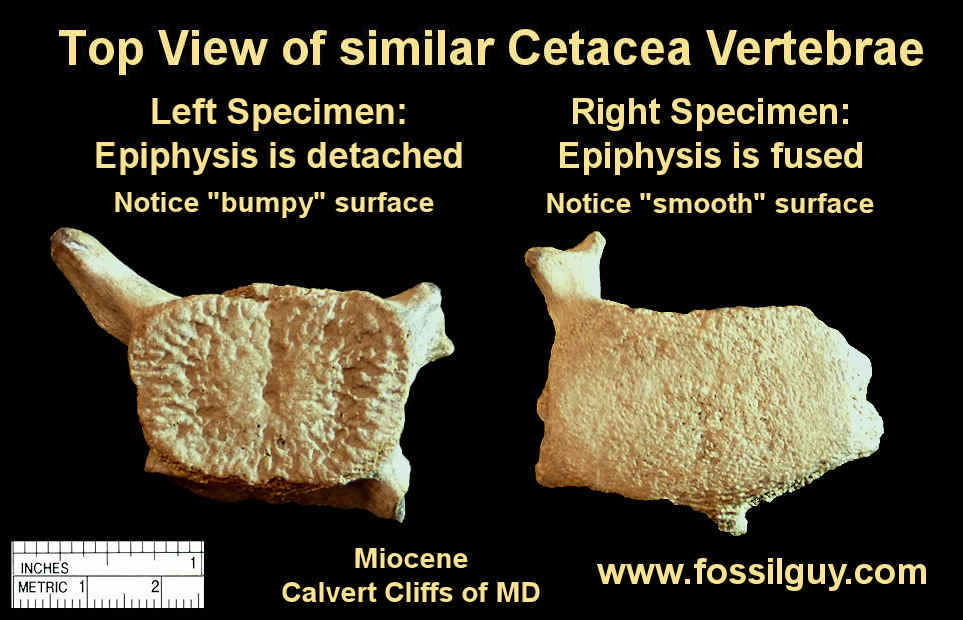
This is a top view comparison of a vertebra missing the epiphysis (LEFT), and a vertebra that has it fused (RIGHT).
Notice the one with the missing vertebral epiphysis has a very bumpy center.
Cetacean Vertebrae - Backbones
Fossil Whale / Dolphin vertebrae are a common find along the Calvert Cliffs.
There are different types of vertebrae depending on the position in the animals back.
Cervical: Vertebrae which form the head and neck veretebrae.
Thoracic: Vertebrae, or Rib Vertebrae, form the upper back.
Lumbar and Sacrum: vertebrae which form the lower back.
Caudal: vertebrae which form the tail.
The numbers of each type of vertebrae vary depending on the species of whale or dolphin. Some have only 41 verebrae, while others have 91 vertebrae!
Usually, at the Calvert Cliffs, vertebrae have most of the processes (bony protrusions) worn or broken off, so only the central disk is left.
Often the genus or species of cetacean cannot be determined from an isolated vertebra, usually only the vertebra position can be determined.
Cetacean Cervical Vertebrae
Cervical Vertebrae are the vertebrae that make up the neck. There are two special ones, the Atlas and the Axis which connect the skull. The others (C3-C7) are very thin. Many of these vertebrae are often found fused together.
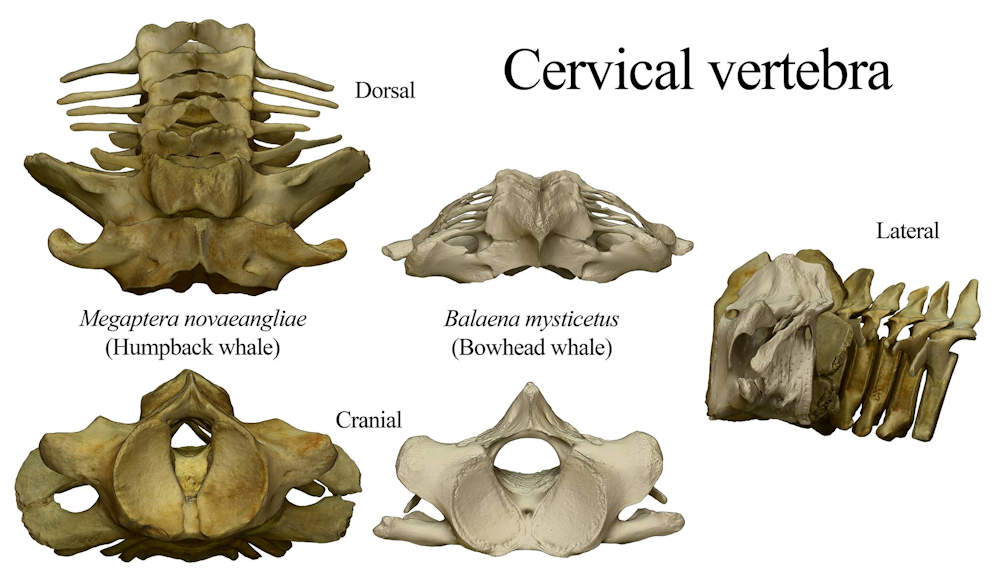
These are virtual scans of two whale cervical vertebral columns, showing the atlas, axis, and other cervical vertebrae and how they all fit together.
This is from the "Whales of the World" scans from the Idaho Virtualization Laboratory at the IMNH. Image has been resized. Copyright: ( CC BY-NC 4.0).
Atlas and Axis Cervical Vertebrae
Two special neck vertebrae are called the Atlas and Axis. These two vertebrae (C1 and C2) connect to the skull.
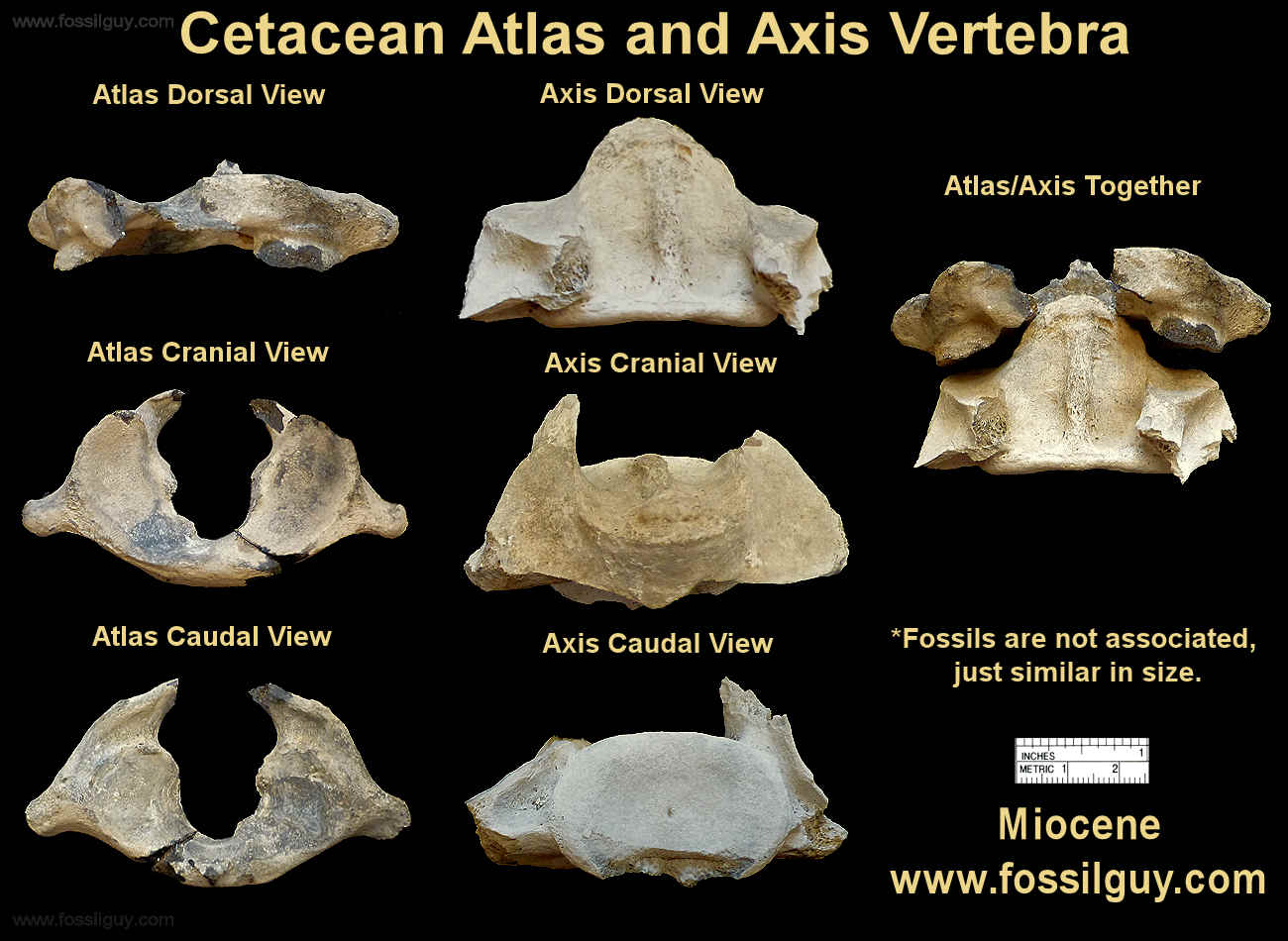
This is an example of an Axis and an Atlas fossil cetacean vertebra from the Calvert Cliffs. The processes are partially broken off, but it shows their general shape and how they fit together.
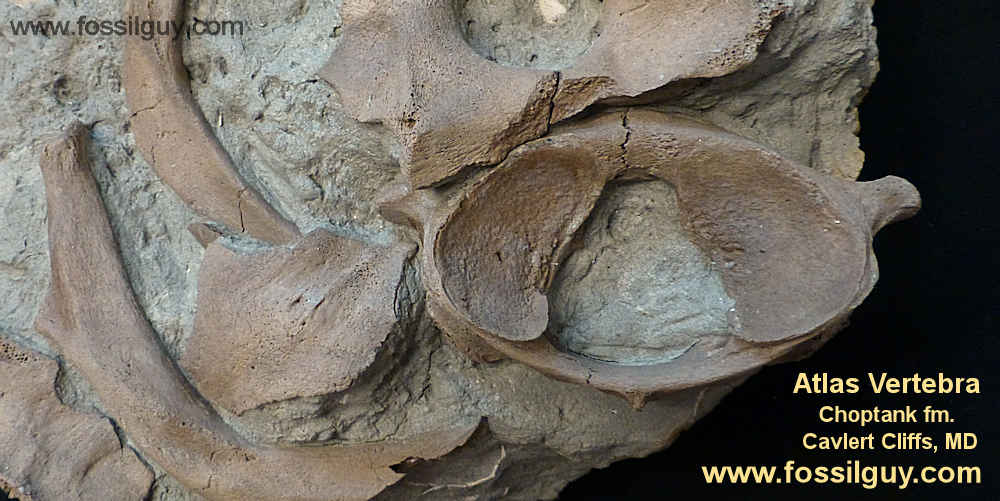
This is a pristine atlas vertebra. It was found in a fallen chunk with a bunch of other bones. Sadly, it looked as if the rest of the animal had already eroded mostly out of the cliffs by time this chunk fell. It looks like it would have made for a nice fossil skeleton for the Calvert Marine Museum if found earlier.
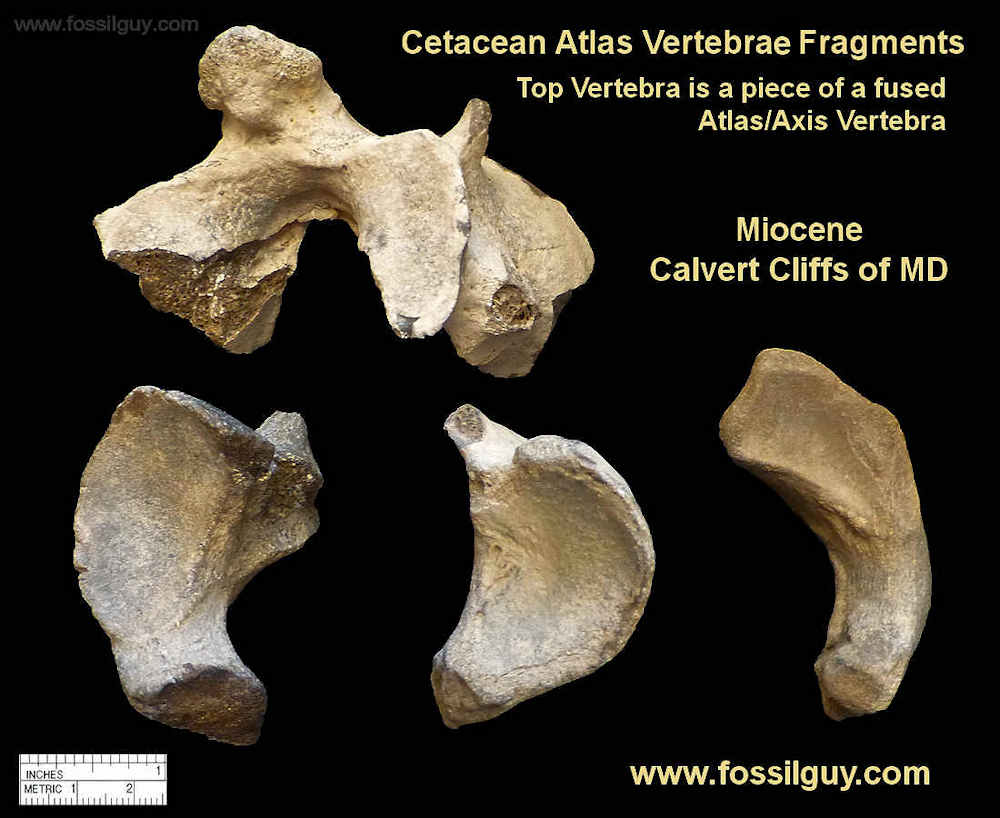
Atlas vertebrae are very fragile. Usually after only being exposed on the beach for a day or two, they break apart. Most often than not, only pieces are found, like the ones above. The articular processes (the kidney bean shaped sections) are the thickest parts and usually become the surviving pieces.
Cetacean Cervical Vertebrae
Cervical Vertebrae C3 to C7
Cetacea and most other mammals, usually have 7 cervical vertebrae. After the Atlas (C1) and Axis (C2), the rest look very similar. In cetacea, they are highly compressed.
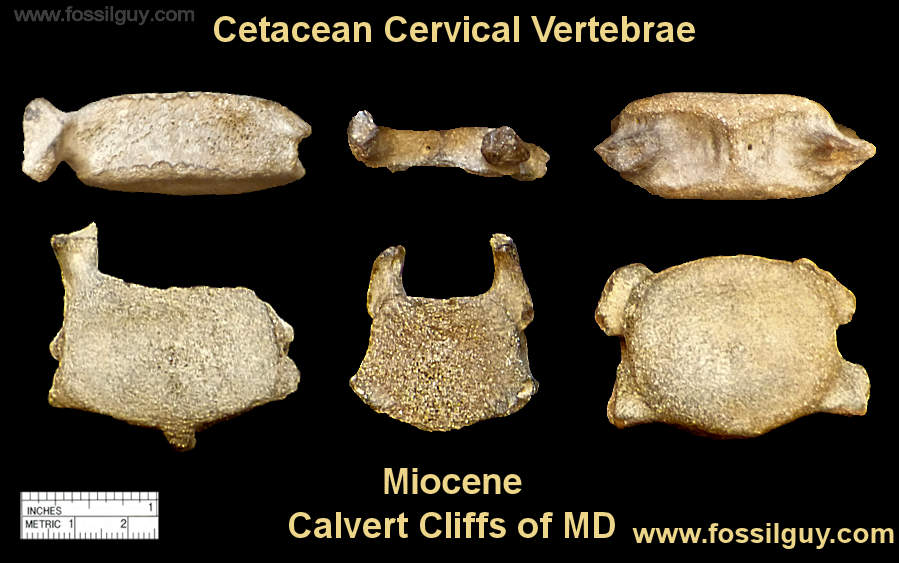
These are some cervical vertebrae fossils from the Calvert Cliffs. The processes are broken off. One can see the thinness of the verberbra centrums (centers). In other vertebrae positions the centrums are much thicker.
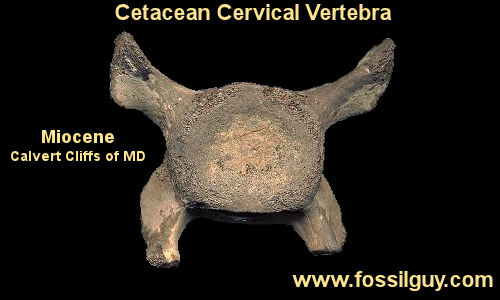
Another Cervical Vertebra. This one has more of the processes still attached.
Thoracic Vertebrae
Cetacea have somewhere around 13 Thoracic vertebrae, depending on the species.
These are the vertebrae of the upper back and have the ribs loosly attached to them.
The central disk is round and has process protruding from the upper sides of the vertebra.
These processes branch into the transverse processes (where the ribs would attach) and a spinal process.
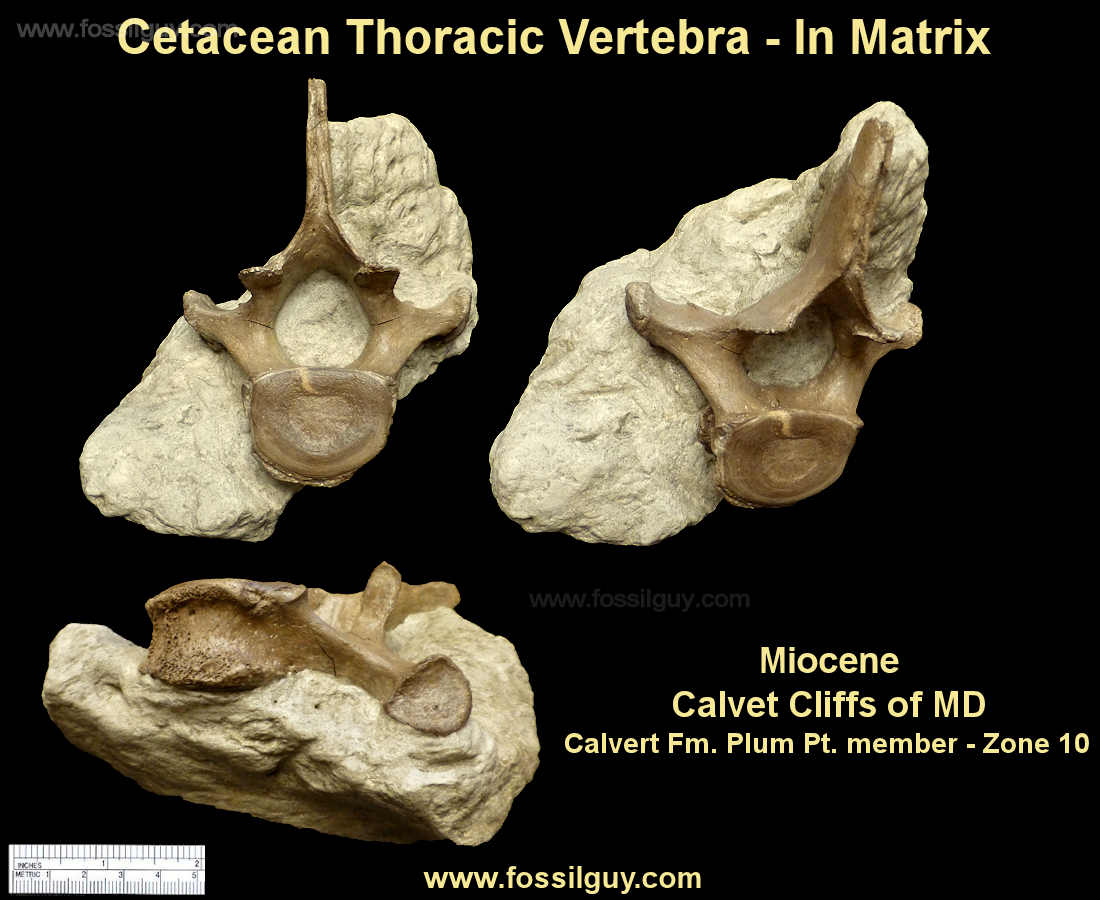
This is a perfect thoracic vertebra from a small cetacean, probably a dolphin like animal. An interesting
note about this vertebra is that it shows signs of arthritis. The arthritis here is seen as bone spurs on the edge of the vertebral disk. The end of the disk normally does not stick out further than the rest of the disk.
This was found in a fallen chunk from Zone 10 of the Calvert Formation. This zone usually has very deep brown colored bone that is well preserved.
Below are a few images of when it was found


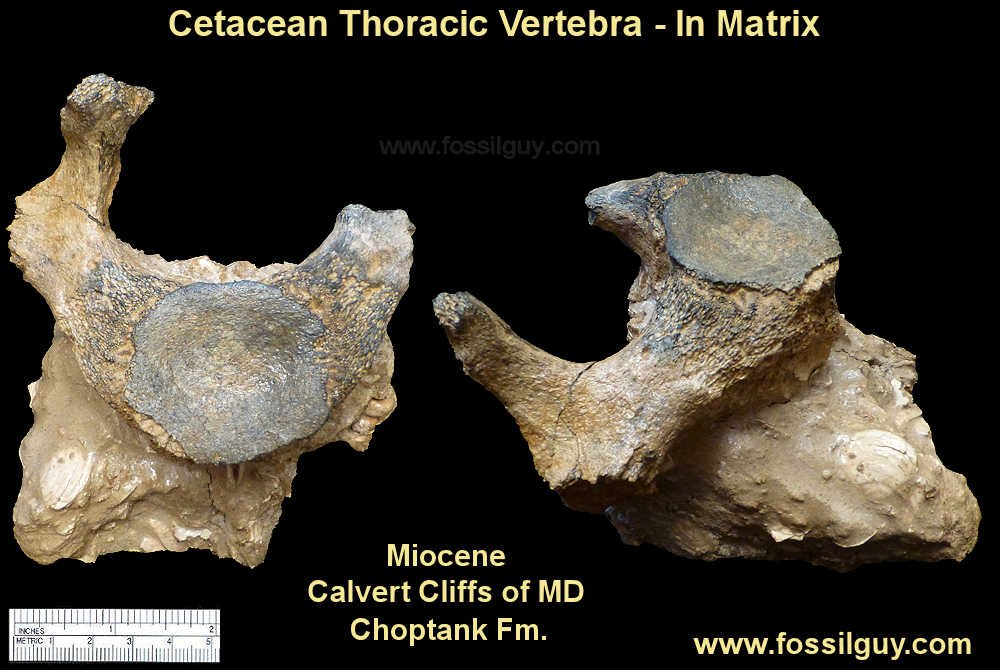
This is a larger, but much more worn thoracic vertebra. It was in a chunk of Choptank formation. I left it in a little bit of matrix. Almost all of the processes are worn off.
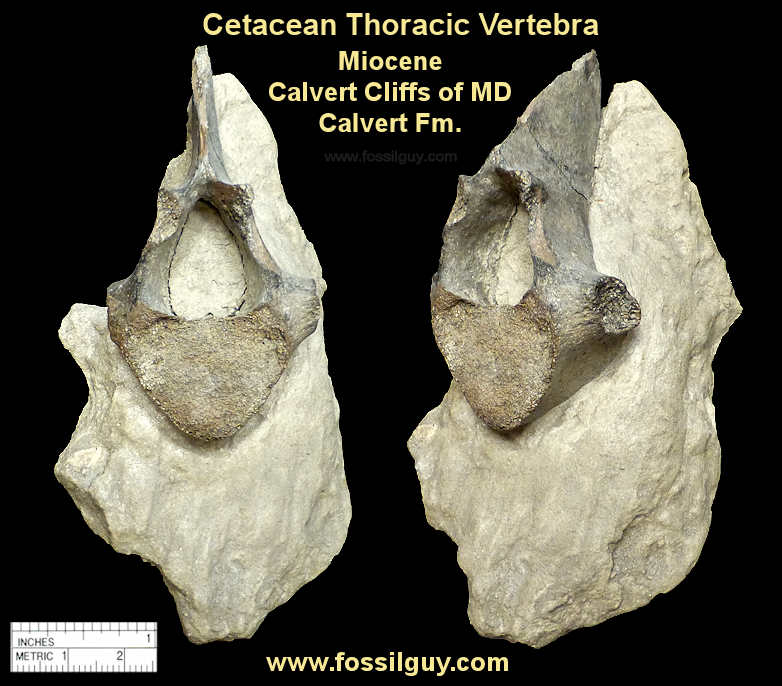
This is a small Thoracic vertebra still in matrix. The side processed are missing, as are the vertebral epiphysis disks.
Lumbar and Sacral Vertebrae
Lumbar vertebrae are the vertebrae of the lower back. They go from past the ribs to the pelvis.
The number of lumbar vertebrae vary among ceteaceans. Dolphins have around 10 - 12 of them.
Lumbar vertebrae have the transverse processes sticking out of the sides, while the spinal process is sticking out of the top of the vertebral disk.
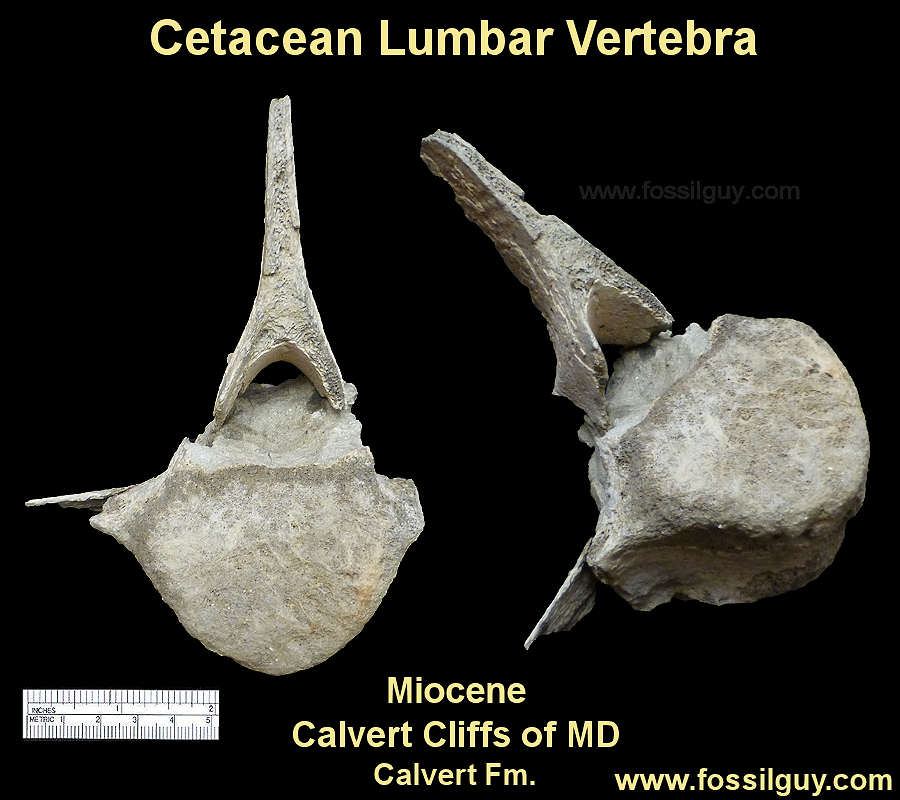
This is a medium sized fossil Lumbar vertebra. It's large enough to be from a whale. It was found crushed up on the beach at the Calvert Cliffs. Some matrix was still attached to it. Part of one of the transverse processes was recovered and most of the spinous process was recovered.
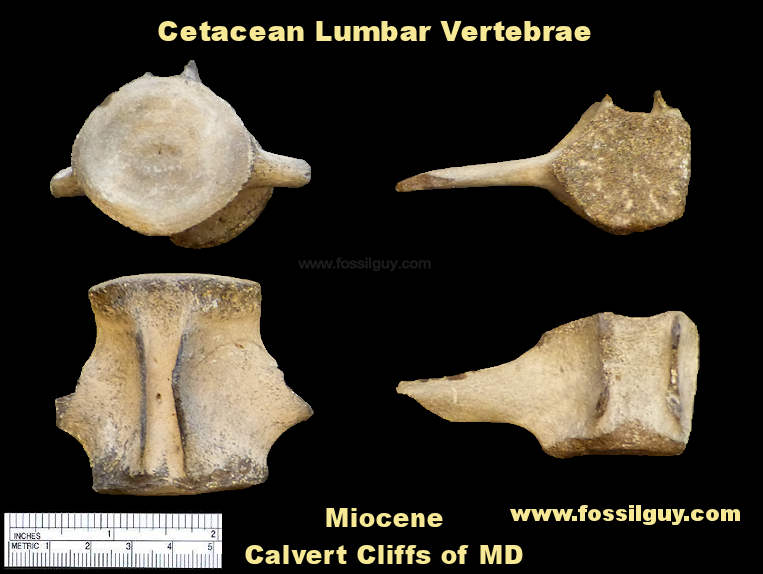
These are smaller fossil lumbar vertebrae from the Calvert Cliffs. They are probably from a type of dolphin like animal. The processes are mostly missing, but one can see where they would have attached.
Caudal Vertebrae
Caudal vertebrae make up the tail of the cetacean. They are very small and the processes are either severely reduced, or missing.
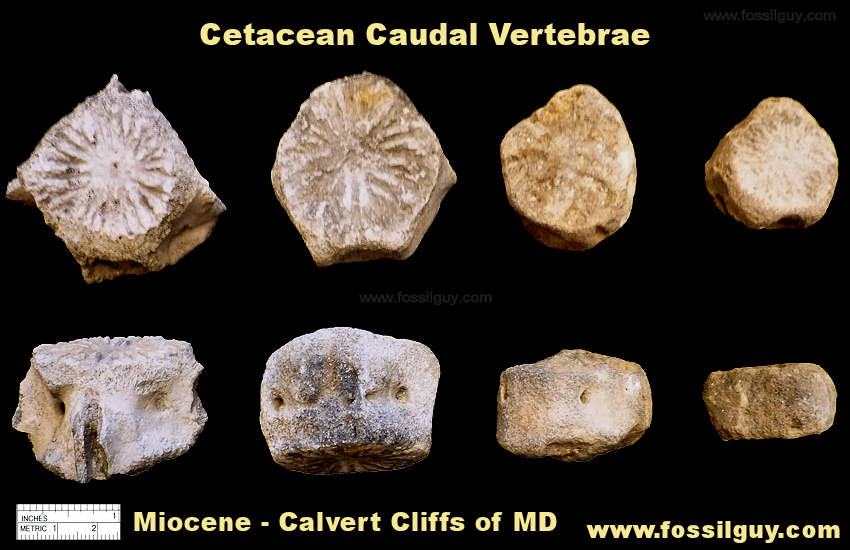
These are worn fossil caudal vertebrae. Notice they are very round and, although they are worn, the processes are severely reduced.
Cetacean Ribs
Rib fragments from cetecea are commonly found fossils along the calvert cliffs.
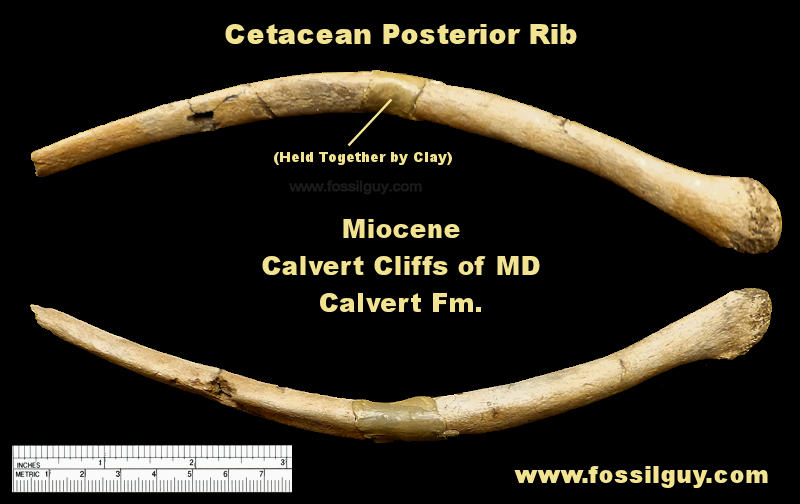
This is a small, but mostly complete rib fossil from a small cetacean, possibly a type of dolphin.
Based on the lack of articulate facets that connect to the thoracic vertebra, it's probably a posterior rib.
It was found broken, the center was missing too much bone to be glued, so I used clay to put it back together.
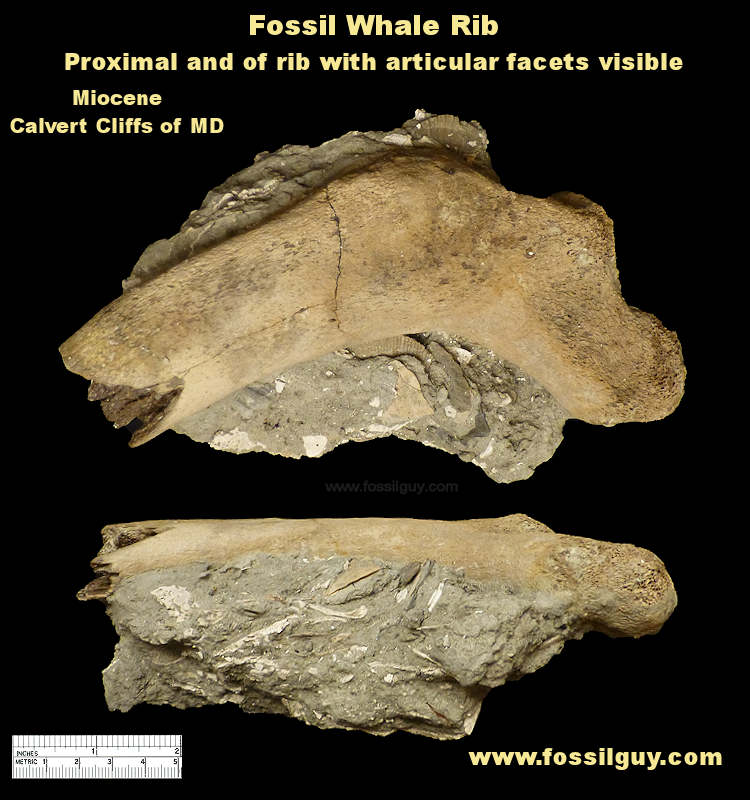
This is the proximal (front) end of a much larger rib. By the size, it's probably from a baleen whale. This one has the articular facets (tubercles) that connect to the vertebra. It is left in the chunk of matrix it was found in.
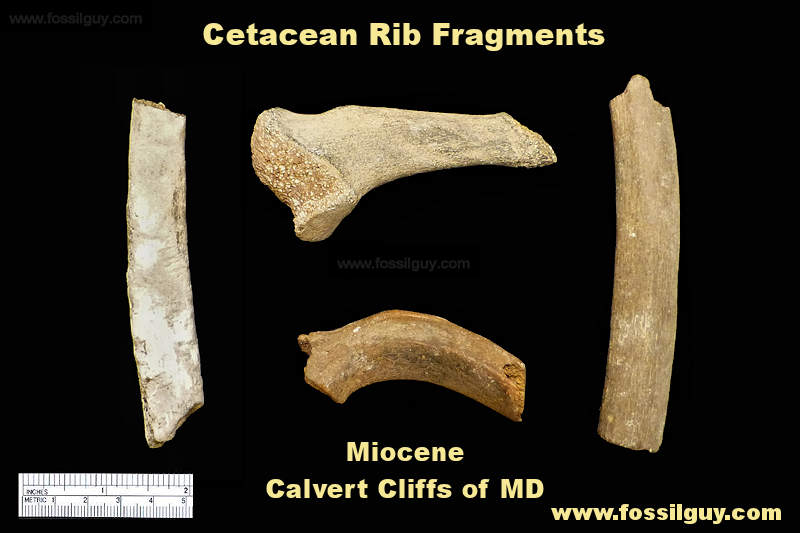
Fossil rib fragments from cetaceans - whales and dolphins.
These are very common bone fragments that wash along the shore at the Calvert Cliffs. This is usually what is found, as ribs break apart quickly in the water.
Cetacean Arms and Hands
Scapula, Humerus, Radius, Ulna, Phalanges, Carpals
Fossil Whale / Dolphin flippers are actually small arms, complete with fingers.
It starts with the shoulder blade (scapula), which connects to the upper arm (Humerus), then the lower arm (Radius and Ulna), and finally to the hand (Carpals and Phalanges).
Carpals and Phalanges are very small and, after a while in the surf, erode to unrecognizable shapes. The scapula is very thin and usually breaks apart rapidly. As a result, these bones are very difficult to find. However, the radius, ulna, and humerus can occasionally be found. These are also more rare than other cetacean bones, as an animal only had 2 of these, instead of dozens like vertebrae, teeth, or ribs.
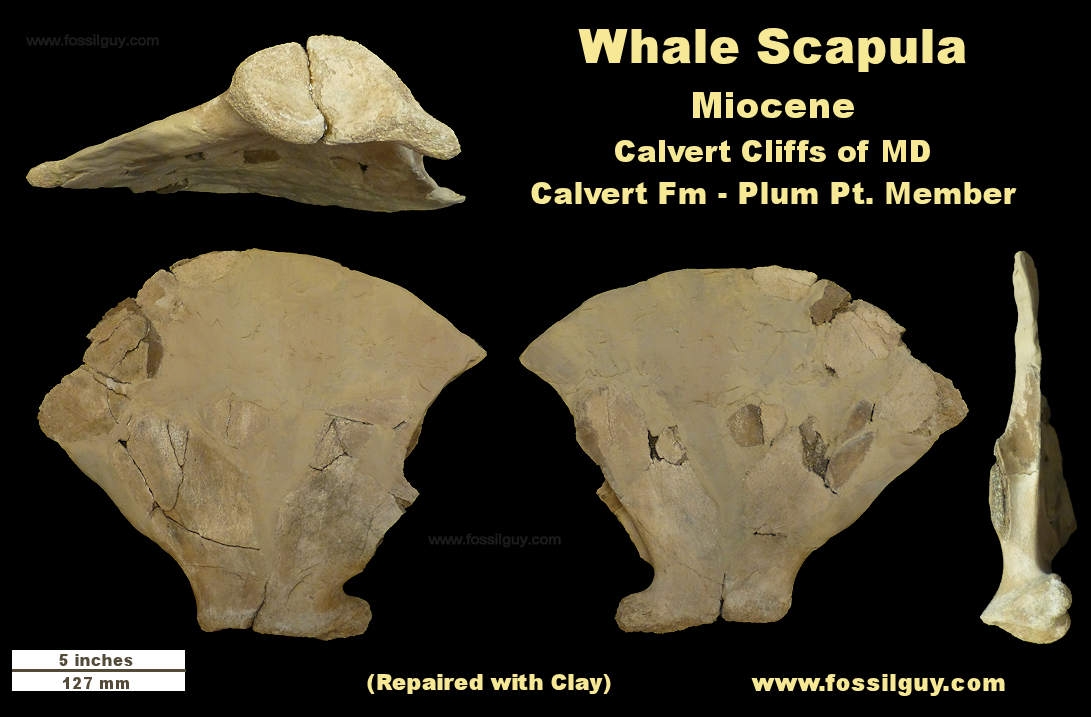
Whale Scapula Fossil - Repaired with clay
This scapula was found in two small pieces of cliff chunks on the beach. It looks like it was there for a few days, as a bunch of pieces were already missing (washed away). I filled in the missing parts with clay.
Click here to see it as found and the prep images.
Dolphin Arm
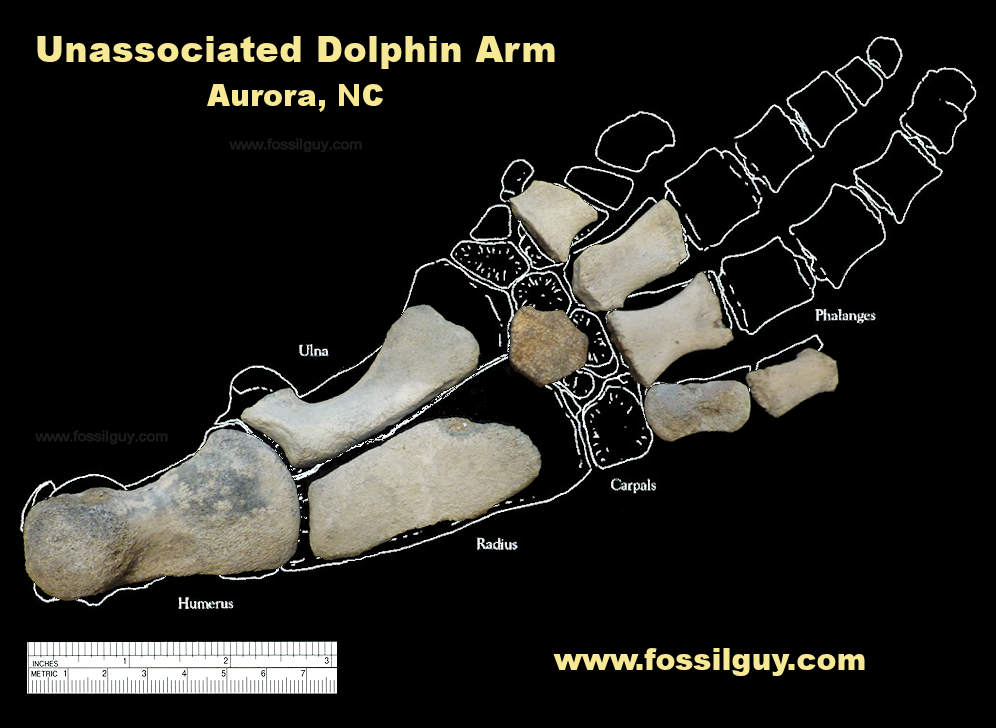
Cetacean Composite Arm
These unassociated are bones from Aurora, NC. They are shown here for identification purposes, as these same fossils can be found at the Calvert Cliffs. Seen is the Humerus, Radius and Ulna, a few carpals and a few phalanges (finger digits). These arm and hand bones are encased in the flipper.
Odontocete Teeth
Toothed Whale Teeth
Teeth of Odontocetes (Toothed whales) are often found along the Calvert Cliffs. Unfortunately, there were countless genus of whales and dolphins at the Calvert Cliffs and isolated teeth usually cannot be identified to any specific genus.
Small Toothed Whale Teeth (Dolphin like odontocetes)
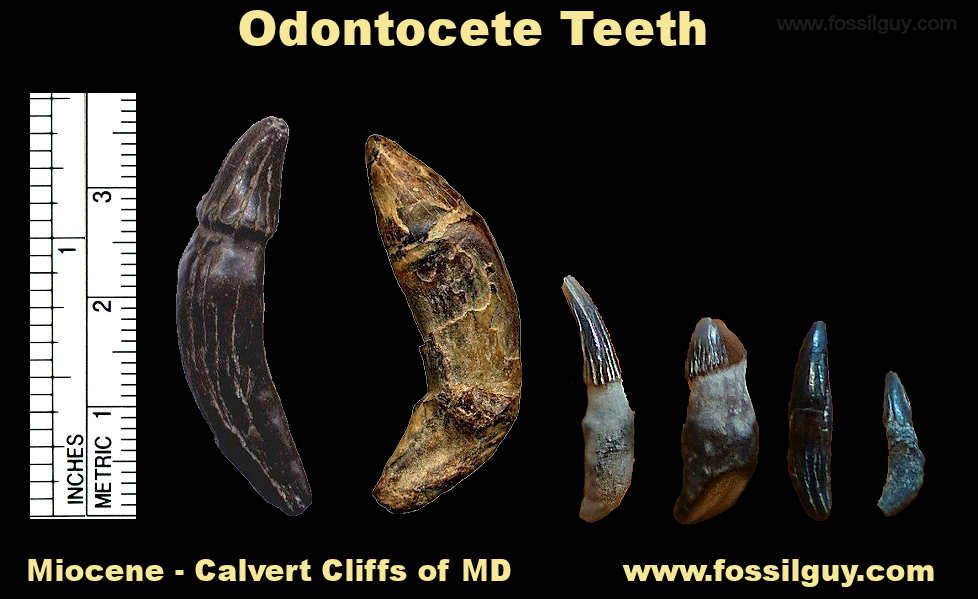
Fossil Odontocete Teeth (Dolphin like animals)
These are a selection of toothed whale teeth that can be found at the Calvert Cliffs. Most are small, under an inch.
Squalodon Tooth (Shark Toothed Whale)
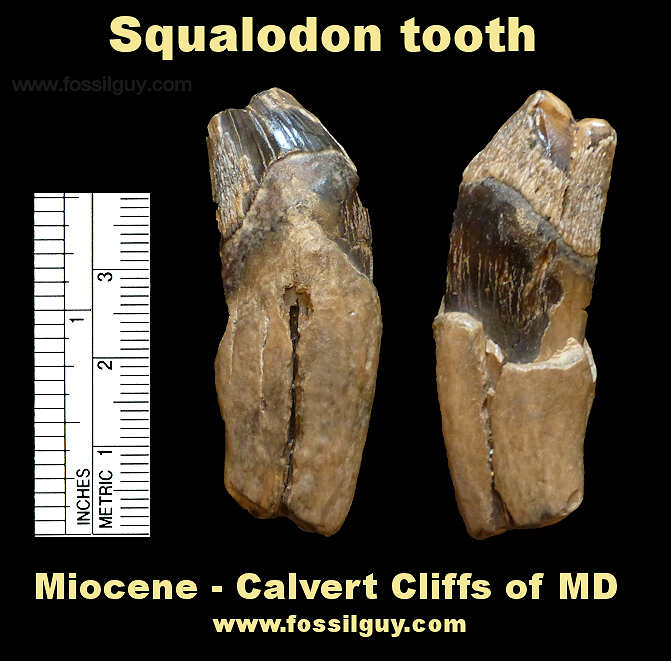
This is a very worn fossil squalodon tooth with a very long root. Squalodons are shark toothed whales. Better fossil squalodon teeth are on the Aurora, NC page.
To learn more about squalodons, go to the squalodon page.
Baleen Whales (Mysticeti)

Baleen whale skeleton on display at the Natural History Museum in London
Baleen Whales are found at the Calvert Cliffs. These are the largest animals that can be found here. They were smaller than todays largest Baleen Whales, but were very diverse. The Calvert Marine museum has a nice collection of Baleen whale skulls from the Calvert Cliffs.
When collecting at the Calvert Cliffs, you will not find a skull. However, if a jaw erodes out of the cliffs, the surf quickly breaks it apart creating hundreds of jaw fragments. These fragments are what is usually found when collecting.

Baleen whale skull from the Museum national d'Histoire naturelle in Paris
Baleen Whales Jaw Sections
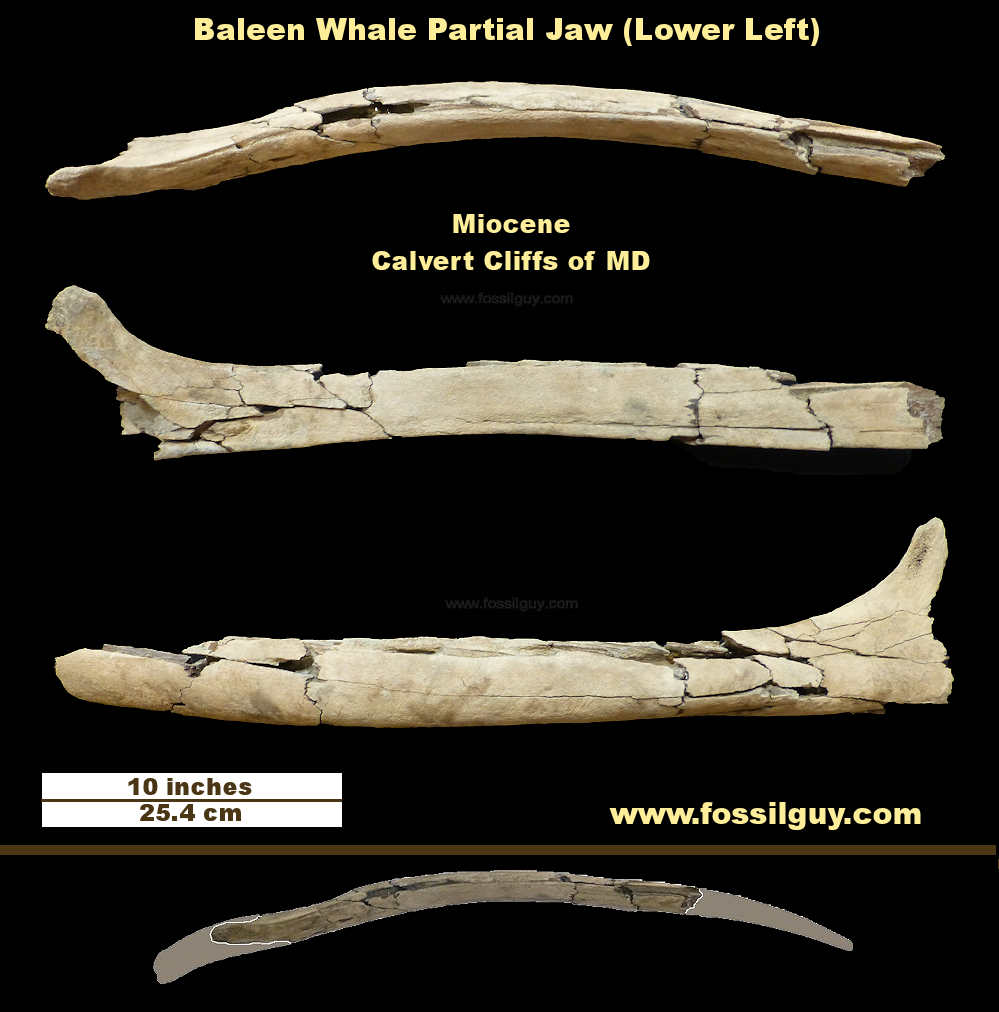
This is a partial lower left fossil Baleen Whale jaw. It's around 28" long, or .71m It was found freshly fallen from the Calvert Cliffs, shattered into dozens of pieces. The waves were already were beginning to wash some pieces around. I almost left it as a lost cause, but decided to rescue it from destruction and pick up as many pieces as I could find. After gluing over 100 pieces back together, it turned out pretty well!
The posterior end, the end that attaches to the skull, is missing. Therefore the defining characteristics to identify it to a genus level are not present.
Click here to see the trip is was found on. The video shows it being repaired.
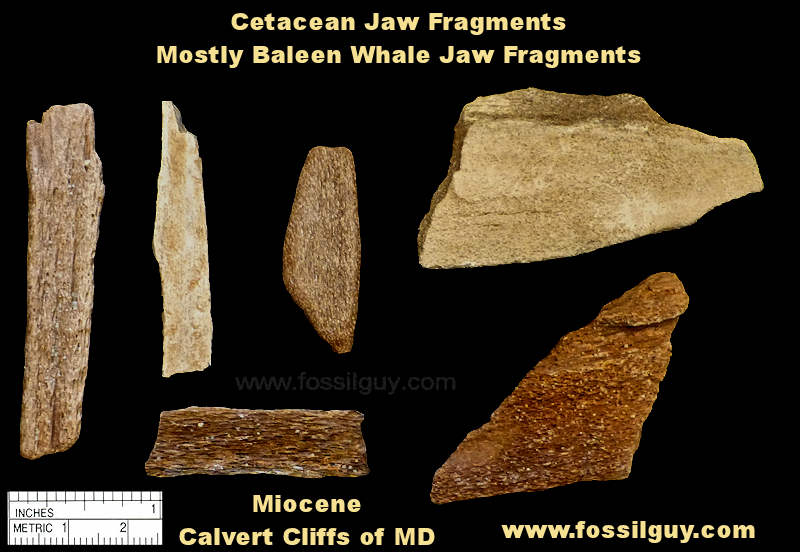
These are fossil whale jaw fragments - mostly from baleen whale jaws. They are very thin and flat.
These are very common bone fragments that wash along the shore at the Calvert Cliffs.
Reptiles
Crocodiles
Thecachampsa antiqua
According to Myrick (2001, p.222), since there is a large variation in tooth shape in Thecachampsa dentitions, and there are no important morphological differences between the skulls of crocodiles found in the Chesapeake Group and other tertiary deposits, all the crocodiles should be assigned to T. antiqua.

A Large American Alligator in the Florida Everglades.
Crocodile Teeth
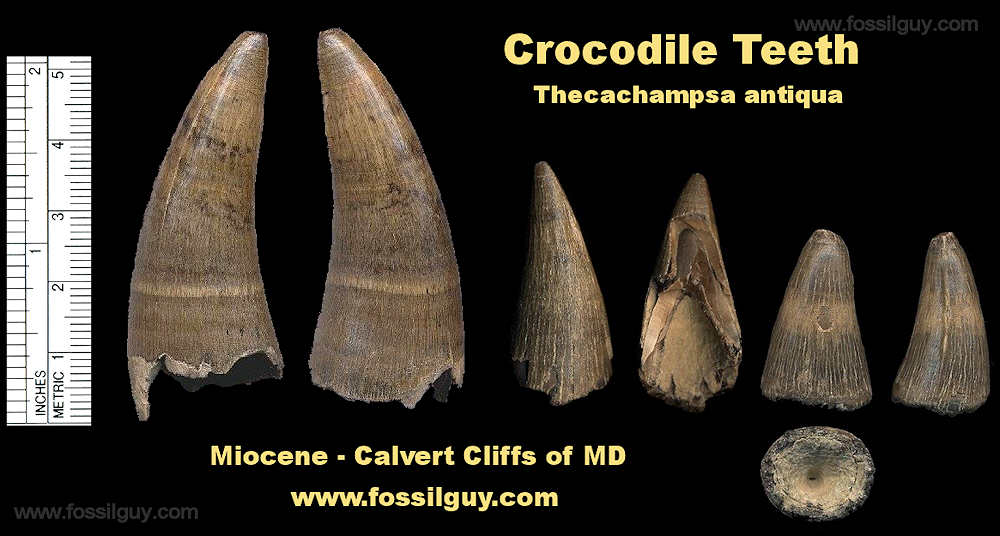
These are sample fossil Crocodile teeth from the Calvert Cliffs.
They are uncommon and usually have a beautiful brown coloring to them.
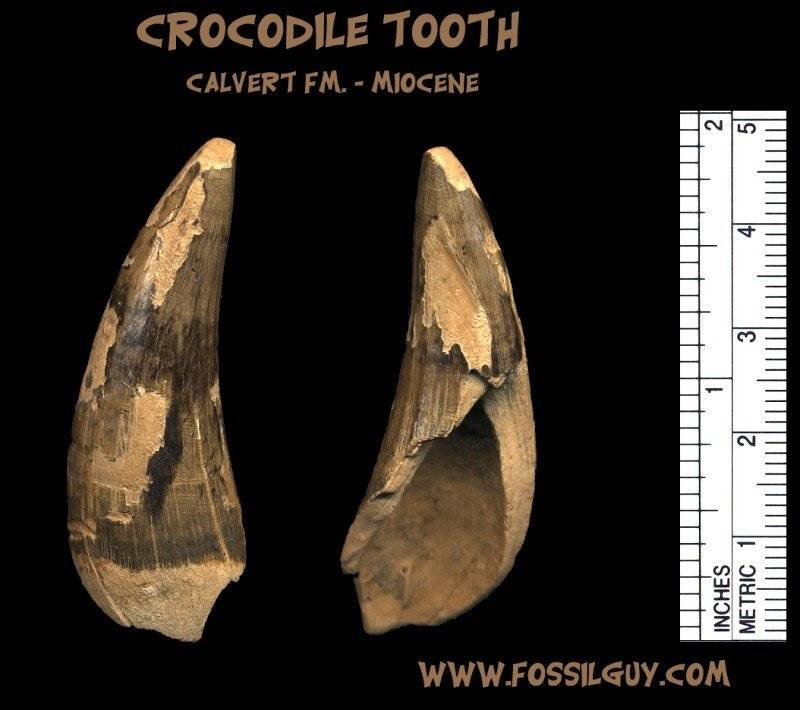
This is another nice crocodile tooth. Although it has a large crack in it, it is large and has nice coloration.
Crocodile Vertebra
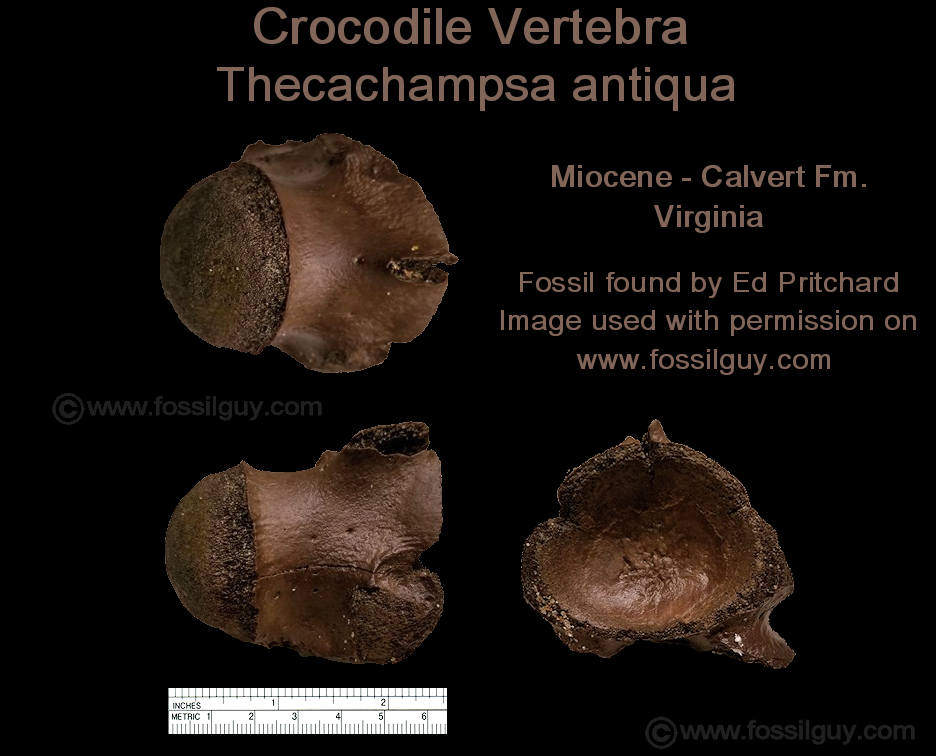
Crocodile Vertebra are very easy to identify. Even with the processes broken off, they have a ball and socket shape that is unmistakable.
This specimen has the beautiful chocolate/brown coloration of the Calvert Formation.
Crocodile Scutes
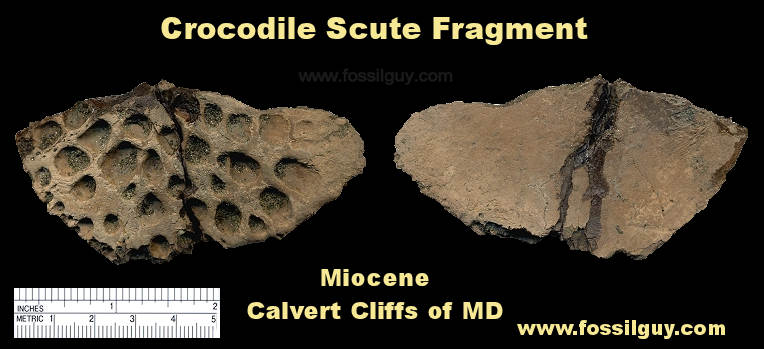
Crocodiles have scutes covering their backs. This is a fragment of a large fossil scute. The large dimples on their tops make them easy to identify.
Testudines - Turtles
Many different fossil turtles are found at the Calvert Cliffs, from fresh water tutules, to sea turtles, and even land tortoises! Usually, only isolated shell fragments are found.

Sea Turtle in the Galapagos
Sea Turtle: Syllomus aegyptiacus
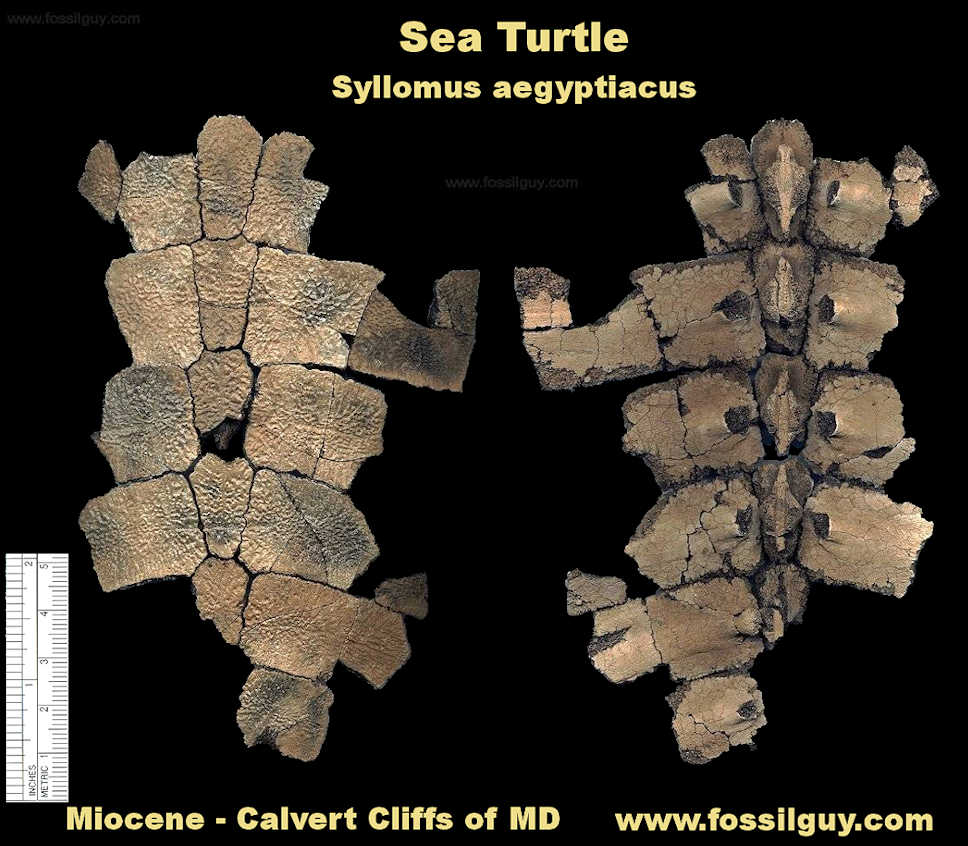
This is a partial shell from the sea turtle Syllomus aegyptiacus. Identification is based on the patterns on the
top of the turtle shell.
Unfortunately, when collecting fragile things that fall 50 feet, things tend to shatter... A good fossil collector
needs to be good at puzzles!
Bony Fish
Fish fossils are commonly found at the cliffs. Usually bony fish vertebrae and teeth are found.
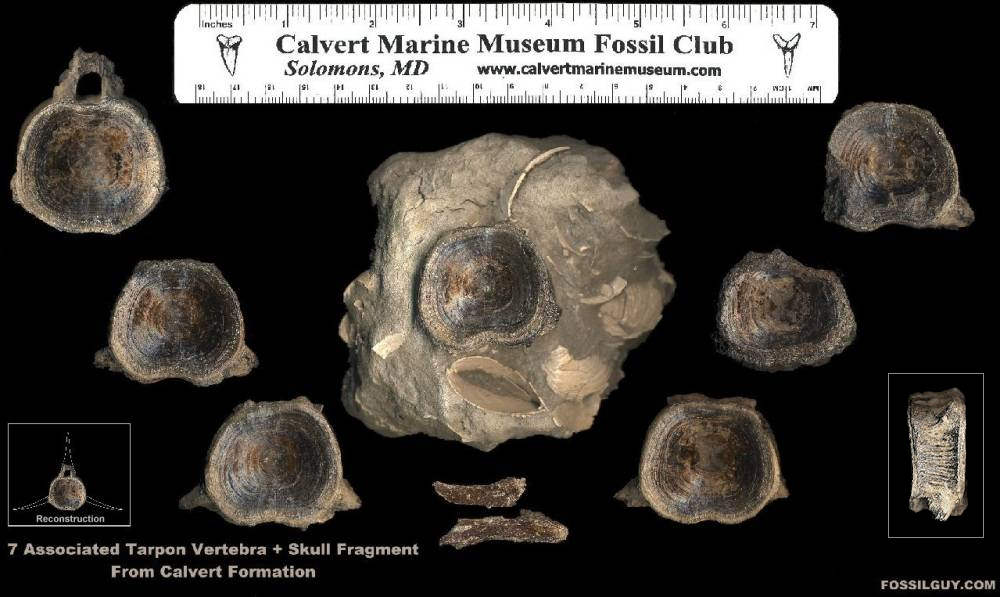
These are associated fossil fish verebra. Possibly from a Tarpon.
Fish Jaw
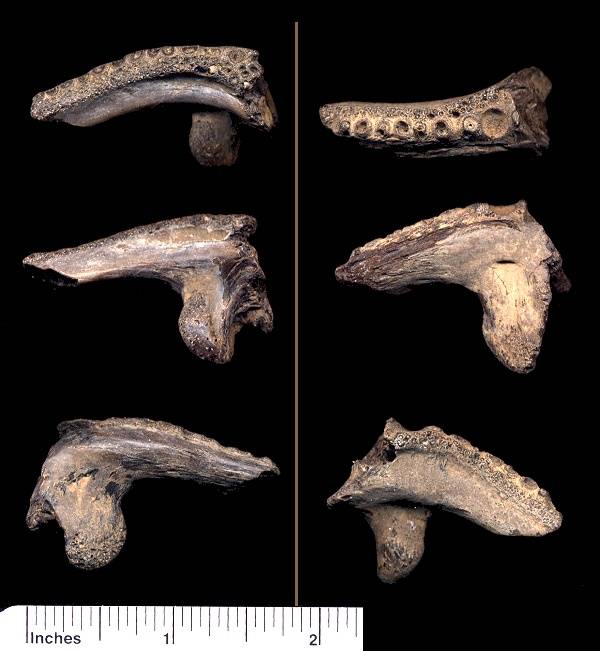
This is a Fossil Drumfish Jaw - Sciaenops from the Calvert Cliffs
Recommended Books for Fossils and Nature of the Calvert Cliffs

The Geology and Vertebrate Paleontology of Calvert Cliffs, Maryland
Stephen J. Godfrey (Volume editor) - 2018
This is the latest comprehensive review of the fossils of Calvert Cliffs. This volume includes fossil sharks, skates, and rays. It also has ray-finned fish, crocodiles, and sea cows.
The shark section is incredible! The second volume is also about about Miocene Turtles and Cetacea. This is a technical publication, for paleontologists and avid fossil collectors of the Calvert Cliffs.
The volumes are published online and can be downloaded FREE at the openSI website.
Once at the site, search for ISSN 1943-6688 for the 1st volume and ISSN 1943-6688 for the 2nd volume.
Fossil Shark Teeth of the World: A Collectors Guide
by Joe Cocke, 2002
A great book for identifying all those teeth. This book is laid out "as simple as possible." It's ease of use and small
size makes it great to carry during collecting trips. This book shows teeth from around the globe, but all the Calvert teeth can be found in it.

Outdoor and Nature Books about the Chesapeake Bay
Thesea are good read to explore the surrounding Chesapeake Bay area when your are done fossil hunting!

Chesapeake Bay Explorer's Guide
David Malmquist, 2021
The Chesapeake Bay Explorer's Guide is an ideal companion for visitors exploring the famous estuary, offering insights into its beauty and history. Discover 14,415 miles of shoreline, hiking trails, wildlife preserves, and more.

A Year across Maryland: A Week-by-Week Guide to Discovering Nature in the Chesapeake Region
Bryan MacKay, 2013
A comprehensive week-by-week guide, A Year across Maryland, by Bryan MacKay, explores the state's rich wildlife and plants. From nesting bald eagles in January to mistletoe harvesting in December, it offers insights for spontaneous adventurers and serious planners, complemented by over seventy species' photographs.
Related Content
About the Author
Contact Us
To ask Questions about Paleontology, Fossil Identification, Image Use, or anything else, email us.
Fossilguy.com is very active on Facebook, you can also message us there!
We don't buy or sell fossils, so please don't email us asking about the value of a fossil or fossil purchases.
Visit us on Social Media:
Enjoy this website?
Consider a Paypal / Credit Card donation of any size to help with site maintenance and web hosting fees:
Privacy Policy and Legal Disclaimer
Back to the TOP of page
© 2000 - 2024 : All rights reserved
FOSSILGUY.COM
Fossilguy.com is a participant in the Amazon Services LLC Associates Program, an affiliate advertising program designed to provide a means for sites to earn advertising
fees by advertising and linking to amazon.com