



Key Takeaway: Giant insects really did fly through Late Carboniferous forests. Meganeura monyi reached a wingspan of about 65 cm (2.1 feet), and several other extinct insect groups also became very large. High oxygen mattered, but recent research shows that insect breathing alone did not set their size.
Fast Facts about Giant Carboniferous Insects

Age: The Carboniferous Period lasted about 359 to 299 million years ago. The most famous giant flying insects occur mainly in Late Carboniferous, or Pennsylvanian, rocks.
Most Famous Giant: Meganeura monyi, a dragonfly-like griffinfly from Commentry, France.
Meganeura Size: Individual wings reached about 32 cm (1 foot) long, giving Meganeura monyi a wingspan of roughly 65 cm, or a little over 2 feet.
Other Giants: Mazothairos enormis, a giant palaeodictyopteran from Mazon Creek, may have reached a wingspan around 56 cm (1.8 feet). Bojophlebia prokopi from the Czech Republic had an estimated wingspan greater than 40 cm (1.3 feet).
Were They Dragonflies? Not exactly. Meganeura belonged to the extinct Meganisoptera, often called griffinflies or griffenflies. They were close relatives of dragonflies and damselflies, but not true modern dragonflies.
Why So Large? High oxygen, open aerial niches, flight biology, predation, competition, and evolutionary history all mattered. Oxygen by itself does not explain the giants.
Famous Fossil Sites: Commentry in France, Mazon Creek in Illinois, and Late Carboniferous deposits in the Czech Republic are among the classic localities for large fossil insects.
Important Correction: Arthropleura was a giant myriapod, not an insect. It lived during the Carboniferous and could reach about 2.6 m (8.5 feet) in length.
Giant Insects of the Carboniferous: A World Before Flying Vertebrates
Imagine an equatorial wetland about 300 million years ago. Towering lycopsids, tree ferns, and giant horsetail relatives crowded the swampy landscape. Overhead, an insect with a wingspan wider than your arm could pass by. Late Carboniferous rocks preserve some of the largest flying insects known.
These animals were not just oversized versions of modern insects. Many early winged-insect groups were still evolving, and several later disappeared. Some looked familiar at a glance, while others had body plans with no close modern match.
Most Carboniferous insects were much smaller. The giants get the attention because a 60 cm flying insect is hard to forget, but the same deposits also preserve many small and medium-sized species, including roach-like forms, orthopteran relatives, odonatopterans, and extinct groups.
The skies were different too. There were no birds, bats, flying dinosaurs, or pterosaurs. Insects had the air to themselves, with no flying vertebrate competitors or predators. Ecology later became an important limit on insect size, even when oxygen remained favorable (Clapham and Karr, 2012).
Why Were Carboniferous Insects So Big?

The Traditional Answer: More Oxygen
For decades, high atmospheric oxygen was the standard explanation. Insects breathe through a branching network of tubes called the tracheal system. Because oxygen must move from these tubes into active tissues, researchers thought this system became harder to scale as insects grew larger. The oxygen-rich Late Carboniferous seemed to fit that idea.
Oxygen still deserves a place in the story. Estimates put late Paleozoic oxygen well above today's 21 percent during parts of this interval, and maximum insect size broadly tracked oxygen early in insect history (Clapham and Karr, 2012). Experiments with living insects also show that oxygen can affect growth and flight performance (Harrison et al., 2010).
What the 2026 Research Changed
A 2026 Nature study changed the breathing part of the story. Researchers examined the tiny tracheoles that supply flight muscle in 44 living species spanning a 10,000-fold range in body mass. They found no simple tracheolar diffusion limit that would cap insect size, and their analysis also included the giant Permian griffinfly Meganeuropsis (Snelling et al., 2026).
Oxygen still could have affected metabolism, development, flight, and the wider ecosystem. What changed is the old claim that a giant insect could not breathe unless the atmosphere held much more oxygen than it does today.
Flight Mechanics Were Only Part of It
A denser atmosphere may also have made flight a little easier. Calculations published in 2024 found that this benefit was far too small to explain griffinflies several times larger than modern dragonflies. Flight-muscle scaling, behavior, oxygen, and other factors have to be considered together (Ellers et al., 2024).
Ecology Probably Mattered
Carboniferous insects also lived in an aerial world without vertebrate fliers. No birds hunted them by day, no bats chased them at night, and there were no pterosaurs to hunt them. Large predatory insects could fill aerial roles that later became much more crowded.
So why were they giant? Several conditions lined up at once: high oxygen, open aerial niches, unusual insect body plans, flight performance, and little competition from flying vertebrates. No single factor explains every giant species.
Meganeura: The Famous Giant "Dragonfly" of the Carboniferous

If one animal represents giant Carboniferous insects, it is Meganeura monyi. Its fossils come from the Late Carboniferous deposits of Commentry in central France. The material was found in the nineteenth century, and Frank Carpenter later helped clarify the specimens and their relationships (Carpenter, 1943).
Meganeura is often called a giant dragonfly because it looks familiar at first glance. It actually belonged to the extinct Meganisoptera, commonly called griffinflies or griffenflies. They were close relatives of the wider odonatopteran branch that includes dragonflies and damselflies.
Size made Meganeura famous. A wing could reach about 32 cm long, giving Meganeura monyi a wingspan near 65 cm, or about 25 to 26 inches. The often-quoted 70 to 71 cm figure fits the largest griffinflies as a group better, especially the later Permian Meganeuropsis.
Related giant griffinfly fossils preserve large compound eyes and predatory mouthparts. A 2018 study interpreted these insects as hawker predators that tracked and caught prey in flight, much like modern hawking dragonflies (Nel et al., 2018).
There is a catch: Meganeura is famous, but its fossils are incomplete. Details of the head, eyes, legs, and hunting biology often come from better-preserved relatives. Good reconstructions combine the parts known from Meganeura with anatomy from closely related griffinflies.
Arthropleura: A Giant Carboniferous Arthropod (Not an Insect)

Important distinction: Arthropleura was an arthropod, but it was not an insect. It belonged to the myriapod branch of arthropods, the broader group that also includes millipedes and centipedes.
Arthropleura was not an insect, but it belongs in any discussion of Carboniferous gigantism. This many-segmented land animal lived in the same broad coal-forest world and could exceed two meters (about 6.5 feet) in length. It is the largest terrestrial arthropod known from the fossil record.
Its relationship to living myriapods was debated for years. Juvenile fossils described in 2024 preserve head anatomy with a mix of millipede-like and centipede-like features. The study placed Arthropleura within the myriapod branch (Lheritier et al., 2024).
Placing Arthropleura beside Meganeura makes one point clear: unusual size was not limited to insects. Several Carboniferous arthropod lineages grew far larger than their familiar modern counterparts.
Mazothairos: A Giant Six-Winged-Looking Insect from Mazon Creek

Mazon Creek in Illinois produced another giant, Mazothairos enormis, from the extinct order Palaeodictyoptera. Its incomplete remains have been used to estimate a wingspan around 56 cm (22 inches), placing it among the largest known Paleozoic insects (Kukalova-Peck and Richardson, 1983).
Palaeodictyopterans had a very different look. Many are reconstructed with a pair of wing-like lobes on the first thoracic segment in front of the main wings, giving them a "six-winged" appearance. Their piercing or sucking mouthparts were probably used on plants.
Mazothairos broadens the picture of Carboniferous giants. The skies held large plant-feeding insects as well as big aerial predators, with several oversized lineages sharing ecosystems unlike any alive today.
Mazon Creek also preserves an extraordinary Pennsylvanian community. Its ironstone concretions contain plants, jellyfish, worms, crustaceans, fishes, amphibians, arachnids, insects, and many other organisms. Mazothairos was one part of that larger ecosystem.
Bojophlebia: A Giant Mayfly-Like Carboniferous Insect

Bojophlebia prokopi is another large Carboniferous insect, known from Pennsylvanian rocks of the Czech Republic. Its wingspan exceeded 40 cm, far larger than living mayflies. Older books often called it a giant early mayfly.
A detailed 2015 revision changed that classification. The authors found that Bojophlebia lacks key wing features expected in a true stem mayfly and placed it more basally within Hydropalaeoptera (Sroka et al., 2015).
This is why fossil insects can be tricky to classify. Wings may preserve beautiful venation while the head, legs, or body are missing or distorted. For Bojophlebia, "mayfly-like" is safer and more accurate than simply calling it a giant mayfly.
Other Carboniferous Insects: Most Were Not Giants

The phrase "giant Carboniferous insects" can be misleading. Most insects were not two-foot giants. The fossil record includes a broad range of sizes, and many species were modest even by modern standards.
Carboniferous rocks preserve many roach-like insects, early orthopteran relatives, palaeodictyopterans, megasecopterans, odonatopterans, and branches near the mayfly lineage. Several of these groups later vanished, which is why a Carboniferous insect community can look familiar and strange at the same time.
Flight was reshaping life on land. Winged insects could move between forest patches, find food and mates, escape ground predators, and use the air above the vegetation. For giant griffinflies, that air became a hunting ground.
Did Carboniferous Insects Have Huge Cockroaches?
Roach-like insects were common in the Carboniferous, but calling all of them "giant cockroaches" goes too far. Many were extinct stem relatives near the ancestry of modern cockroaches and mantises, and most were not giants.
What Happened to the Giant Insects?

Giant insects did not disappear when the Carboniferous ended. Griffinflies survived well into the Permian. Meganeuropsis from Early Permian North America reached a wingspan near 71 cm, slightly larger than the famous Carboniferous Meganeura.
That survival is important. Large griffinflies persisted while atmospheric conditions changed, so maximum insect size cannot be reduced to one environmental dial.
A study of more than 10,500 fossil insect wing measurements found that maximum size tracked estimated oxygen reasonably well early in insect history. Later, that link weakened. As birds appeared and diversified, predation and competition may have become stronger limits on the largest flying insects (Clapham and Karr, 2012).
The broader insect fauna also changed gradually across the Permian and Triassic. Paleozoic groups faded while lineages that dominate modern insect faunas expanded. Schachat and Labandeira described this long turnover as an end-Permian insect "eclipse," rather than a single sudden insect mass extinction (Schachat and Labandeira, 2021).
Could a Meganeura-Sized Insect Live Today?
The old answer was often a firm "no": a two-foot insect supposedly could not supply enough oxygen to its flight muscles in today's atmosphere. The 2026 tracheole study challenges that claim and found no evidence that flight-muscle tracheoles set a hard maximum body size (Snelling et al., 2026).
That does not mean a Meganeura-sized insect would thrive today. Its old ecological world is gone. Carboniferous giant flying insects lived before birds, bats, or pterosaurs, when large insects had much more of the aerial ecosystem to themselves. Today, many of those hunting and feeding niches are occupied by birds and bats, while giant insects would also face new predators and competitors. Wing loading, muscle power, temperature, development, and food supply would matter too. Modern oxygen levels alone may not prevent a giant insect from existing, but today's ecosystem would make the Carboniferous lifestyle much harder to reproduce.
Famous Carboniferous Insect Fossil Sites

Commentry, France
Commentry is one of the classic fossil-insect localities. Its Late Carboniferous rocks produced Meganeura monyi and many other Paleozoic insects. The Muséum national d'Histoire naturelle in Paris holds a major historical collection from the site.
Mazon Creek, Illinois
Mazon Creek is famous for siderite concretions that preserve both hard and soft-bodied organisms from a Pennsylvanian delta and coastal setting. The site has produced important palaeodictyopterans, including Mazothairos enormis, alongside plants and a wide range of aquatic and terrestrial animals.
Czech Late Carboniferous Deposits
Late Carboniferous deposits in the Czech Republic have produced important early winged insects, including Bojophlebia prokopi. Their detailed wing venation has helped paleontologists work through difficult questions about early insect relationships and wing evolution.
Conclusion: A Very Different Insect World
The Carboniferous earned its reputation for spectacular insects, but the real picture is richer than a world of giant bugs. Meganeura was enormous, Mazothairos belonged to a very different plant-feeding lineage, and Bojophlebia does not fit neatly into a familiar modern group. Most insects were much smaller.
High oxygen still belongs in the story because it overlapped with large insect size during the late Paleozoic. Newer research, however, has weakened the old idea of a strict oxygen-delivery limit. Atmosphere, physiology, flight, predators, competitors, open niches, and evolutionary history all shaped how large these animals could become.
That is what makes these fossils so interesting to me. They are not modern insects simply scaled up. They came from early lineages living in a sky with no flying vertebrates, and they show just how different land ecosystems can become over deep time.
Recommended Carboniferous Books and Fossils

A Guide to Pennsylvanian (Carboniferous) Age Plant Fossils of Southwest Virginia
Although focused on Virginia, this guide is useful for many Carboniferous plant fossils found across Pennsylvania, Maryland, and West Virginia. With 280 illustrations, many in color, it is a well-organized identification guide for common coal forest plants.
View on Amazon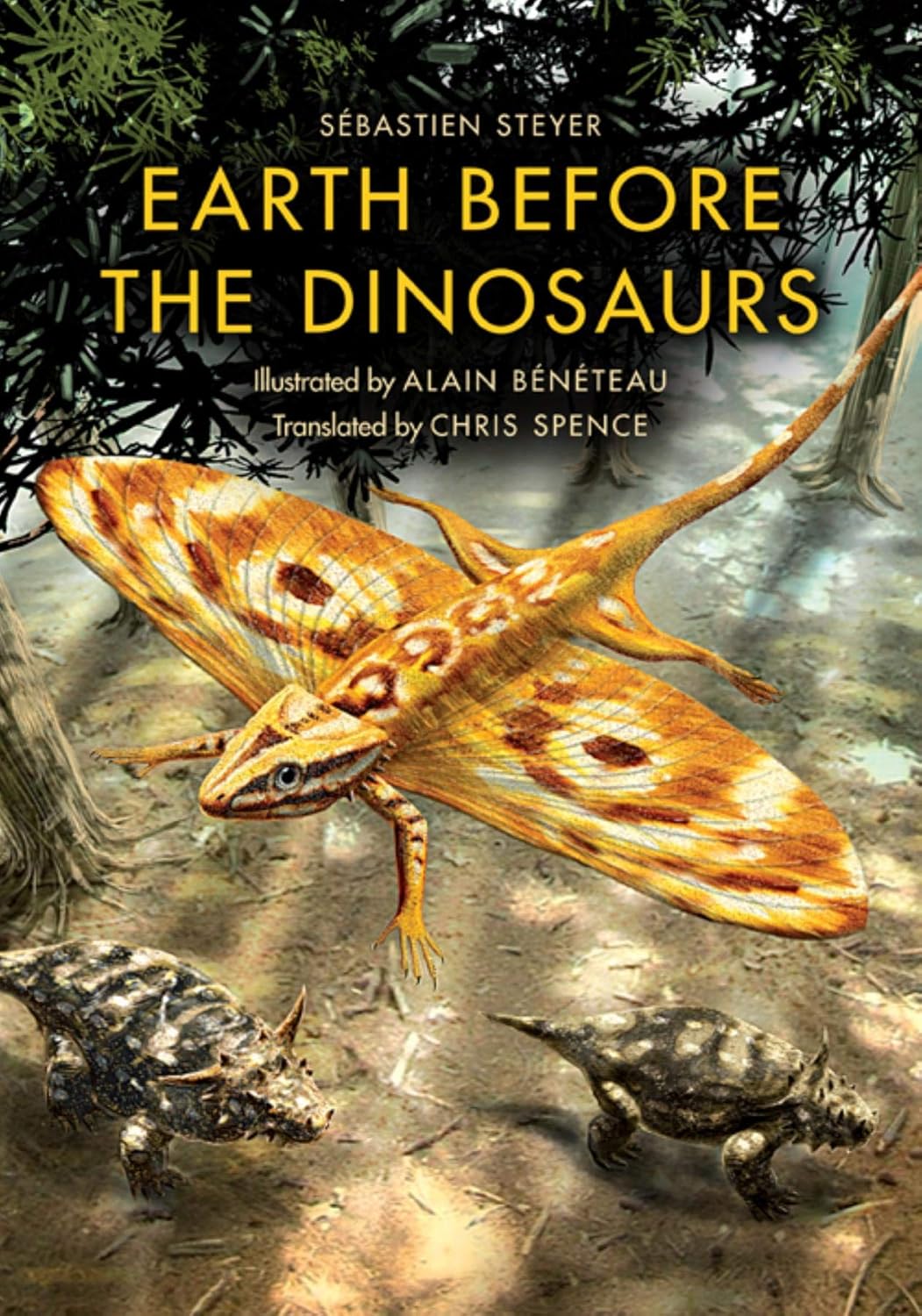
Earth before the Dinosaurs
This book explores the strange and fascinating world before dinosaur dominance, tracing the rise of tetrapods, early amphibians, and amniotes through fossils, evolutionary detective work, and vivid reconstructions of ancient life.
View on Amazon
Carboniferous Giants and Mass Extinction: The Late Paleozoic Ice Age World
A very detailed, visually written look at the Carboniferous world, from giant arthropods and vast coal forests to ancient climate change and mass extinction. Best for readers with some geology background, not a casual overview.
View on AmazonReferences / Works Cited
Carpenter, F. M. (1943).
Studies on Carboniferous insects from Commentry, France; Part I. Introduction and families Protagriidae, Meganeuridae, and Campylopteridae.
Geological Society of America Bulletin, 54(4), 527-554.
View publication.
Lheritier, M., Edgecombe, G. D., Garwood, R. J., et al. (2024).
Head anatomy and phylogenomics show the Carboniferous giant Arthropleura belonged to a millipede-centipede group.
Science Advances, 10(41), eadp6362.
https://doi.org/10.1126/sciadv.adp6362
Clapham, M. E., & Karr, J. A. (2012).
Environmental and biotic controls on the evolutionary history of insect body size.
Proceedings of the National Academy of Sciences, 109(27), 10927-10930.
https://doi.org/10.1073/pnas.1204026109
Ellers, O., Gordon, C. M., Hukill, M. T., Kukaj, A., Cannell, A., & Nel, A. (2024).
Induced Power Scaling Alone Cannot Explain Griffenfly Gigantism.
Integrative and Comparative Biology, 64(2), 598-610.
https://doi.org/10.1093/icb/icae046
Harrison, J. F., Kaiser, A., & VandenBrooks, J. M. (2010).
Atmospheric oxygen level and the evolution of insect body size.
Proceedings of the Royal Society B, 277(1690), 1937-1946.
https://doi.org/10.1098/rspb.2010.0001
Kukalova-Peck, J., & Richardson, E. S. Jr. (1983).
New Homoiopteridae (Insecta: Palaeodictyoptera) with wing articulation from Upper Carboniferous strata of Mazon Creek, Illinois.
Canadian Journal of Zoology, 61(7), 1670-1687.
https://doi.org/10.1139/z83-218
Nel, A., Prokop, J., Pecharova, M., Engel, M. S., & Garrouste, R. (2018).
Palaeozoic giant dragonflies were hawker predators.
Scientific Reports, 8, 12141.
https://doi.org/10.1038/s41598-018-30629-w
Schachat, S. R., & Labandeira, C. C. (2021).
Are Insects Heading Toward Their First Mass Extinction? Distinguishing Turnover From Crises in Their Fossil Record.
Annals of the Entomological Society of America, 114(2), 99-118.
https://doi.org/10.1093/aesa/saaa042
Snelling, E. P., et al. (2026).
Oxygen supply through the tracheolar-muscle system does not constrain insect gigantism.
Nature, 653, 439-443.
https://doi.org/10.1038/s41586-026-10291-3
Sroka, P., Staniczek, A. H., & Bechly, G. (2015).
Revision of the giant pterygote insect Bojophlebia prokopi Kukalova-Peck, 1985 (Hydropalaeoptera: Bojophlebiidae) from the Carboniferous of the Czech Republic, with the first cladistic analysis of fossil palaeopterous insects.
Journal of Systematic Palaeontology, 13(11), 963-982.
https://doi.org/10.1080/14772019.2014.987958
FAQs: Giant Carboniferous Insects Frequently Asked Questions
Quick answers about Meganeura, giant Carboniferous insects, oxygen, griffinflies, and the giant myriapod Arthropleura.
-
Why were Carboniferous insects so big?
Some Carboniferous insects became giant while oxygen was high and the skies had no flying vertebrates. Oxygen helped, but recent work shows that insect breathing did not impose the simple hard size limit once assumed. Ecology, flight, competition, and evolutionary history mattered too.
See: Why Were Carboniferous Insects So Big? -
How big was Meganeura?
Meganeura monyi from the Late Carboniferous of France had individual wings about 32 centimeters long, giving it a wingspan of roughly 65 centimeters, or a little over two feet.
See: Meganeura
-
Was Meganeura really a dragonfly?
No. Meganeura was a dragonfly-like griffinfly in the extinct group Meganisoptera. Griffinflies were close relatives of dragonflies and damselflies within the broader odonatopteran lineage, but they were not true modern dragonflies.
See: Meganeura -
What was the largest Carboniferous insect?
Meganeura monyi is one of the largest well-known Carboniferous flying insects, with a wingspan around 65 centimeters. Mazothairos enormis may have reached about 56 centimeters, although it is known from fragmentary remains. The often-cited 71-centimeter Meganeuropsis lived later, during the Permian, not the Carboniferous.
See: Meganeura -
Were all Carboniferous insects giant?
No. The giants were unusual. Carboniferous ecosystems also held many small and medium-sized insects, including roach-like forms, orthopteran relatives, mayfly relatives, and many extinct groups.
See: Other Carboniferous Insects -
Was Arthropleura a giant Carboniferous insect?
No. Arthropleura was a giant myriapod, the broader arthropod group that includes millipedes and centipedes. It was an arthropod, but it was not an insect.
See: Arthropleura - Giant Carboniferous Arthropod -
What did Meganeura eat?
Meganeura and other large griffinflies were aerial predators. Fossil anatomy from related giant griffinflies indicates large eyes and predatory mouthparts suited for capturing other insects in flight.
See: Meganeura -
Could giant Carboniferous insects live in today's atmosphere?
A Meganeura-sized insect would not automatically suffocate in today's 21 percent oxygen atmosphere. A 2026 study found no hard body-size limit from oxygen diffusion through flight-muscle tracheoles. Flight mechanics, climate, development, prey, predators, and competition would still matter.
See: Could a Meganeura-Sized Insect Live Today? -
When did giant insects disappear?
Giant griffinflies survived into the Permian, where Meganeuropsis included some of the largest flying insects known. Their decline was gradual and involved changing climates, ecosystems, oxygen levels, extinctions, and later competition and predation from flying vertebrates.
See: What Happened to the Giant Insects? -
Where are famous Carboniferous insect fossils found?
Important Carboniferous insect fossil sites include Commentry in France, famous for Meganeura; Mazon Creek in Illinois, which preserves diverse Pennsylvanian insects including giant Palaeodictyoptera; and several Late Carboniferous deposits in the Czech Republic that have produced giant winged insects such as Bojophlebia.
See: Famous Fossil Sites
Jump to Sections
Fast Facts | Overview | Why Were They So Big? | Meganeura | Mazothairos | Bojophlebia | Other Insects | Arthropleura | What Happened to the Giants? | Fossil Sites | Conclusion | References | FAQs