



Key-Takeaway: Giant ground sloths were large extinct relatives of modern sloths that lived on the ground instead of in trees. They ranged from bear-sized animals to elephant-sized giants such as Eremotherium. Their range spread across the Americas, and their timeline overlapped with humans in some regions, and disappeared near the end of the Ice Age or later depending on the population.
Fast Facts About Giant Ground Sloths

Name: "Giant ground sloth" is a general name for several groups of large, extinct sloths that lived primarily on the ground.
Taxonomy and relatives: Mammalia - Xenarthra - Pilosa - Folivora. They were true sloths and distant relatives of today's much smaller two-toed and three-toed tree sloths.
Famous genera: Megalonyx, Paramylodon, Mylodon, Glossotherium, Nothrotheriops, and Eremotherium.
Age: Ground sloths evolved in South America and had a long Cenozoic history; many of the best-known giants lived during the Pleistocene Ice Age.
Distribution: South, Central, and North America. In North America, Megalonyx was widespread, Nothrotheriops was common in the Southwest, and Eremotherium was concentrated along the Gulf Coast and Southeast, especially Florida.
Body size: Size varied greatly. The Shasta ground sloth (Nothrotheriops shastensis) was one of the smaller North American forms at roughly 550 pounds, while the largest Eremotherium exceeded 3 tons.
Burrowing: Some South American ground sloths appear to have dug enormous burrows, although burrowing was probably not common to every species.
Diet: Herbivorous. Different species browsed, grazed, or used a combination of feeding strategies.
Extinction: Most mainland giant ground sloths disappeared near the end of the Pleistocene, while some island sloths in the Caribbean survived later until 4500-5000 years ago.
Historic connection: Thomas Jefferson studied fossils later recognized as Megalonyx and initially thought the giant animal might still survive in the unexplored American West.
Introduction: What Were Giant Ground Sloths?
When most people think of a sloth, they picture a small, slow animal hanging from a tree. The fossil record tells a much wilder story. For millions of years, sloths also came in giant ground-dwelling forms. Some were bear-sized. Others were as large as an elephant. They walked on powerful limbs, carried long claws, and browsed across forests, grasslands, and open woodlands from South America into North America.
These animals were not simply oversized versions of modern tree sloths, they were part of a diverse and successful lineage with many body plans and lifestyles. Some Giant ground sloths probably pulled down branches, some grazed or browsed low vegetation, and some may have reared up on their hind limbs and tails to feed higher above the ground.
What Were Giant Ground Sloths?
Giant ground sloths were extinct relatives of modern sloths that lived on land rather than in trees. They belonged to several different sloth lineages, so "giant ground sloth" is simply a general term for this large group of animals.
What these animals shared was their deep chests, long forelimbs, strong hind limbs, and curved claws that were probably used for pulling vegetation, defense, and possibly digging in some situations. Large species may have balanced on their hind limbs and tails to reach higher food, a feeding posture that would have made them look even more imposing.

Discovery and Scientific History
Giant ground sloth fossils have been turning up in the Americas for centuries, but their scientific story became especially important in the late 1700s and early 1800s. At that time, naturalists were still trying to understand what fossils really represented. Were they the remains of animals that still lived somewhere in the world, or did they belong to species that had vanished forever?
Ground sloths ended up right in the middle of that debate. Their strange bones and claws looked unlike those of familiar living animals. As more material was found, especially from caves and Pleistocene deposits, paleontologists began to realize that the Americas had once supported an extraordinary mammal fauna that no longer existed.

The Jefferson Ground Sloth and Thomas Jefferson
A fossil that caught Jefferson’s imagination
One of the most famous giant ground sloths is Megalonyx jeffersonii, often called the Jefferson ground sloth. The animal was named in honor of Thomas Jefferson because he studied fossil bones and claws from a cave in what is now West Virginia. In 1797, Jefferson presented a paper on the remains. At the time, he thought the animal was probably a giant lion-like predator, mainly because the claws were so large and impressive.
That interpretation did not last. As more fossils were discovered and compared, scientists realized the bones belonged not to a giant cat, but to a giant sloth. Even so, Jefferson’s role made Megalonyx one of the classic fossils in early American science. It showed that the young United States had its own extraordinary prehistoric animals to study.
Jefferson and the idea of living western giants
Jefferson lived at a time when extinction was still a difficult idea for many naturalists to accept. He believed that some large American animals known mainly from fossil bones might still survive in the vast, poorly explored West. That possibility was part of his broader interest in the natural history of the new nation.
The idea became especially relevant as Jefferson prepared the Lewis and Clark Expedition. In February 1803, he wrote that the western route being explored might bring further evidence of Megalonyx. His formal instructions to Meriwether Lewis that June also directed the expedition to record animals not known in the United States and “the remains & accounts of any which may be deemed rare or extinct.” Lewis and Clark were not sent simply to hunt for giant sloths, but Jefferson clearly saw western exploration as a chance to learn whether supposedly vanished American giants might still exist. None were found alive, but the expedition returned a remarkable record of western wildlife and natural history.

Claw Cores and the Full Claw
Claw cores are among the most distinctive ground-sloth fossils and are especially prized finds for fossil collectors. A claw core is the ungual phalanx, the last bone of a digit. It was not the complete claw. In life, this bone supported a tough keratin sheath, made of the same basic material as fingernails and other mammal claws, that wrapped around the bony core and extended beyond its tip. Because keratin rarely survives fossilization, the claw core is usually the part that remains.
This means a fossil claw core understates the size of the living claw. In the original Megalonyx jeffersonii material associated with Jefferson, the longest known ungual is about 17 cm (6.7 in) long. The complete claw would have extended farther because of its keratin covering. It's easy to think of if you ever have trimmed a cat or dogs nails, you are trimming the end of the Keratin sheath, not the actual claw.
Claw core vs. complete claw: Think of the fossil claw core as the bony framework inside the claw. The living claw was longer and thicker, with a keratin sheath forming the outer surface and sharp tip.
Evolution and Relatives
Sloths are part of Xenarthra, the South American mammal group that also includes anteaters and armadillos. Ground sloths evolved in South America, where they became diverse long before the Great American Biotic Interchange allowed several sloth lineages to spread into Central America and North America. By the Pleistocene, ground sloths ranged from relatively small forms to massive animals such as Megatherium and Eremotherium.
Their evolutionary tree is more surprising than their modern appearance suggests. Molecular DNA and protein studies showed that the two living tree-sloth genera are not each other's closest relatives. Choloepus, the two-toed sloths, belongs to the mylodontoid radiation that includes extinct forms such as Mylodon. Bradypus, the three-toed sloths, belongs to the megatherioid radiation, which also includes the broader groups represented by Megatherium, Eremotherium, Nothrotheriops, and the Megalonyx lineage. Their similar hanging, arboreal lifestyles therefore evolved independently.

The diagram focuses on representative lineages rather than every known sloth. Recent total-evidence work places an early divergence among major sloth lineages in the late Eocene, roughly 36 million years ago. Some relationships within Megatherioidea remain uncertain, particularly the exact position of the Megalonyx lineage, so that portion of the graphic is deliberately shown as simplified rather than as a completely resolved species-by-species tree.
Habitat and Range
Giant ground sloths lived in a variety of environments. Depending on the genus and species, they occupied woodlands, savannas, open grasslands, and forest edges. Their fossils are found across much of South America and in parts of North and Central America. During the Pleistocene, several kinds became part of the broader Ice Age megafauna that also included mammoths, mastodons, saber-toothed cats, dire wolves, and giant armadillo relatives.
The largest forms, such as Eremotherium, seem to have handled open environments well, while other species are often found in cave or shelter deposits that help preserve their remains. Some South American ground sloths were also active burrowers. Large Pleistocene tunnels in Argentina have been attributed mainly to Scelidotherium and probably Glossotherium, based in part on their size and claw marks preserved on tunnel walls. These burrows could reach roughly 1.2 meters high, 1.8 meters wide, and 20 meters long. As climate shifted near the end of the Pleistocene, the plant communities and habitats that supported large herbivores also changed.
The figure below shows how different ground sloth genera occupied very different parts of the Americas during the Pleistocene. Panel A plots fossil localities spanning roughly 2.5 million to 11,000 years ago for Eremotherium, Megatherium, Mylodon, and Nothrotheriops, along with the approximate extent of ice sheets at the Last Glacial Maximum. Panels B and C use paleoart to bring those climatic differences to life: Eremotherium and Nothrotheriops are reconstructed in early-spring Florida, while a heavily furred Megatherium is shown in the cool, windy Pampas of Argentina.

Diet and Feeding
Ground sloths were herbivores, but they were probably not all feeding in exactly the same way. Tooth shape, skull form, body size, and limb proportions all indicate that different species used somewhat different feeding strategies. Many are usually interpreted as browsers, eating leaves, twigs, and other plant material. Some may also have grazed or taken softer ground-level vegetation. Large claws probably helped them hook or pull branches within reach.
The biggest species may have fed in an especially dramatic way. By bracing with the hind limbs and tail, they may have been able to rear up and tug vegetation downward. That would have let them exploit food above the reach of smaller herbivores. In that sense, giant ground sloths may have filled a browsing role somewhat like other large plant-eating mammals, but with a body plan all their own.
The historical reconstruction below illustrates this proposed browsing behavior in Megatherium americanum, with one animal rearing to reach vegetation. Published in 1913, it still remains a useful visual explanation of the feeding posture.

Preserved Skin and Fur: What Did Ground Sloths Look Like?
Mylodon darwinii is one of the rare giant ground sloths known from actual preserved skin and hair. Exceptional remains from Cueva del Milodón in southern Chile include pieces of skin, fur, and dung, and some of this material is preserved in the collections of the Natural History Museum, London.
These remains give us something skeletons cannot: direct evidence of the animal's coat. Modern microscopic study of Mylodon hair distinguishes longer guard hairs from finer underhairs. The surviving reddish-brown coat is dense and layered, showing that Mylodon was a substantially fur-covered animal. These specimens give a rare glimpse of an Ice Age ground sloth's fur.

Interactions with Humans: Hunting, Rock Art, and Symbolism
Giant ground sloths survived long enough to overlap with people in several parts of the Americas. Archaeological sites in South America show that humans sometimes hunted or scavenged these animals and, in some cases, modified their remains. Campo Laborde in Argentina preserves evidence consistent with ground-sloth hunting, while Eremotherium remains from El Vano in northwestern South America were directly dated to about 11.8 thousand years ago and found in association with El Jobo artifacts.
At Santa Elina in Brazil, three Glossotherium osteoderms (small protective bony plates embedded in the skin) were flattened and perforated, indicating they may have been used as pendants or ornaments. Together, these sites show that giant ground sloths were more than distant Ice Age animals: people encountered them on the landscape and sometimes used their remains.
Possible Giant Ground Sloth Rock Art at La Lindosa
One of the most intriguing possible records comes from Serranía de la Lindosa in the Colombian Amazon, where thousands of reddish-ochre paintings cover open rock-shelter walls. Iriarte and colleagues proposed that several of these paintings may depict extinct Ice Age megafauna. On the Las Dantas panel at Cerro Azul, they interpret one animal as a possible giant ground sloth.

Why It May Be a Ground Sloth — and Why the Identification Is Uncertain
The proposed identification is based on a combination of features, including massive claws, a short snout, a large head, a robust chest, an apparently inverted foot, a smaller animal interpreted as an offspring, and nearby miniature human figures. The study compares the painting with an artistic reconstruction of Eremotherium, while noting that details such as fur and wrinkles in the reconstruction are interpretive rather than visible in the rock art.

The identification remains debated, and the painting itself has not been directly dated. Late-Pleistocene human occupation at La Lindosa, ochre in archaeological layers dating to about 12.6 thousand years ago, and the presence of giant ground sloths in the region provide important context, but they do not prove the age or identity of this individual painting. If the interpretation is correct, however, it would offer a rare glimpse of how early people perceived one of the large mammals sharing their landscape.
Extinction
Like mammoths, mastodons, and many other large Ice Age mammals, giant ground sloths disappeared near the end of the Pleistocene or shortly after, depending on the region and species. The best explanation is a combination of causes. Climate change altered vegetation and habitats. Human expansion added a new source of pressure. Together, those forces likely pushed already vulnerable populations past the breaking point.
Some sloths survived surprisingly late in isolated regions, especially on Caribbean islands. Several Caribbean species, including Megalocnus rodens from Cuba and Acratocnus ye and Parocnus dominicanus from Hispaniola, survived until roughly 4,000-5,000 years ago. Their late survival shows that ground sloth extinction was not a single event that occurred everywhere at the same time; instead, it unfolded differently across regions and through time.

Where to See and Find Giant Ground Sloth Fossils
You don't have to travel to a major natural history museum to see giant ground sloths or learn about their fossils. A few of my favorite fossil destinations have displays of these animals or places where their bones and teeth can still be found. Here are three worth knowing about.
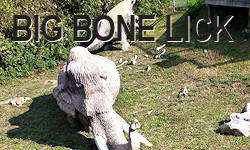
Big Bone Lick, Kentucky: See Harlan's and Jefferson's Ground Sloths
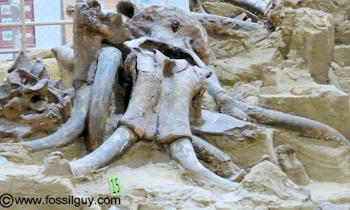
Big Bone Lick State Historic Site in northern Kentucky is a classic Ice Age fossil locality. Its museum displays a claw cast from Jefferson's ground sloth (Megalonyx jeffersonii), a jaw fragment and life-sized cast of Harlan's ground sloth (Paramylodon harlani), and an outdoor Pleistocene diorama. The site is for viewing fossils, not collecting: visitors may not disturb or remove fossils or artifacts.
Read more: Fossilguy's Big Bone Lick fossil and museum guide.
Coastal South Carolina: Cooper River Blackwater Diving
Coastal South Carolina is famous for shark teeth, but its rivers also preserve Ice Age land mammals. While blackwater diving in the Cooper River, I found the giant ground sloth tooth shown below. Finds like this are much less common than marine fossils and show how river deposits can mix fossils from very different ancient environments.

Read more: Fossilguy's Coastal South Carolina fossil hunting guide. Blackwater diving requires advanced experience and a South Carolina Hobby License; always check local collecting regulations and conditions before planning a trip.
Peace River, Florida: Search for Ice Age Mammal Fossils
The Peace River in Florida is a well-known fossil hunting destination where collectors sift shallow gravel for shark teeth and Ice Age mammals, including occasional ground sloth material. The lower-water dry season is usually best for access. Most vertebrate fossils collected from Florida state lands require a Florida Fossil Permit, so check current rules and river conditions before collecting.
Read more: Fossilguy's Peace River fossil hunting guide, including access, techniques, seasonal conditions, and permits.
References / Works Cited
Jefferson, T. 1799. Memoir on the discovery of certain bones of a quadruped of the clawed kind in the western parts of Virginia.
Jefferson, T. 1803. Letter to Bernard Germain de Lacépède, February 24, 1803, discussing the western expedition and the possibility of further evidence for Megalonyx. Lewis & Clark source.
Jefferson, T. 1803. Instructions to Meriwether Lewis, June 20, 1803. Thomas Jefferson Papers, Library of Congress. Library of Congress transcript.
McDonald, H. G. Various works on ground sloth systematics, paleobiology, and North American records.
Cartelle, C. and De Iuliis, G. Works on Eremotherium and other giant sloths of the Americas.
Pujos, F. and colleagues. Research on sloth evolution and Neogene-Pleistocene xenarthrans.
Delsuc, F., Kuch, M., Gibb, G. C., et al. 2018. Resolving the phylogenetic position of Darwin's extinct ground sloth (Mylodon darwinii) using mitogenomic and nuclear exon data. Proceedings of the Royal Society B 285: 20180214. DOI: 10.1098/rspb.2018.0214.
Presslee, S., Slater, G. J., Pujos, F., et al. 2019. Palaeoproteomics resolves sloth relationships. Nature Ecology & Evolution 3: 1121-1130. DOI: 10.1038/s41559-019-0909-z.
Tejada, J. V., Antoine, P.-O., Münch, P., Billet, G., Hautier, L., Delsuc, F., & Condamine, F. L. 2024. Bayesian Total-Evidence Dating Revisits Sloth Phylogeny and Biogeography: A Cautionary Tale on Morphological Clock Analyses. Systematic Biology 73(1): 125-139. DOI: 10.1093/sysbio/syad069.
Deak, M. D., Porter, W. P., Mathewson, P. D., et al. 2025. Metabolic skinflint or spendthrift? Insights into ground sloth integument and thermophysiology revealed by biophysical modeling and clumped isotope paleothermometry. Journal of Mammalian Evolution 32: 1. DOI: 10.1007/s10914-024-09743-2. Figure 9 used above; paleoart by Haider Syed Jaffri. CC BY 4.0.
National Park Service. Giant Ground Sloths: Nothrotheriops shastensis and Megalonyx profiles, Tule Springs Fossil Beds National Monument.
Florida Museum of Natural History. Eremotherium eomigrans species account and North American distribution information.
Vizcaíno, S. F., Zárate, M., Bargo, M. S., & Dondas, A. 2001. Pleistocene burrows in the Mar del Plata area (Argentina) and their probable builders. Acta Palaeontologica Polonica 46(2): 289-301.
Lopes, R. P., & Pereira, J. C. 2019. On the presence of Megatherium Cuvier, 1796 (Xenarthra, Pilosa) in fossiliferous deposits of the Coastal Plain of Southern Brazil. Revista Brasileira de Paleontologia 22(1): 38-52. DOI: 10.4072/rbp.2019.1.04. Figure 8 used above. CC BY 4.0.
Babcock, L. E. 2024. Nomenclatural history of Megalonyx Jefferson, 1799 (Mammalia, Xenarthra, Pilosa, Megalonychidae). ZooKeys 1195: 297-308. DOI: 10.3897/zookeys.1195.117999.
Leidy, J. 1855. A Memoir on the Extinct Sloth Tribe of North America. Smithsonian Contributions to Knowledge, no. 72. Smithsonian Institution.
Scott, W. B. 1913. A History of Land Mammals in the Western Hemisphere. New York: The Macmillan Company. The Megatherium americanum feeding reconstruction on p. 220 was illustrated by R. Bruce Horsfall. Public-domain book; image source.
Jayson Kowinsky / Fossilguy.com. Primary hero image: cast of Megatherium americanum, a giant ground sloth from South America at the Natural History Museum, London; AI-assisted wide-format adaptation created for this page.
Natural History Museum, London. Mylodon darwinii: Darwin's ground sloth. The Museum documents exceptionally preserved skin, fur, and dung from Mylodon Cave in southern Chile. Natural History Museum.
Santos, L. E., Ajala-Batista, L., Carlini, A. A., & Monteiro-Filho, E. L. A. 2024. Mylodon darwinii (Owen, 1840): hair morphology of an extinct sloth. Zoomorphology 143: 571-579. DOI: 10.1007/s00435-024-00652-9.
Ghedoghedo. 2012. Mylodon darwini - skin, droppings and toenails.JPG. Photograph taken at the Natural History Museum, London. Wikimedia Commons. The skin image used above was cropped and enhanced from the original. Source image. CC BY-SA 3.0.
La Brea Tar Pits Museum. La Brea Tar Pits and Hancock Park. The museum notes that extinct animals preserved in the asphalt deposits were trapped mainly between about 50,000 and 11,000 years ago. La Brea Tar Pits.
Iriarte, J., Ziegler, M. J., Outram, A. K., Robinson, M., Roberts, P., Aceituno, F. J., Morcote-Ríos, G., & Keesey, T. M. (2022). Ice Age megafauna rock art in the Colombian Amazon? Philosophical Transactions of the Royal Society B, 377: 20200496. DOI: 10.1098/rstb.2020.0496. CC BY 4.0.
Recommended Prehistoric Mammal Books:

The Rise and Reign of the Mammals: A New History, from the Shadow of the Dinosaurs to Us
Steve Brusatte, the acclaimed paleontologist behind The Rise and Fall of the Dinosaurs, continues his narrative in The Rise and Reign of the Mammals. From surviving the asteroid impact to their later diversification, Brusatte follows mammals through time using scientific detective work and modern technology. Illustrations, charts, photos, and figures help keep the story clear and visual.
View on Amazon
End of the Megafauna: The Fate of the World's Hugest, Fiercest, and Strangest Animals
A captivating exploration of prehistoric mammal extinctions and their possible causes, particularly human predation. A scientific page-turner for anyone intrigued by mammoths, giant ground sloths, and animals lost since the last Ice Age. The author bridges scientific research and lay readers with a comprehensive overview of prehistoric megafauna and gorgeous illustrations.
View on Amazon
The First Fossil Hunters: Dinosaurs, Mammoths, and Myth in Greek and Roman Times
Adrienne Mayor's The First Fossil Hunters explores the idea that classical mythic creatures were inspired by real fossils discovered by Greeks and Romans. Through detailed research, Mayor connects ancient legends with fossil discoveries and early interpretations of the prehistoric world.
View on AmazonGiant Ground Sloth FAQs
Quick answers to common questions about giant ground sloths, Jefferson's Megalonyx, Ice Age fossils, human interactions, and fossil sites.
What is a giant ground sloth?
A giant ground sloth is an extinct land-dwelling sloth. These mammals were relatives of modern sloths, but many were much larger and lived on the ground instead of in trees.
Were giant ground sloths dangerous?
They were herbivores, so they were not predators, but a large adult ground sloth would have been a formidable animal. Its size, claws, and strength would have made it difficult for predators to attack and unwise for humans to approach casually.
More Giant Ground Sloth FAQs
What is the Jefferson ground sloth?
The Jefferson ground sloth is Megalonyx jeffersonii , named for Thomas Jefferson. It became famous because Jefferson studied its fossils in the early days of American paleontology.
Did giant ground sloths live in North America?
Yes. Several species lived in North America, including Megalonyx and Eremotherium . Their fossils have been found across many parts of the continent.
Where can I see or find giant ground sloth fossils?
Big Bone Lick in Kentucky has displays of Jefferson's and Harlan's ground sloths. For fossil hunting, coastal South Carolina and Florida's Peace River can produce ground sloth material, although finds are uncommon and collecting permits or other local rules may apply.
Is there ancient rock art that may show a giant ground sloth?
Possibly. Iriarte and colleagues proposed that a painting at La Lindosa in the Colombian Amazon depicts a giant ground sloth based on its claws, head, thorax, limb proportions, and foot posture. The identification remains debated and the painting itself has not been directly dated.
Jump to Sections
Quick Answer | Fast Facts | Introduction | Discovery | Jefferson's Sloth | Evolution | Habitat | Diet | Preserved Skin & Fur | Humans & Rock Art | Extinction | Where to See / Find | References | Books | FAQs | Related Fossil Content