



Key Takeaway:The Permian lasted from 299 to 252 million years ago and ended the Paleozoic Era. During this time, Pangaea formed, interiors became drier and more seasonal, and synapsids and therapsids dominated land ecosystems. It ended with the Great Dying, the largest known mass extinction, closely linked to Siberian Traps.
Fast Facts about the Permian Period

Time Range: About 298.9 to 251.902 million years ago. The Permian lasted roughly 47 million years and was the sixth and final period of the Paleozoic Era.
Period Before: Carboniferous Period, when coal forests were widespread in the tropics and the first amniotes appeared.
Period After: Triassic Period, the first period of the Mesozoic Era and the beginning of a long recovery after the end-Permian extinction.
Major Divisions: The Cisuralian, Guadalupian, and Lopingian, corresponding broadly to the Early, Middle, and Late Permian.
Name: The Permian was named by British geologist Roderick Impey Murchison in 1841 after the Perm region of Russia.
Pangaea: Most major landmasses were assembled into the supercontinent Pangaea, surrounded by the enormous Panthalassa Ocean, with the Tethyan oceans along its eastern side.
Best Known For: Dimetrodon, diverse therapsids, the spread of more drought-tolerant vegetation, Glossopteris forests in Gondwana, giant griffinflies such as Meganeuropsis, and the end-Permian mass extinction.
Famous Life: Dimetrodon, Edaphosaurus, Moschops, Inostrancevia, Scutosaurus, dicynodonts, therocephalians, early cynodonts, captorhinids, temnospondyl amphibians, Glossopteris, conifers, seed ferns, ammonoids, brachiopods, sharks, fusulinids, and the last surviving trilobites.
Ending Event: The Permian-Triassic mass extinction, often called the Great Dying, was the most severe known extinction crisis of the Phanerozoic Eon.
Where the Permian Period Fits in Geologic Time


The Permian was the final period of the Paleozoic Era. It followed the Carboniferous Period and ended at the beginning of the Triassic. The current International Chronostratigraphic Chart places the Permian from about 298.9 to 251.902 million years ago (International Commission on Stratigraphy, 2026).
The period is divided into three series. The Cisuralian covers the Early Permian, from about 298.9 to 274.4 million years ago. The Guadalupian covers the Middle Permian, from about 274.4 to 259.857 million years ago. The Lopingian covers the Late Permian, from about 259.857 to 251.902 million years ago.
Those names can look intimidating, but the basic story is simple: the Early Permian still carried many features inherited from the Carboniferous, the Middle Permian saw major changes in climate and land-animal communities, and the Late Permian developed some of the most advanced therapsid ecosystems of the Paleozoic before ending in catastrophe.
History of Discovery and Naming: Why Is It Called the Permian?

The name Permian comes from Russia. In 1841, British geologist Roderick Impey Murchison introduced the term after studying a thick sequence of rocks lying above the Carboniferous strata west of the Ural Mountains. He named the new system for the region of Perm.
Murchison had already played a major role in establishing the Silurian and Devonian systems. The Permian filled an important gap between the Carboniferous rocks below and the Triassic rocks above. His original 1841 report described a broad succession of marls, shales, limestones, sandstones, and conglomerates and proposed the name "Permian System" for them (Benton and Sennikov, 2022).
The type region remains especially appropriate because Russia preserves some of the world's most important Permian rocks and vertebrate fossils. The modern international time scale now defines the period using globally correlated boundaries and stages, but the historical name still points back to the geology that first made the interval recognizable.
What Earth Was Like During the Permian Period
The Permian world looked very different from the Carboniferous world that came before it. By this time, most major continental landmasses were joined into Pangaea, a huge supercontinent stretching across a wide range of latitudes. The vast Panthalassa Ocean surrounded much of it, while the Tethyan ocean system bordered its eastern side.
A supercontinent this large created strong climate contrasts. Coastal areas could still be humid, but enormous regions lay far from a dependable source of ocean moisture. Many continental interiors became increasingly seasonal and dry, with broad floodplains, deserts, salt basins, and seasonal river systems replacing some of the wetter Carboniferous landscapes.
The change was not a simple switch from "wet" to "dry." The Early Permian began while the Late Paleozoic Ice Age was still winding down, and southern Gondwana retained cool climates and glacial influences in some areas. Through the Permian, Earth moved toward a warmer climate state, but different parts of Pangaea experienced very different rainfall patterns, temperatures, elevations, and seasonal extremes.

Mountain belts formed where continents had collided during the assembly of Pangaea. These highlands affected rainfall and drainage, while erosion filled nearby basins with sediment. As a result, Permian rocks often preserve a patchwork of river deposits, lake beds, desert sediments, marine limestones, evaporites, red beds, and volcanic rocks.
Life and Major Evolutionary Events of the Permian
Permian life was far more than a prelude to the dinosaurs. In fact, dinosaurs had not evolved yet. The dominant story on land involved synapsids, the broad vertebrate branch that eventually produced mammals, along with diverse reptiles and amphibians. Plants adapted to climates that were becoming more seasonal, while insects continued to diversify and marine ecosystems remained rich and complex.
Famous Permian Animals
The Permian produced some of the most recognizable animals from before the age of dinosaurs. One important thing to remember is that these animals did not all live at the same time. The Permian lasted nearly 47 million years, so an Early Permian predator such as Dimetrodon was separated by tens of millions of years from many of the famous animals of the Late Permian.

Dimetrodon - The Sail-Backed Predator
Dimetrodon is probably the most famous Permian animal. It lived during the Early Permian and was a large predator with an enormous sail supported by elongated spines along its back. Despite its reptile-like appearance, Dimetrodon was not a dinosaur. It was a synapsid, meaning it belonged to the broad evolutionary branch that eventually gave rise to mammals.
Moschops - A Heavyweight Herbivore
Moschops lived much later, during the Middle Permian of what is now South Africa. This massive, barrel-bodied plant eater was a dinocephalian therapsid and had an unusually thick skull. Detailed scans of its skull and inner ear support the idea that head-to-head combat may have been part of its behavior (Benoit et al., 2017). It is a good example of how strange and varied Permian herbivores could be.
Inostrancevia - A Saber-Toothed Gorgon
Inostrancevia was one of the largest and most famous gorgonopsians, a group of predatory therapsids that included some of the top land predators of the Late Permian. It had a long skull and oversized saber-like canine teeth that would have made it a formidable hunter. Fossils are especially well known from Russia, where Inostrancevia lived near the end of the Permian, shortly before the Great Dying.
Scutosaurus - The Armored Plant Eater
Scutosaurus was a large, heavily built Late Permian herbivore from Russia. It belonged to the pareiasaurs, an extinct group of parareptiles, and had a broad body, sturdy limbs, a short skull, and bony armor embedded in its skin. Its bulky appearance makes it one of the most distinctive plant eaters of the Late Permian.
Permian Animal Timeline: Dimetrodon is mainly Early Permian, Moschops is Middle Permian, and Inostrancevia and Scutosaurus are Late Permian. They are all iconic Permian animals, but they should not be reconstructed as one natural community.
Dimetrodon and the Early Permian Synapsids

The most famous Permian animal is probably Dimetrodon, with its tall sail and large skull. It is also one of the most commonly misidentified prehistoric animals. Dimetrodon was not a dinosaur. It lived tens of millions of years before dinosaurs appeared and belonged to the synapsid branch of the amniote family tree.
Early Permian synapsids came in many forms. Dimetrodon was a large predator, while Edaphosaurus was primarily a plant eater and also carried a tall sail. Other synapsids occupied smaller predator, insect-eating, and herbivorous roles. These animals show that complex land food webs were already developing long before the age of dinosaurs.
Recent studies of early synapsid and reptile evolution show that both branches were experimenting with new body plans early in their history, although they did so in different ways (Brocklehurst et al., 2022). That makes the Early Permian an important chapter in the deeper history of both mammals and reptiles.

Therapsids and the Road Toward Mammals
By the Middle and Late Permian, many earlier synapsid groups declined and therapsids became increasingly important. Therapsids are a more advanced branch of synapsids and include the ancestors and close relatives of mammals.
They were extremely diverse. Dinocephalians included large herbivores and predators, including the thick-skulled plant eater Moschops. Dicynodonts were mostly plant eaters with a beak and, in many species, a pair of tusks. Gorgonopsians were powerful predators with long canine teeth; Inostrancevia is one of the best-known examples. Therocephalians included a range of carnivores and omnivores, while early cynodonts developed features that would later become characteristic of mammals.

The predator-prey relationships among synapsids also became more varied through the Permian. A 2024 study found a major shift in predatory synapsid feeding styles between the Early and Middle Permian, with later predators occupying a wider range of skull and jaw functions (Singh et al., 2024). In other words, Permian land ecosystems were becoming more complex and specialized.
Reptiles and Amphibians
Synapsids were only part of the story. Permian reptiles included captorhinids, parareptiles such as the large armored pareiasaur Scutosaurus, and early diapsids. Some small reptiles developed unusual lifestyles, including climbing and gliding. These lineages help trace the early history of the reptile branch that would later include lizards, crocodilians, dinosaurs, birds, and many other groups.
Large amphibians also remained important, especially around rivers, lakes, and wetlands. Temnospondyls ranged from small forms to large aquatic predators. Unlike the increasingly land-adapted amniotes, many amphibians still depended strongly on water for reproduction and early development.
The Permian therefore did not have one single "dominant" land-animal type. It contained a changing mixture of synapsids, reptiles, amphibians, and many smaller animals, with the balance shifting through time and from one region to another.
Permian Plants and Forests

Permian vegetation varied greatly across Pangaea. The tropical coal swamps that had dominated many Carboniferous lowlands became less widespread, while seed plants better suited to seasonal conditions expanded in many regions. Conifers and seed ferns became increasingly important, although ferns, horsetails, and other spore-producing plants remained common where moisture was available.
In southern Gondwana, one plant became especially famous: Glossopteris. These seed plants formed extensive forests across regions that are now South Africa, India, Australia, Antarctica, and South America. Their broad distribution later became an important piece of evidence for continental drift.
A remarkable middle Permian fossil site in South Africa preserves Glossopteris plants along with insects, arachnids, and freshwater organisms from a lakeshore ecosystem about 266 to 268 million years ago. The site provides a rare look at how plants and small animals actually lived together in Gondwana (Prevec et al., 2022).
Permian Insects and Arthropods
The Permian still had some giant insects. The famous griffinfly Meganeuropsis lived during the Early Permian and is known from North America. With an estimated wingspan around 71 cm, it is often cited as one of the largest flying insects ever known. That famous 71 cm record is Permian, not Carboniferous.
At the same time, insects were becoming more diverse in ways that look increasingly familiar. Early beetles appeared and began to radiate, while roach-like insects, hemipterans, stonefly relatives, and many now-extinct insect groups occupied forests, lakeshores, and dryland habitats. The fossil record is patchy because insects preserve only under special conditions, but exceptional sites occasionally reveal whole communities.

Other Paleozoic arthropod groups were nearing the end of their long histories. Eurypterids, the sea scorpions, survived into the Permian but disappeared in the end-Permian extinction. Trilobites also persisted only as a small remnant of their former diversity and vanished completely at the same boundary.
Permian Marine Ecosystems

Permian seas were still filled with many familiar Paleozoic animals. Brachiopods, bryozoans, crinoids, mollusks, sponges, and reef-building organisms were widespread. Ammonoids, relatives of modern squid and octopuses with coiled shells, continued to diversify. Bony fishes were also common, along with many kinds of cartilaginous fishes - the larger group that includes sharks, rays, and chimaeras.
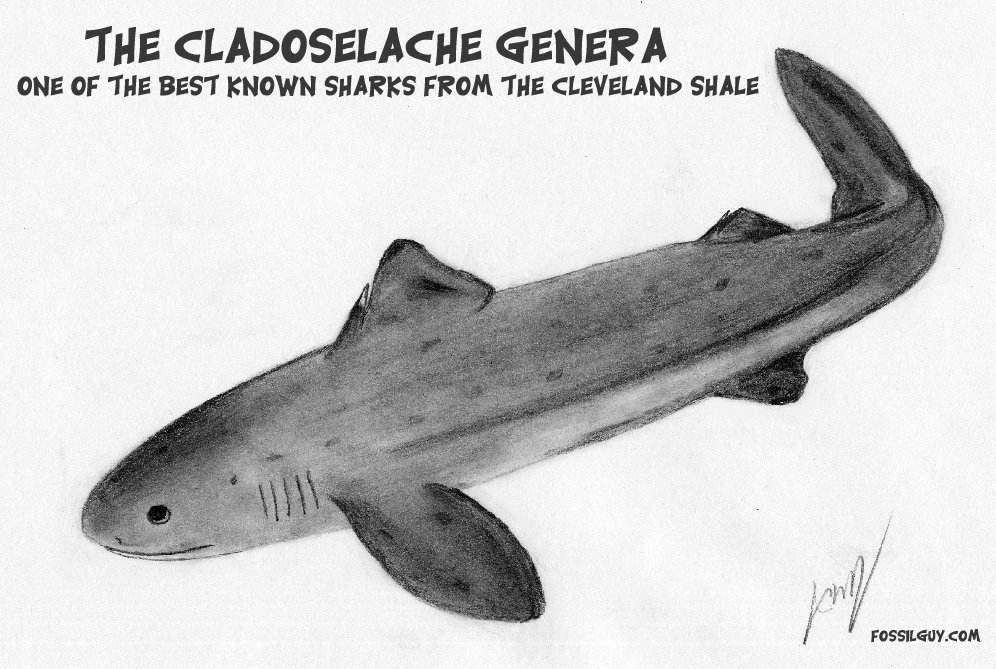
Sharks and other cartilaginous fishes had already undergone a major burst of diversification during the Carboniferous, and that evolutionary experimentation continued into the Permian. One of the strangest examples was Helicoprion, a shark-like fish famous for the tightly coiled whorl of teeth in its lower jaw. Helicoprion belonged to an extinct group called the eugeneodonts and was more closely related to the branch that includes modern chimaeras, sometimes called ghost sharks, than to true sharks. As the animal grew, new teeth were continually added to the whorl while the older teeth were retained, creating one of the most unusual feeding structures known from the Paleozoic.
Fusulinids were tiny single-celled marine organisms that built complex shells, many shaped somewhat like grains of rice. They were especially important index fossils - fossils that geologists use to date and match rock layers from different locations. Fusulinids evolved rapidly and were widespread in warm, shallow Permian seas, so particular species can help identify rocks of a similar age across widely separated regions.
Trilobites were still hanging on during the Permian, but only a few members of a group called the proetids remained. When they finally disappeared during the end-Permian mass extinction, they brought to a close a fossil record that had lasted for more than 270 million years. Eurypterids, the famous "sea scorpions," also vanished, while many groups of brachiopods, corals, echinoderms, and mollusks suffered devastating losses.
The End-Permian Mass Extinction: The Great Dying

The Permian ended with the most severe known mass extinction of the Phanerozoic. The event is commonly called the Great Dying. Marine ecosystems were hit especially hard, but land plants, insects, and vertebrate communities also underwent enormous disruption.
The leading explanation centers on the Siberian Traps, one of the largest episodes of continental volcanism in Earth history. High-precision dating shows that enormous volumes of magma were emplaced before, during, and after the extinction interval, closely tying the volcanic event to the biological crisis (Burgess and Bowring, 2015).
The most damaging phase may not have been lava simply pouring across the surface. A 2017 study identified the widespread intrusion of magma into carbon-rich and volatile-rich sediments of the Tunguska Basin as a critical interval. Heating those rocks could release huge amounts of greenhouse gases and other compounds into the atmosphere (Burgess et al., 2017).
The environmental consequences cascaded through the Earth system. Rapid warming reduced the amount of oxygen seawater could hold and increased the oxygen needs of marine animals. Modeling and fossil-distribution data indicate that the combination of heat and oxygen loss can explain much of the pattern of marine extinction (Penn et al., 2018).
Recent research adds another layer to the story. A 2024 study concluded that unusually intense and persistent El Nino-like climate behavior may have greatly amplified temperature and rainfall extremes during the crisis (Sun et al., 2024). Rather than replacing volcanism as the trigger, this work helps explain how volcanic warming could have produced such destructive and unstable conditions across the planet.
The land record is complicated because erosion and gaps in sedimentation can blur the timing from place to place. New studies continue to refine how rapidly terrestrial ecosystems collapsed and whether different regions were affected at exactly the same time. Research from southwest China, for example, documents severe terrestrial ecological disruption across the boundary and strengthens the evidence that the end-Permian crisis reached far beyond the oceans (Wu et al., 2024).
Why the Permian Matters: The Permian is the bridge between the old Paleozoic world and the ecosystems that followed in the Mesozoic. It records the early success of the mammal branch of the vertebrate family tree, the spread of more drought-tolerant vegetation, increasingly complex terrestrial food webs, and finally a global extinction so severe that life in the Triassic had to rebuild from a drastically reduced set of survivors.
Famous Fossil Sites from the Permian Period

Aranos Basin, Namibia: The Aranos Basin preserves important Lower Permian rocks of southern Gondwana, including the Whitehill Formation. These fine-grained sediments contain fossils of Mesosaurus, an aquatic reptile also found in South America. The occurrence of closely related Mesosaurus fossils on both sides of the South Atlantic became an important line of evidence that Africa and South America were once joined as part of Gondwana.
Karoo Basin, South Africa: The Beaufort Group preserves one of the world's most detailed records of Middle and Late Permian terrestrial vertebrates. Its successive fossil assemblages document dinocephalians, dicynodonts, gorgonopsians, therocephalians, cynodonts, amphibians, and other animals through major ecological changes leading toward the end-Permian extinction.
Perm and Ural regions, Russia: These rocks gave the Permian its name and preserve important marine and terrestrial fossils. Russian Permian deposits have produced pareiasaurs, therapsids, amphibians, fishes, plants, and many other fossils that helped establish the global picture of Permian life.
Texas Red Beds, United States: North-central Texas preserves classic Early Permian terrestrial faunas. Famous fossils include Dimetrodon, Edaphosaurus, large amphibians, reptiles, and many smaller vertebrates. These red-bed deposits played a major role in the early scientific study of Permian land animals in North America.
Richards Spur, Oklahoma: Early Permian cave and fissure deposits preserve an unusually rich assemblage of small reptiles, amphibians, and other tetrapods. Because small animals are often underrepresented in ordinary river and floodplain deposits, Richards Spur provides an important counterpoint to the large-bodied animals that dominate museum displays.
Kupferschiefer, Germany: This thin marine unit is famous for beautifully preserved fishes and reptiles, along with other marine organisms. It provides a very different view of Late Permian life than the land-dominated records of Texas, Russia, and South Africa.
Meishan, China: The Meishan section is one of the most important boundary sites in all of geology. Its marine rocks record the end-Permian extinction in exceptional detail, and the section contains the internationally recognized reference point for the base of the Triassic System.
Recommended Permian and Paleozoic Books

When Life Nearly Died: The Greatest Mass Extinction of All Time
This book begins with the history of paleontology, geologic time, and changing ideas about extinction, then moves into the end-Permian catastrophe, the Great Dying, and the evidence behind Earth's most devastating mass extinction.
View on Amazon
Earth before the Dinosaurs
This book explores the strange and fascinating world before dinosaur dominance, tracing the rise of tetrapods, early amphibians, and amniotes through fossils, evolutionary detective work, and vivid reconstructions of ancient life.
View on Amazon
Carboniferous Giants and Mass Extinction: The Late Paleozoic Ice Age World
A very detailed, visually written look at the Carboniferous world, from giant arthropods and vast coal forests to ancient climate change and mass extinction. Best for readers with some geology background, not a casual overview.
View on AmazonReferences / Works Cited
International Commission on Stratigraphy. (2026). International Chronostratigraphic Chart, v2026/06.
International Chronostratigraphic Chart
Murchison, R. I. (1841). First sketch of some of the principal results of a second geological survey of Russia. Philosophical Magazine and Journal of Science, Series 3, 19, 417-422.
Benton, M. J., & Sennikov, A. G. (2022). The naming of the Permian System. Journal of the Geological Society, 179.
https://doi.org/10.1144/jgs2021-037
Brocklehurst, N., Ford, D. P., & Benson, R. B. J. (2022). Early origins of divergent patterns of morphological evolution on the mammal and reptile stem-lineages. Systematic Biology, 71(5), 1195-1209.
https://doi.org/10.1093/sysbio/syac020
Benoit, J., Manger, P. R., Norton, L. A., Fernandez, V., & Rubidge, B. S. (2017). Synchrotron scanning reveals the palaeoneurology of the head-butting Moschops capensis (Therapsida, Dinocephalia). PeerJ, 5, e3496.
https://doi.org/10.7717/peerj.3496
Prevec, R., Nel, A., Day, M. O., et al. (2022). South African Lagerstatte reveals middle Permian Gondwanan lakeshore ecosystem in exquisite detail. Communications Biology, 5, 1154.
https://doi.org/10.1038/s42003-022-04132-y
Singh, S. A., Elsler, A., Stubbs, T. L., Rayfield, E. J., & Benton, M. J. (2024). Predatory synapsid ecomorphology signals growing dynamism of late Palaeozoic terrestrial ecosystems. Communications Biology, 7, 201.
https://doi.org/10.1038/s42003-024-05879-2
Burgess, S. D., & Bowring, S. A. (2015). High-precision geochronology confirms voluminous magmatism before, during, and after Earth's most severe extinction. Science Advances, 1(7), e1500470.
https://doi.org/10.1126/sciadv.1500470
Burgess, S. D., Muirhead, J. D., & Bowring, S. A. (2017). Initial pulse of Siberian Traps sills as the trigger of the end-Permian mass extinction. Nature Communications, 8, 164.
https://doi.org/10.1038/s41467-017-00083-9
Penn, J. L., Deutsch, C., Payne, J. L., & Sperling, E. A. (2018). Temperature-dependent hypoxia explains biogeography and severity of end-Permian marine mass extinction. Science, 362(6419), eaat1327.
https://doi.org/10.1126/science.aat1327
Sun, Y., et al. (2024). Mega El Nino instigated the end-Permian mass extinction. Science, 385.
https://doi.org/10.1126/science.ado2030
Wu, Q., et al. (2024). The terrestrial end-Permian mass extinction in southwest China. Science Advances, 10, eadi7284.
https://doi.org/10.1126/sciadv.adi7284
FAQs: Permian Period Frequently Asked Questions
Quick answers to common questions about Permian time, Pangaea, Dimetrodon, therapsids, plants, giant insects, fossils, and the Great Dying.
-
When was the Permian Period?
The Permian Period lasted from about 298.9 to 251.902 million years ago. It followed the Carboniferous and was the final period of the Paleozoic Era.
See: Geologic Time -
Why is it called the Permian Period?
Roderick Murchison introduced the name Permian in 1841 after studying rocks in Russia. The name comes from the Perm region west of the Ural Mountains.
See: Discovery and Naming
-
What are the three divisions of the Permian?
The Permian is divided into the Cisuralian, Guadalupian, and Lopingian series. They correspond broadly to the Early, Middle, and Late Permian.
See: Geologic Time -
Was Dimetrodon a dinosaur?
No. Dimetrodon lived tens of millions of years before the first dinosaurs. It was a non-mammalian synapsid, part of the broad evolutionary branch that later produced mammals.
See: Dimetrodon and Synapsids -
What animals lived during the Permian Period?
Famous Permian land animals include the sail-backed predator Dimetrodon, the thick-skulled herbivore Moschops, the saber-toothed gorgonopsian Inostrancevia, and the armored plant eater Scutosaurus. These animals lived at different times during the Permian. Other ecosystems included dicynodonts, cynodonts, reptiles, amphibians, insects, and diverse marine life.
See: Famous Permian Animals -
What plants lived during the Permian?
Permian plant communities varied by region. Glossopteris forests dominated many parts of Gondwana, while conifers, seed ferns, horsetails, ferns, and other seed plants were important across Pangaea.
See: Permian Plants -
Were there giant insects in the Permian?
Yes. Giant dragonfly-like griffinflies survived into the Early Permian. Meganeuropsis is famous for an estimated wingspan of roughly 71 centimeters, making it one of the largest known flying insects.
See: Insects and Arthropods -
What was the Great Dying?
The Great Dying is the informal name for the end-Permian mass extinction about 252 million years ago. It was the most severe known mass extinction of the Phanerozoic and devastated both marine and terrestrial ecosystems.
See: The Great Dying -
What caused the end-Permian mass extinction?
The leading explanation links the extinction to enormous Siberian Traps eruptions. Volcanic gases and related processes drove rapid warming, disrupted the carbon cycle, reduced oxygen in the oceans, and caused other environmental stresses. Recent work also points to extreme climate variability as an important amplifier.
See: The Great Dying -
Where are famous Permian fossils found?
Important Permian fossil regions include the Karoo Basin of South Africa, the Perm and Ural regions of Russia, the Texas Red Beds and Oklahoma of the United States, the Kupferschiefer of Germany, and the Permian-Triassic boundary section at Meishan in China.
See: Famous Fossil Sites
Jump to Sections
Fast Facts | Geologic Time | Discovery and Naming | Earth and Climate | Life and Events | Famous Permian Animals | Dimetrodon | Therapsids | Reptiles and Amphibians | Plants | Insects | Marine Life | The Great Dying | Famous Fossil Sites | Books | References | FAQ