



This original news article examines the peer-reviewed study Formoso et al. (2026) in Current Biology, with context from the original Rutgers University press release.
Key Findings From the Mosasaur Tail Study
- Study: Formoso and colleagues, published online October 7, 2026, in Current Biology.
- Animals compared: Platecarpus tympaniticus, Tylosaurus proriger, Mosasaurus sp., and Plotosaurus bennisoni.
- Period: Late Cretaceous, when mosasaurs were among the top predators in the world’s oceans.
- Method: A physics-based “slam-start” model of the initial burst from one powerful tail sweep.
- Model conditions: Three tail-curl angles, three muscle-power levels, and three drag assumptions, totaling 27 combinations for each of the four taxa.
- Main result: Platecarpus and Tylosaurus reached higher modeled lunge speeds relative to body length than Mosasaurus and Plotosaurus.
- Speed example: An especially large Tylosaurus model reached roughly 15 mph (24 km/h) in a brief burst, not as a sustained swimming speed.
Introduction: Not All Mosasaurs Hunted the Same Way
Mosasaurs are often pictured as enormous, fast-moving marine predators, but that description probably hides a great deal of variety. Some may have rushed out of cover to seize prey, while others chased animals through open water. A new study published October 7, 2026, in Current Biology explores how differences in tail anatomy could have helped shape those hunting styles.
The Rutgers-led research team, headed by paleontologist Kiersten K. Formoso, reconstructed the bodies and tails of four mosasaurs and applied a physics-based model to estimate how rapidly each could accelerate during a single powerful tail stroke. This is a different question from how fast a mosasaur might swim over a long distance. For a predator, the first second of an attack can matter just as much as top cruising speed.
The clearest result is a split between the four animals. Platecarpus and Tylosaurus consistently achieved stronger lunges relative to their body length than Mosasaurus and Plotosaurus. The difference points toward ambush-oriented hunters on one side and animals more suited to sustained open-water swimming on the other.
What Is a Mosasaur “Slam-Start”?
Think of a swimmer pushing away from the wall of a pool. The initial shove produces a sudden burst of speed before regular swimming begins. A mosasaur had no wall to push against, but it could bend its tail sharply to one side and sweep it back against the surrounding water. The researchers call this initial maneuver a slam-start.
This kind of quick start could be particularly useful for an animal waiting for prey to come within striking distance. It might also help an animal escape an attacker. Previous studies of extinct marine reptiles have often concentrated on efficient steady swimming, but the new work focuses on the force and motion of that first strong tail sweep.
Because no one can watch a living mosasaur accelerate, Formoso and colleagues reconstructed the missing features mathematically. They began with the fossilized skeletons, estimated the muscles that would have moved each tail, and tested the effects of tail movement and water resistance using established physical principles.
Earlier Research: Could Mosasaurs Also Propel Themselves With Their Flippers?
The 2026 tail study builds on another interesting line of research by Kiersten Formoso. In 2019, Formoso, Michael Habib, and David Bottjer presented work on the pectoral girdle, the bones of the shoulder and chest that supported mosasaur foreflippers. Those bones were unusually large, suggesting room for substantial muscle attachments rather than flippers used only for steering.
The researchers examined mosasaur shoulder anatomy, including a Plotosaurus specimen from the Natural History Museum of Los Angeles County. Their reconstruction shows that the shoulder muscles could produce a particularly strong inward pulling motion, called adduction, as well as a backward stroke. In the 2019 Geological Society of America meeting abstract, they proposed that these powerful foreflippers may have helped propel mosasaurs during fast starts, perhaps working together with the tail. The Geological Society of America news release described this possibility as a breaststroke-like movement.
The articulated mosasaur flipper pictured below shows the many individual bones that formed this paddle-like limb. While the fossil itself does not establish how much muscle surrounded the shoulder, it helps illustrate the structure behind the earlier propulsion hypothesis.

Muscle Power Versus Water Resistance
A follow-up 2020 conference abstract considered an important trade-off: a wider chest could hold more flipper muscle, but it could also create more drag. In their Plotosaurus model, a 10% reduction in the estimated chest width lowered body drag by a factor of 2.5, while also reducing the potential power of the forelimbs. This helps explain why the relationship between large muscles and swimming speed is not straightforward.
These earlier presentations raised the possibility of two sources of propulsion: a powerful tail stroke and active foreflipper strokes. They did not establish exactly how living mosasaurs moved their flippers, and the new Current Biology study specifically models tail-driven lunges, not simultaneous flipper propulsion. Taken together, the research indicates that mosasaur swimming may have been more varied than a simple tail-only picture.
Reconstructing the Tails of Four Ancient Predators
The study compared four Late Cretaceous mosasaurs: Platecarpus tympaniticus, Tylosaurus proriger, Mosasaurus sp., and Plotosaurus bennisoni. All were powerful marine reptiles, but their bodies and tails were not built exactly alike. The first two belong to the russellosaurine branch, while the latter two belong to Mosasaurinae.
Of particular interest was the part of the tail that could bend sideways and drive the animal forward. Its length, shape, and the placement of the reconstructed muscles affect how much water the tail could push during a lunge. Platecarpus and Tylosaurus had proportionally longer tail regions available for this movement than the two mosasaurines in the comparison.
An earlier skeletal reconstruction of Platecarpus illustrates one of these important adaptations: the tip of its tail bends downward, supporting the inference of a fin-like fluke.

From Fossil Bones to Swimming Models
To turn fossil bones into working biomechanical models, the researchers used skeletal proportions and reconstructed the missing soft tissues. Muscle mass and arrangement had to be inferred, partly by comparison with living lizards. The estimates were then applied in the same way to each animal, making their relative performance more useful to compare than any one predicted speed.
If you are interested in more background on how these marine reptiles evolved, their fossil anatomy, and the shape of their tail fins, see Fossilguy's complete guide to mosasaurs.
Which Mosasaurs Had the Fastest Lunges?
Rather than choose one idealized tail movement, the researchers ran 27 combinations of conditions for each species, or 108 modeled cases altogether. Tail curl varied from 60° to 120°. The tests also changed muscle power (200, 500, and 800 watts per kilogram) and the drag force assumed for motion through water.
The same pattern appeared repeatedly. Platecarpus ranked highest in body-length-normalized lunge velocity, followed by Tylosaurus, Mosasaurus, and Plotosaurus. Increasing the modeled muscle power made all four launch faster, while increasing drag reduced the speeds somewhat. But the biggest influence was how far the tail could curl before it swept back.
Why Body Lengths per Second Matter
The researchers reported predicted velocity in body lengths per second, rather than simply miles per hour. That distinction is important. A large animal can cover more meters in one second while still moving fewer body lengths relative to its own size. Measuring speeds this way allows a more meaningful comparison of animals with very different lengths.
The model also compared how far each mosasaur could advance during a single burst. The relative advantage of Platecarpus and Tylosaurus remains apparent, even though the exact distances depend on which assumptions are selected.
Could a Giant Tylosaurus Really Lunge at 15 MPH?
One result from the study makes an especially striking headline. The researchers expanded their model to represent exceptionally large mosasaurs, including a giant Tylosaurus based on the skull dimensions of the famous specimen nicknamed “Bunker.” Under a selected combination of model assumptions, that enormous animal reached about 6.66 meters per second, or 15 miles per hour (24 km/h), after its modeled burst.
That does not mean a giant Tylosaurus cruised around the Cretaceous oceans at 15 mph. The estimate is based off a quick lunge resulting from one tail stroke.
The study also considered an exceptionally large Mosasaurus in the New Jersey State Museum collection. This adds a regional connection to the research, since mosasaur fossils and teeth are known from the Cretaceous deposits of New Jersey. Here is my Big Brook fossil Fossil Hunting Guide where you can try to find your own mosasaur fossil teeth.
Ambush Hunters Versus Open-Water Cruisers
If an animal can accelerate rapidly from nearly a standstill, it has an advantage when attacking prey at close range. This is the kind of performance expected from an ambush predator. The stronger modeled first stroke of Platecarpus and Tylosaurus supports the idea that these animals could use sudden, forceful attacks.
A lower score for a single burst does not automatically mean an animal was slow or ineffective in the water. A tail specialized for steady, repeated swimming may sacrifice some instantaneous acceleration in exchange for efficient travel. The study shows Mosasaurus, and particularly Plotosaurus, were better adapted to that cruising style, somewhat like the sustained swimming of tuna and other open-water predators.
These interpretations also help explain how several large marine reptiles could live in the same ocean without all hunting in exactly the same way. Different movement styles may have allowed them to exploit different prey or hunting situations. The new results agree broadly with other evidence used to investigate mosasaur diets, including teeth, bite mechanics, and fossil chemistry.

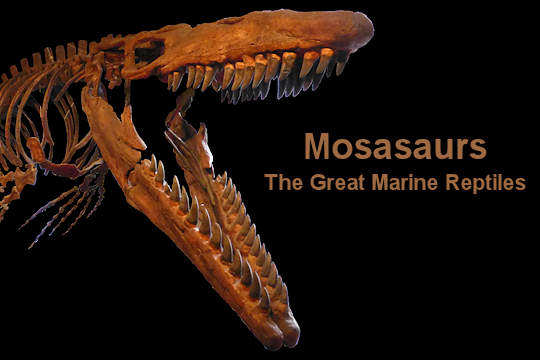
An actual mosasaur skeleton makes the scale of these animals easier to appreciate. The specimen pictured above was photographed at a now-closed Drexel museum in Philadelphia. Although it was not presented as a study specimen, the long jaws, numerous teeth, and overall body proportions offer a useful real-world look at the kinds of predators being modeled.
The new research gives a biomechanical explanation for why some mosasaurs were built for a sudden burst while others may have specialized in sustained swimming. As more fossils and better models become available, scientists can examine whether the pattern holds across additional mosasaur species.
Journal Article and Scientific Sources
Formoso, K. K., Hebdon, N., Fish, F. E., Cieri, R. L., & Habib, M. B. (2026). Mosasaur tail morphology reveals burst swimming performance and ecological diversity. Current Biology. Published online October 7, 2026. DOI: 10.1016/j.cub.2026.09.036.
Rutgers University / Kitta MacPherson. (October 7, 2026). Some of Those Ancient Sea Predators Were Built for Surprise Attacks. Original Rutgers University news release.
Lindgren, J., Caldwell, M. W., Konishi, T., & Chiappe, L. M. (2010). Convergent evolution in aquatic tetrapods: Insights from an exceptional fossil mosasaur. PLOS ONE, 5(8), e11998. Original 2010 study; Platecarpus reconstruction (CC BY 2.5).
Formoso, K. K., Habib, M. B., & Bottjer, D. J. (2019). Reassessment of the mosasaur pectoral girdle and its role in aquatic locomotion. Geological Society of America Annual Meeting, conference abstract. Original GSA abstract; Geological Society of America press release.
Formoso, K. K., Habib, M. B., & Bottjer, D. J. (2020). Assessing the mosasaur pectoral girdle and its controls on chest width: Implications for mosasaur swimming function. Society for Integrative and Comparative Biology, conference abstract. Original SICB abstract.
Formoso et al. (October 8, 2026). Extended Data: Mosasaur tail morphology reveals burst swimming performance and ecological diversity. Mendeley Data, version 1. Supplementary research dataset (CC BY 4.0).
FAQs: Mosasaur Swimming and Hunting
Common questions about the new tail study and what it tells us about mosasaurs.
- Were mosasaurs dinosaurs?No. Mosasaurs were ocean-going squamate reptiles, part of the broader lizard lineage. They lived alongside dinosaurs during the Cretaceous.
- Which mosasaur had the fastest modeled lunge?Platecarpus had the highest lunge speed relative to body length among the four modeled taxa across the tested conditions.
- Could Tylosaurus really swim 15 miles per hour?The study estimated about 15 mph for a scaled-up, exceptionally large Tylosaurus during one modeled tail-stroke burst under selected assumptions. It was not a directly measured speed or an estimate of sustained cruising.
- What is a slam-start?A slam-start is the researchers’ model of a single forceful side-to-side tail sweep that propels a swimmer forward from near rest.
- Why did some mosasaurs likely hunt differently?Differences in tail proportions and modeled burst performance suggest that Platecarpus and Tylosaurus were better suited for sudden lunges, while Mosasaurus and Plotosaurus may have favored steady open-water pursuit.
- How do scientists estimate swimming speed from fossils?Researchers reconstruct body and tail dimensions from skeletons, estimate the missing muscles, and apply biomechanical equations under several plausible assumptions. The result is a model, not a direct observation.
- Did mosasaurs use their flippers for propulsion?Formoso and colleagues proposed in 2019 and 2020 conference abstracts that large shoulder muscles could have powered foreflipper strokes, possibly alongside tail strokes. This remains a biomechanical hypothesis; the 2026 study models tail-powered lunges rather than flipper strokes.
Jump to Sections
Key Facts | Introduction | Slam-Start | Foreflipper Research | Tail Anatomy | Results | 15 MPH? | Hunting Styles | Study Limits | Sources | FAQs