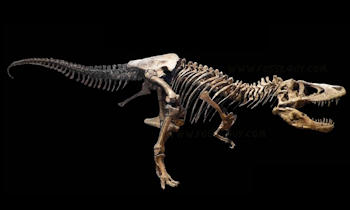




This news article is based on the peer-reviewed study (Falkingham et al., 2026) published in the Journal of Vertebrate Paleontology, along with the Denver Museum of Nature & Science press release.
Summary points about the adult T. rex trackway:

- Age: About 66.5 million years old
- Location: Hell Creek Formation near Marmarth, southwestern North Dakota
- Trackway: Four three-toed footprints extending about 7 meters, or 23 feet
- Footprint size: Roughly 0.9-1 meter long; the clearest track is about 0.96 by 0.8 meters
- Stride: About 4 meters, or 13 feet
- Estimated speed: About 1.5-2 meters per second, roughly 3.5-4.5 mph
- Likely trackmaker: Adult Tyrannosaurus rex
- Big discovery: The first sequence of tracks likely attributable to an adult T. rex
Introduction: Four Steps From 66.5 Million Years Ago
A skeleton can tell us what a dinosaur looked like. A trackway catches it in the middle of doing something.
In the badlands of southwestern North Dakota, researchers have described four enormous footprints that preserve a short walk across a Late Cretaceous floodplain. Each track is close to a meter long. Together, they form a roughly 7-meter-long sequence of two left and two right steps.
The researchers identify an adult Tyrannosaurus rex as the most likely trackmaker. If that interpretation is correct, this is the first known adult T. rex trackway - a sequence of footprints that lets us follow the animal rather than simply see where one foot touched the ground.
Discovered by a High School Teacher in the North Dakota Badlands
The site was discovered in 2025 by Kent M. Hups, a Northglenn High School teacher and volunteer fossil hunter working with the Denver Museum of Nature & Science. The tracks occur on federal land administered by the U.S. Forest Service near Marmarth, North Dakota.
Hups became a co-author of the study alongside Peter Falkingham of Liverpool John Moores University and Denver Museum researchers Evan Tamez-Galvan, Antoine Bercovici, and Tyler Lyson.

The trackway lies in the upper Hell Creek Formation about 33 meters below the contact with the overlying Fort Union Formation. That position places the footprints at approximately 66.5 million years old, shortly before the end-Cretaceous mass extinction.

The First Adult T. rex Trackway - But Not the First T. rex Footprint
The phrase "first T. rex trackway" needs an important qualifier. Paleontologists have already described isolated tracks attributed to adult Tyrannosaurus rex.
One is Tyrannosauripus pillmorei from the Raton Formation of New Mexico, an 86-centimeter-long track that even preserves an impression of the small first toe, or hallux. Another large probable T. rex track was reported from the Hell Creek Formation of Montana.
Other tyrannosaur trackways are known too, but they were made by smaller tyrannosaurids, juvenile animals, or possibly Nanotyrannus. What makes the new North Dakota discovery different is the combination of adult-sized footprints and multiple consecutive steps.
Why the Researchers Think T. rex Made the Tracks
Fossil tracks rarely come with the trackmaker conveniently standing next to them. Identifying a footprint therefore requires several lines of evidence.
The new tracks are enormous, roughly 0.9 to 1 meter long, and clearly three-toed. They are longer than they are wide and show relatively narrow toe impressions. The trackway also comes from the latest Cretaceous Hell Creek Formation, where adult T. rex fossils are well documented locally.
A large hadrosaur such as Edmontosaurus annectens could also leave huge three-toed footprints, so the researchers explicitly considered that alternative. Hadrosaur tracks, however, usually have broader digit impressions and tend to be wider than they are long.
The evidence does not make the trackmaker's identity absolutely certain, which is why the paper says the trackway is "likely attributable" to an adult Tyrannosaurus rex. But among the dinosaurs known from that place and time, adult T. rex is the strongest match.

A T. rex Walking at About 4 Miles Per Hour
The trackway preserves two left and two right steps with a stride of approximately 4 meters, or 13 feet.
Using footprint and stride measurements, the researchers estimated that the animal was moving at roughly 1.5 to 2 meters per second, or about 3.5 to 4.5 miles per hour.
That is not a sprint. It is an ordinary walking speed for a very large animal, roughly comparable in speed to a brisk human walk.
The number is approximate. The footprints are weathered, their edges are not sharply preserved, and the tracks may be slightly larger than the actual feet because of how sediment deformed as the animal stepped into and out of it.
How a Footprint Turned Into a Hard Sandstone Concretion
The T. rex apparently stepped into soft sediment deposited on a floodplain, probably in a crevasse-splay environment where sand and mud spread out from a nearby river channel. Each foot left a depression.
Later, groundwater carrying calcium carbonate moved through the sediment. Minerals precipitated around the footprint depressions, cementing the sand into harder masses called concretions. Over millions of years, the softer surrounding sediment eroded away more quickly, leaving the footprint-bearing concretions exposed.

That process preserved the general size and three-toed form of the footprints, but not much fine anatomical detail. Their surfaces are heavily fractured and weathered.
A T. rex Trackway Studied From Across the Atlantic
The team documented the footprints with high-resolution 3D surface scanning. Individual tracks and the entire trackway were converted into detailed digital models that could be measured and viewed from different angles.
Lead author Peter Falkingham analyzed the trackway from England without ever visiting it in person. The field team sent him the 3D data, allowing him to examine the footprints on a computer and in virtual reality.
What Four Footprints Can - and Cannot - Tell Us
A trackway is a snapshot of behavior. These four footprints show that a very large tyrannosaur crossed this patch of floodplain at a normal walking pace. They also provide direct information about stride length and trackway width that an isolated footprint cannot.
At the same time, four weathered tracks are not enough to answer every locomotion question about T. rex. The authors emphasize that the short trackway and poor anatomical preservation limit what can be inferred about precise foot motion, gait, or unusual behavior.
There may be additional tracks hidden beneath the surrounding hillside, but exposing them would require removing considerable overburden.
For now, the value of the site is wonderfully straightforward: for four steps, we can trace the path of an adult-sized Tyrannosaurus rex across North Dakota about 66.5 million years ago.
The Footprints Are Headed for the Museum
The Denver Museum of Nature & Science announced plans to recover three of the footprint-bearing concretions and transport them to Denver for preparation and further study.
Because of the remote terrain and the size of the specimens, the museum plans to lift them by helicopter. The museum also intends to share updates from the recovery and preservation work.
Journal Article and Press Release
Falkingham, P. L., Hups, K. M., Tamez-Galvan, E. M., Bercovici, A. D., & Lyson, T. R. (2026). A large tridactyl trackway from the Upper Cretaceous Hell Creek Formation of North Dakota, likely attributable to an adult Tyrannosaurus rex. Journal of Vertebrate Paleontology, e2706201. Published online September 8, 2026. https://doi.org/10.1080/02724634.2026.2706201.
Denver Museum of Nature & Science. (2026). Denver Museum of Nature & Science discovers first-ever adult T. rex trackway. Museum press release.
Image credits and reuse: The images used on this page come from the official Denver Museum of Nature & Science media materials for the trackway discovery. The drone image is credited to Kent M. Hups; the Alex Polich scale photograph is credited to Natalie Toth; other field photographs are credited to Tyler Lyson / Denver Museum of Nature & Science; and the reconstructions are credited to Andrey Atuchin. These are press/media assets and are not Creative Commons. The journal article is not CC-licensed, so figures from the paper itself are not used.
FAQs: The First Adult T. rex Trackway
Quick answers about the North Dakota trackway, how it was identified, and what it tells us about an adult Tyrannosaurus rex in motion.
- Is this really the first T. rex trackway?It is the first reported trackway likely attributable to an adult Tyrannosaurus rex. Isolated adult-sized T. rex footprints were already known, and smaller tyrannosaur trackways have also been described.
See: First Adult T. rex Trackway - Where was the T. rex trackway found?The trackway was found in 2025 in the Hell Creek Formation on Dakota Prairie Grasslands in Slope County, southwestern North Dakota, near Marmarth.
See: Discovery
-
How old is the trackway?
Its stratigraphic position places it at about 66.5 million years old, very near the end of the Cretaceous Period. -
How many footprints are in the trackway?
The exposed trackway contains four large three-toed tracks: two left footprints and two right footprints. -
How large are the footprints?
The tracks are roughly 0.9 to 1 meter long, or about 3 feet. The clearest track measures approximately 0.96 meters long and 0.8 meters wide. -
How fast was the T. rex walking?
The researchers estimated a walking speed of about 1.5 to 2 meters per second, approximately 3.5 to 4.5 miles per hour. Because the tracks are weathered, the estimate is approximate. -
How do scientists know T. rex made the tracks?
The identification is based on the enormous size, three-toed shape, narrow digit impressions, age and locality of the trackway, and the abundance of T. rex skeletal fossils in the surrounding Hell Creek Formation. -
Could a hadrosaur have made the tracks?
The researchers considered that possibility, but Hell Creek hadrosaurs such as Edmontosaurus generally made broader-toed tracks that tend to be wider than long. The new tracks are longer than wide and have narrower digit impressions. -
Why are the footprints preserved as hard rounded rocks?
The animal stepped into soft overbank sediment. Later, calcium-carbonate-rich groundwater cemented sediment around the footprint depressions into hard sandstone concretions. Erosion then removed softer surrounding rock and exposed the footprint casts. -
Who discovered the trackway?
Kent M. Hups, a Northglenn High School teacher and volunteer fossil hunter, discovered the site in 2025 while participating in fieldwork with the Denver Museum of Nature & Science.
Jump to Sections
Key Facts | Introduction | Discovery | Why It Is the First | Why T. rex? | Walking Speed | Preservation | 3D Scanning | What It Tells Us | Museum Recovery | Sources | FAQs