


Article written by: Jayson Kowinsky - Fossilguy.com
Tyrannosaurus Rex
Fast Facts about Tyrannosaurus rex
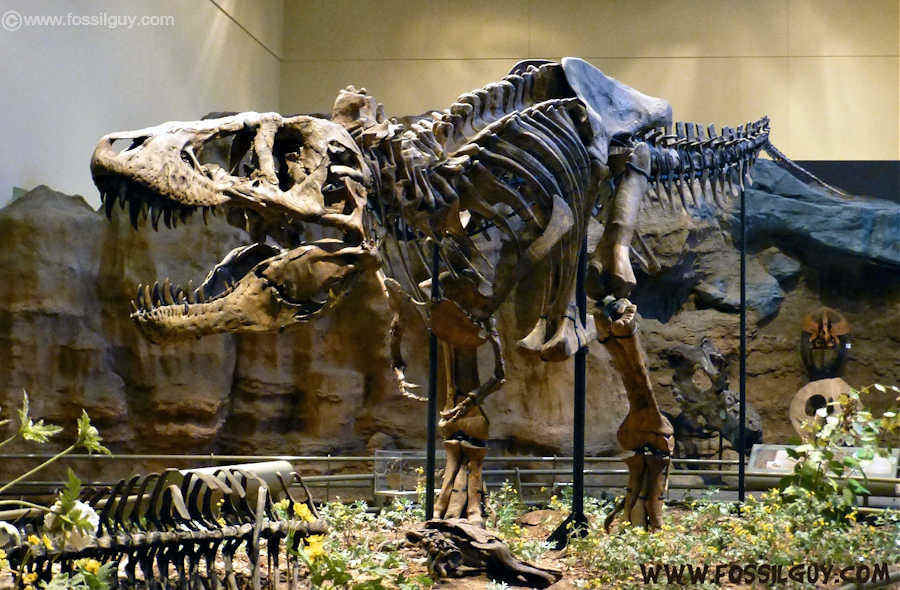
Name:
Tyrannosaurus rex (pronunciation: "tie-RAN-oh-SAW-rus") - The name means "Tyrant Lizard King"
Taxonomy:
Dinosauria (Dinosaur) - Saurischia (Lizard Hipped) - Theropoda (Beast Footed) - Tyranosauroidea (Superfamily) -
Tyranosauridae (Family) - Tyrannosaurini (Tribe) - Tyranosaurus (Genus) - T. rex (species)
Age: Late Cretaceous
Despite its popularity, T. rex only existed for about 2 million years.
It lived for a short time period around 68 to 65 million years ago.
Extinction:
T. rex was one of the last dinosaurs to ever exist. It went extinct at the end Cretaceous mass extinction event, which
brought a close to the age of Dinosaurs.
Discovery: Osborn, 1905
The discovery of T. rex is an intriguing story (discussed in an article here). The brief version:
T. rex was originally discovered by Barnum Brown in 1900 while doing excavations in Wyoming.
However, Brown thought the fossil was something else. Osborn, in 1905 caught the error and named it T. rex.
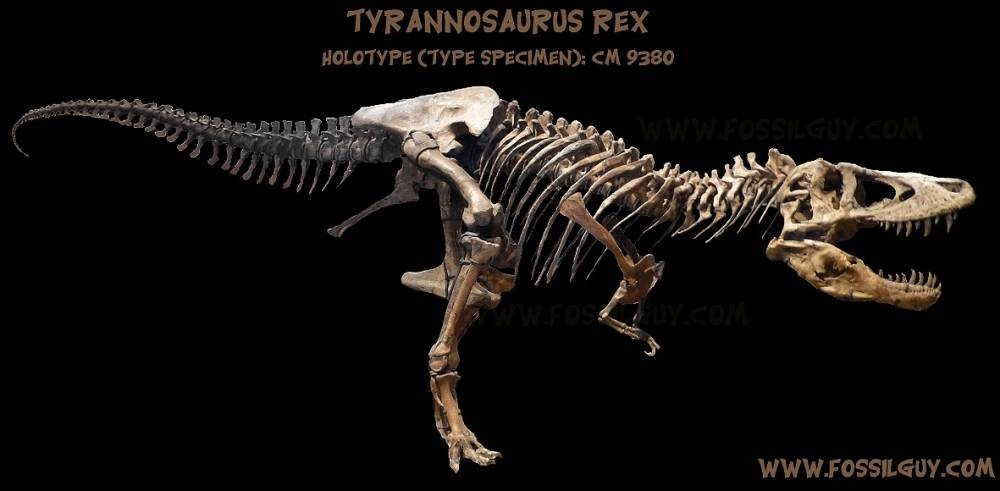
The Holotype specimen, CM 9380 (AMNH 973), is at the Carnegie Muesuem of Natural History in Pittsburgh.
Distribution: Western North America (Laramidia):
Despite its popularity, T. rex only lived on an island continent called "Laramidia". This continent is
present day Western North America.
Body Size: Pretty Big! 13 meters (42.6 feet)!
Although T. rex was not the largest carnivore, it was pretty substantial.
T. rex could reach a length of over 40 feet and weight over 7 tons (equal to 93 people).
The largest specimen is Scotty. She is 13m (42.6ft) in length.
Bone Crushing Bite: Strongest Bite of any Land Animal... Ever!
T. rex had MASSSIVE jaws with HUGE muscles. It had the strongest bite of any animal ever!
One tooth could produce up to 12,800 pounds of force!
Diet: Anything
T. rex was the Apex predator of the Western United States. It could eat just about anything.
Ceratopsians (triceratops) and Hadrosaurs (duck-billed dinosaurs) were among its favorites. Evidence
shows it even ate other T. rex's!
Speed: Fast: 18 mph
Recent studies indicate T. rex could run at speeds over 18 mph!
Skin: Scales, not Feathers
The discovery of skin impressions of a T. rex in 2002 reveals scales, not feathers.
Tyrannosaurus rex fossils have been found in the following formations:
| Late Cretaceous Formations | Locations |
|---|---|
| Frenchman Formation | Saskatchewan |
| Hell Creek Formation | Montana, N/S Dakota |
| Javelina Formation | Texas |
| Lance Formation | Wyoming |
| Livingston Formation | Montana |
| Laramie Formation | Colorado |
| McRae Formation | New Mexico |
| Scollard Formation | Alberta |
| Willow Creek Formation | Alberta |
| www.fossilguy.com |

General Overview of Tyrannosaurus rex
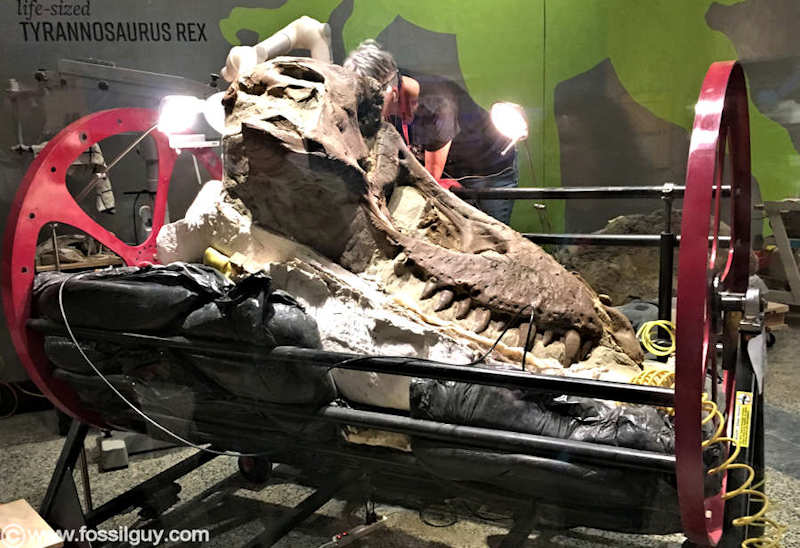
This is the large skull of "Tufts Love T. rex" when it was being prepped at the Burke Muesum in Seattle.
Tyrannosaurus rex is one of the largest and most popular members of the Tyrannosaurus family of dinosaurs.
This is this is probably because it was one of the most dangerous predators to ever walk earth. T. rex is
characterized by an oversized head with forward facing eyes, huge muscular jaws, robust serrated teeth,
a powerful tail, and tiny arms.
T. rex was the apex predator of its time. It was a powerful carnivore that hunted many large
dinosaurs including the Ankylosaurs,
Triceratops (Ceratopsids),
Hadrosaurs, and the last of the Sauropods.
Although Tyrannosaurs have a long history, the species, T. rex, lived for a short time period of about
3 million years during the very end of the Cretaceous.
The first fossils are around 67 million years old and the last fossils are 65 million years old. It was the last of the Tyrannosaurs and went
extinct with the rest of the dinosaurs during the end Cretaceous mass extinction event.
T. rex only lived on the small island continent of Laramindia (now western North America). During the Cretaceous,
a large seaway (the Western Interior Seaway) split North America in half. The western half of North America is called
Laramindia and the eastern half is called Appalachia. Fossils of T. rex from Laramindia are found from Canada down
into Texas. T. rex shared this island continent with many other well known clades of dinosaurs including the hadrosaurs,
and the ceratopsids,
such as Triceratops.
Isolated teeth and isolated bone fragments of T. rex are common, however, associated specimens are rare.
Under 60 partial specimens have been described by science.
(Here is the list).
Among these specimens, only 13 are over 25% complete. The most complete T. rex is called "Sue" (PR2081), which was
found in 1990 in South Dakota. Sue is 80% complete and can be seen in the Field Museum of Chicago.
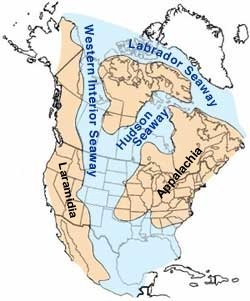
Map of the Late Cretaceous of North America. The continent was split
into two island continents by the Western Interior Seaway. The West was called
Laramidia and the East was called Appalachia. Both island continents had
different Dinosaur fauna. T. rex was confined to Laramidia.
Image by the U.S. Geological Survey.
Tyrannosaurus rex Anatomy and Physiology - Body, Skull, Arms, and Speed
T. rex is a very specialized dinosaur with many unique anatomical features. These next paragraphs highlight some of the main features of this apex predator: T. rex could crush other dinosaurs bones, it actually used its tiny arms, and it was fast and agile!
The Body - Bulkier than previously thought
Prior to 2018, T rex skeletons were mounted as sleek looking dinosaurs, however, paleontologists working with SUE (the most complete T rex found to date) at the Field Museum in Chicago figured out where the placement of a series of rib-like bones go. These gastralia bones go under the ribs of T-rex, on it's belly and aided in the dinosaurs breathing. The addition of these gastralia bones makes SUE have a bulging belly and widens it's rib cage. A comparison of the old mount of SUE and the new mount are shown below in this Field Museum image.
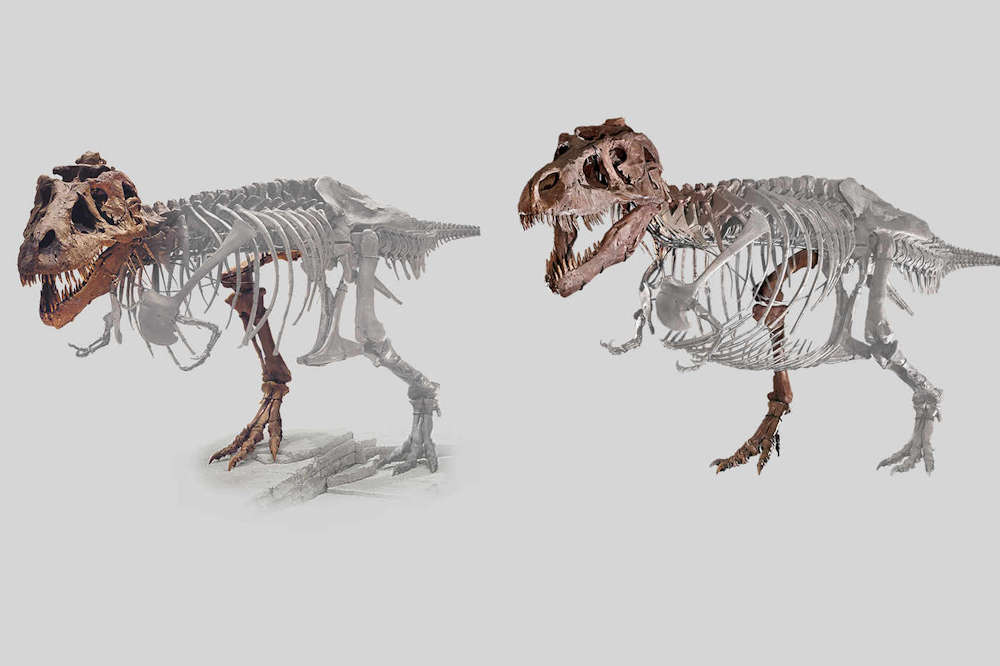
This image shows how SUE's mount changed after the addition of the gastrialia bones. The left is from 2000, the right is from 2018. Notice how much wider and bulkier SUE is. Image from: JOHN WEINSTEIN/FIELD MUSEUM - Here is a link to the complete article from the Field Museum
Tyrannosaurus rex's Huge Skull and Powerful Bite! - "T. rex the Bone Crusher"
Compared to other theropod dinosaurs, Tyrannosaurus rex had the largest, most robust, and most powerful skull.
It was clearly specialized. T. rex underwent dramatic skeletal changes as it grew from a hatchling into a full
grown adult. The skull starts out very slender with a somewhat long snout. However, as it aged, the skull became
significantly larger, the snout became blunt, and the jaws
became very robust. By looking at an adult T. rex skull and comparing it to other theropods of the time,
one can tell the jaws would have been much more muscular.
In 2012, Bates did a computer study of the bite force of a human, Allosaurus, juvenile T. rex, and an adult
T. rex (STAN-BHI3033). The study was much more accurate than previous estimates because they used "dynamic
musculoskeletal models" to simulate the maximum bite forces of the animals. Bates found juvenile T. rex had a
small bite force, indicating a diet of small prey. While adult T. rex had an incredibly powerful bite force,
much higher than other theropods. The bite force was found to be between 35,000 and 57,000 Newtons per tooth
(up to 12,800 pounds of force per tooth) (Bates, 2012). In layman's terms, Bates says, 12,000 lbs is
the equivalent of an elephant sitting on a person!
T. rex bite force is MUCH more powerful than any other land animal EVER. While other theropods, like Allosaurus
and juvenile T. rex's probably couldn't chomp through bone, an adult T. rex could crush any bone with ease.
It could have fed on even the largest dinosaurs. Dr. Bates concludes the extremely powerful bite makes
"it one of the most dangerous predators to have roamed our planet."
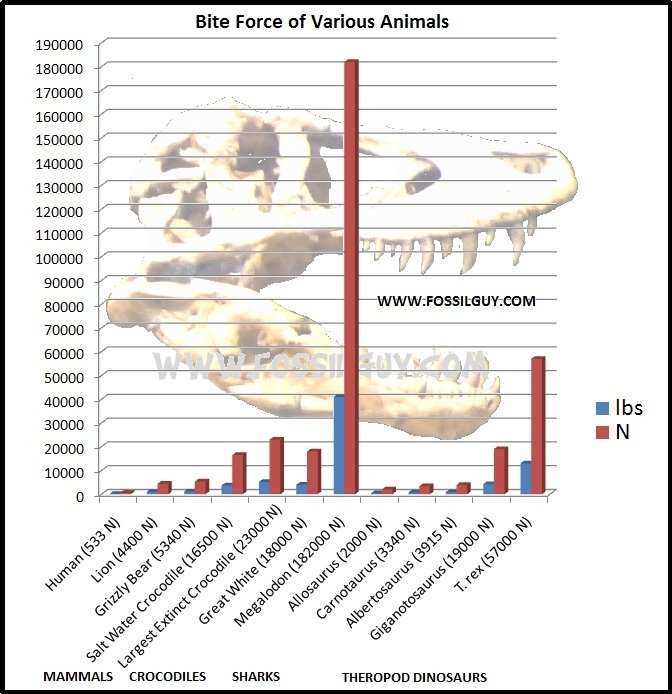
This graph shows the bite force of T. rex
compared to other animals, including similar
theropods, crocodiles, some mammals, and the
creature with the largest bite force known, C. megalodon.
Bite force values of the reptiles are
from: Erickson, et al. (2012). The Sharks are
from: Wroe, et al. (2008). Most dinosaurs from this
table are from: Bates and Falkingham (2012).
Tyrannosaurus rex's Tiny Arms - Specialized, not useless.
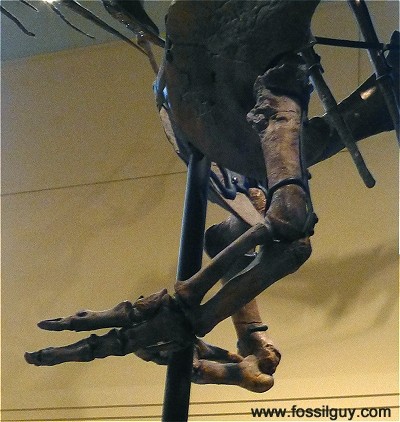
Image of an arm of T. rex
T. rex 's arms are probably the most perplexing feature of this terrifying dinosaur. For a 40 foot animal, they
are only about the length of human arms. While other theropods, such as the Ornithomimosaurs, were developing
long arms, all of the large Tyrannosaurs across the globe had developed very short and stubby arms.
A quick look makes many people think they were useless and vestigial, and therefore they simply shrunk in size.
However, the rest of T. rex 's anatomy appears to have been highly specialized. It would be strange to see a
very specialized body plan that contains small useless arms.
A closer look at the few fossil arms of T. rex show they still had large menacing claws
on their remaining two finger digits; they did not reduce in size. Also, Lipkin and Cerpenter (2008) found that
T. rex arms were actually incredibly powerful and muscular.
An image of very muscular, shortened arms with large claws shouts specialization. They were not vestigial. If they
were highly specialized, like the rest of T. rex's anatomy, the question becomes what were these strong,
sharp tooth picks used for?

This is a diagram of a Tyrannosaurus rex arm. This work is by Conty (Public Domain).
Rothschild and Molnar (2008) investigated Tyrannosaur arms. They looked for stress fractures in the
arms of T. rex and found that stress fractures were common.
What's the big deal about
stress fractures? A stress fracture is different from a break. Stress fractures occur during high impact and repeated activities.
For example, stress fractures are not uncommon in people training for a marathon. Stress fractures occur with extensive use or overuse, not because of
trauma. This means T. rex was actively using its arms for something.
So, what did T. rex use its arms for? This is where speculation comes to play. They could have been used for some
sort of mating behavior. Perhaps they helped T. rex go from a sitting to standing posture,
or maybe they could have been used to stick into struggling prey. The speculation goes on and on.
Rothschild and Molnar (2008), tried to tackle this question. When looking at predators, stress fractures occur
in their limbs when holding onto struggling prey. Previously, in 2001, Rothschild and others studied the numerous
stress fractures in the limbs of Allosaurus, a Jurassic theropod. They concluded this theropod actively used its
arms and legs to hold and grasp struggling prey. Rothschild and Molnar came to the same conclusion about T. rex's
arms, that holding onto struggling prey could cause this type of injury. Short muscular arms with large claws
could hold the prey steady while the giant, bone crushing, jaws tore through the struggling dinosaur.
Lipkin and Carpenter (2008) also support this. They note that the many injuries to the dinosaurs' shoulders
were probably the result of predator-prey interactions.
So, based on the research, what were T. rex arms used for? To hold onto struggling prey.
How fast could T. rex run?
We don't know, but it was built for agility and speed.
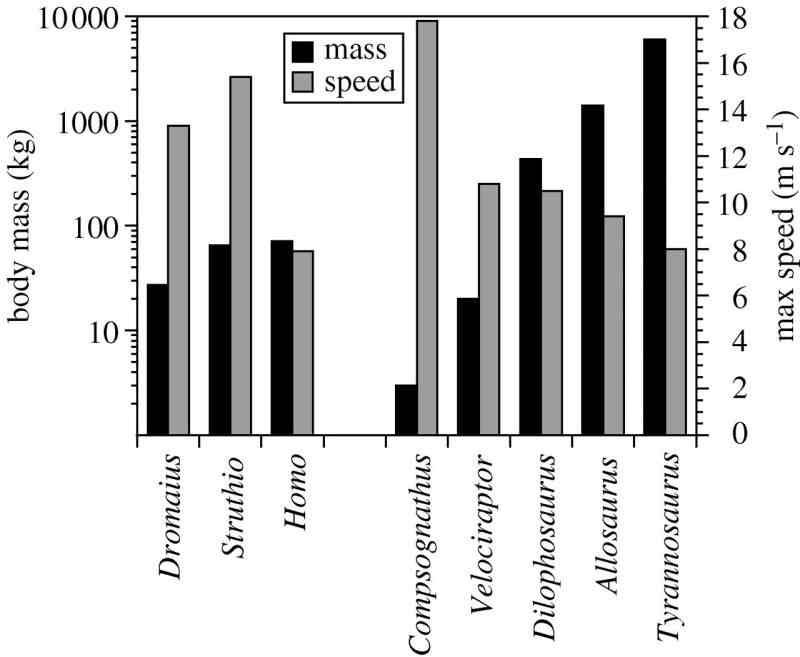
Figure 2 from Sellers & Manning (2007). Click on the link to view the full article. This figure shows body mass vs top speeds from the simulations. Tyrannosaurus rex is on the far right. The fastest theropod on thier chart is Compsognathus, a tiny 1m long critter.
The best way to gauge the speed of a dinosaur is to study dinosaurs tracks.
Unfortunately, there is a lack of Tyrannosaurus tracks. There have been a few isolated footprints found in the western U.S. and Mongolia,
but these isolated footprints tell us nothing about the dinosaurs speed.
There have only been two trackways discovered so far.
1: The first trackway is from British Columbia. It was excavated between 2011 and 2012 and published in 2014 (McCrea et al, 2014).
This trackway consists of 3 individual Tyrannosaurs walking together. Based on the gate of one of the trackways, it has been
deduced that one of the Tyrannosaurs was walking between 6.5 - 8.5 km/hr (4 - 5.3 mph) (McCrea et al, 2014). Unfortunately,
this trackway is of Tyrannosaurs walking, not running. So the running speed from this trackway cannot be determined.
2: The second trackway is from the Lance Formation in Wyoming. It was discovered near the Paleon Museum in
Glenrock years ago, and with the help of Scott Persons, was recently researched and published on.
These tracks are either of a juvenile T. rex or a Nanotyrannosaurus (Smith et al, 2016). Calculations based on the tracks give a speed of between
4.5 and 8 km/h (2.8 mph and 5 mph) (Smith et al, 2016). Like the previous tracks, these tracks are of a fast walking or trotting dinosaur.
So, again, the running speed of a T. rex cannot be determined.
However, when compared to other dinosaurs, T. rex, had a faster walking / trotting speed than other large herbivores,
including its prey, the duckbilled dinosaurs (Smith et al., 2016).
Until further trackways are found, we must rely on other methods to deduce the maximum speed of a Tyrannosaur, such as
the anatomy and physiology of the legs and tail, as discussed below.
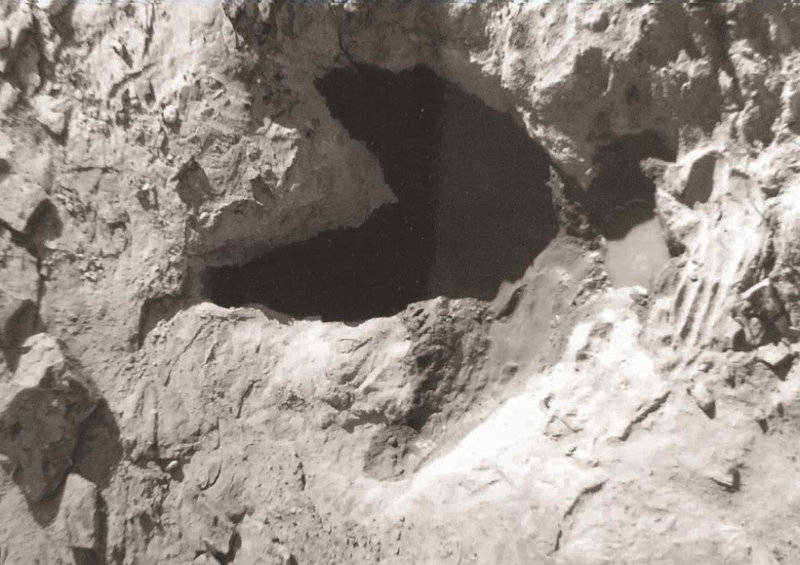
Image of one of the Tyrannosaurus' tracks. Photo by Scott Persons, one of the papers authors: Smith et al, 2016.
Tyrannosaur legs and tail - Built for speed
In the past, T. rex was thought of as a slow and cumbersome dinosaur. It was often thought that due to its size, overcoming its own inertia would be difficult to do. If it could not move as fast as its prey, T. rex would be a terrible hunter, and would therefore need to resort to scavenging. Walking speeds from the two trackways gives walking speeds around 3-5 mph, but say nothing about it's running speed. This is where musculoskeletal models come into play.
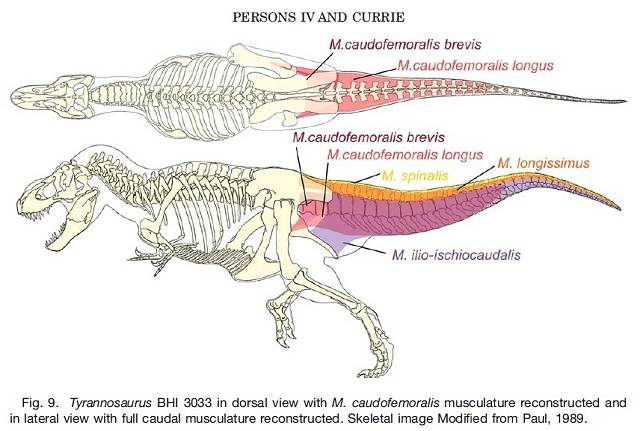
Figure 9 from Persons & Currie 2010.
Click on the link to view the full article.
This figure shows the reconstructed tail musculature. The M. caudofemoralis muscle is
the main retractor muscle of the hind limb. A larger retractor muscle indicates a faster animal.
Tryannosaurus had a large M. caudofemoralis.
A paper published in 2007 by Sellers and Manning shows that T. rex was not terribly slow. They developed musculoskeletal
computer models of three living animals (including a human) as well as for five theropod dinosaurs. The speeds
calculated for the three living animals were "in reasonably good agreement with accepted values." For the theropods,
they found the smaller ones were the fastest, while T. rex was the slowest. Although it was the slowest, the speed found
was still a respectable 8 m/s (18 mph), which is faster than a sprinting human or an elephant. A table of their data
is shown above. Sellers and Manning conclude that improved musculoskeletal models will produce even more accurate
values.
Later, in 2010, a more accurate T. rex musculoskeletal model was created by Persons and Currie. They looked at
both the leg structure and the unique tail structure of theropod dinosaurs. Theropods have tails with a
structure unlike any living animal today. Persons and Currie realized the tails weren't
simply a large counterbalance, but an extension of the dinosaur's leg muscles. Some of the large tail muscles gave
extra power to the dinosaurs' legs.
These extra muscles also added mass to the tail which would help center the inertia of the animal (center of mass).
They say Tyrannosaurus had a "sizeable investment in locomotive muscle among theropods."
They concluded that Tyrannosaurus had greater athleticism, in terms of running, balance, and turning agility.
This evidence suggests a much more mobile and agile animal capable of chasing down prey (Persons and Currie, 2010).
In light of this new evidence, it appears T. rex may have been able to move a little faster than the 18 mile per
hour value given by Sellers and Manning. T. rex also has proportionately longer legs than other theropods, enabling
it to have a longer stride and faster gate. So, when all the evidence is considered, it appears T. rex's
legs and tail were specialized for agility and speed.
Was Tyrannosaurus rex a Predator or Scavanger?
The debate as to whether or not T. rex was a predator or scavenger is not really a big debate. Most
paleontologists agree that T. rex was an opportunistic carnivore. This conclusion is not only drawn
from fossils but also from looking at predators today. There is no black and white line that separates
a "predator" from a "scavenger." Nature is not that clear cut. To clarify, one can take a look at
living carnivores. A good example is the lion and hyena.
The Lion
The lion is traditionally thought of as an apex predator in southern Africa.
However, even though a typical lion will hunt and kill over 15 animals per year, up to
40% of a lions food comes from scavenging carcasses.
The Hyena
On the flip side, the hyena is traditionally thought of as a scavenger.
However, it has been found that many hyenas hunt for most of their food. In
fact, the spotted hyena hunts and kills as much as 95% of its own food (Cooper et al. 1999), way more than a lion.
T. rex
Based on the facts, a hyena is much more of a predator than a lion. However, neither is a pure predator
or scavenger. They are opportunistic carnivores. If one researches almost any apex carnivore, one
will find they are a mix of both. So, it doesn't really makes sense to group T. rex as only a
predator or scavenger. Like most carnivores, it was probably a mix of both. How much it hunted vs scavanged will never be known.
However, science tells us T. rex is designed as a predator, so it's reasonable to assume it would hunt it's share of food.
Below discusses some of the predator traits T. rex has.
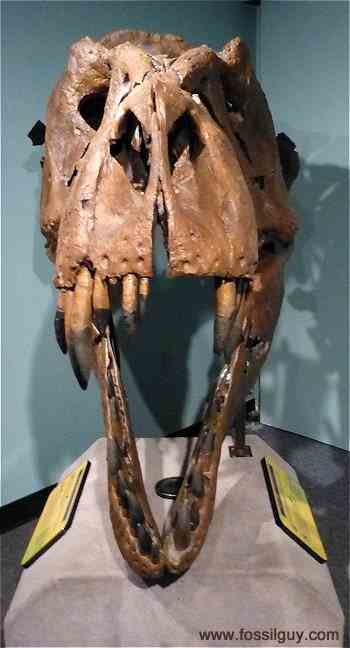
A cast of a T rex skull at the Academy of Natural Sciences in Philadelphia. Although the skull is slightly crushed, one can see the eyes clearly look forward. This is a key trait of most active hunters.
Physical Evidence
Physical trace evidence of T. rex either hunting or scavenging is sparse. There have been many dinosaurs
found with tooth marks, tooth pieces, and bite marks from T. rex. A study of T. rex marks on Triceratops
horridus specimens even show how T. rex would have eaten them... by pulling their heads off! There have been
many digested dinosaur bones found at fossil T. rex sites (stomach contents). Bite and scrape marks from
T. rex have even been found on the bones of another T. rex (Farke, et al., 2010). This means they ate each
other! However all of this evidence simply shows T. rex ate dinosaurs; it doesn't tell us if T. rex hunted
them or scavenged them.
However, a paper by DePalma et al (2013), studied a T. rex tooth embedded in a hadrosaur
caudal (tail) vertebra. The interesting thing about this embedded tooth is the tail vertebra began to heal
over. This means T. rex bit into a living hadrosaur. DePalma's team believes the T. rex intended to eat the
hadrosaur, but it managed to escape.
T. rex - designed to be a predator
Besides the sparse trace evidence of predation, one can study the actual anatomy of T. rex itself and see if
it was more suited as a predator or scavenger. Looking at the various specialized body parts suggests it was
a well designed predator.
T. rex has a huge skull with large, impact resistant teeth. The jaws had the strongest bite force of any land
animal ever. Paleontologists argue these overly strong jaws and solid teeth would be ideal for capturing and
holding struggling prey, even a large hadrosaur or triceratops.
T. rex's eyes are the eyes of a predator. The dinosaur has forward facing eyes, not eyes on the sides of the
head. Forward facing eyes gives an animal depth perception and is a key trademark of predators.
As we now know, the tail of T. rex contains an abnormally large muscle which would have given T. rex increased speed and agility.
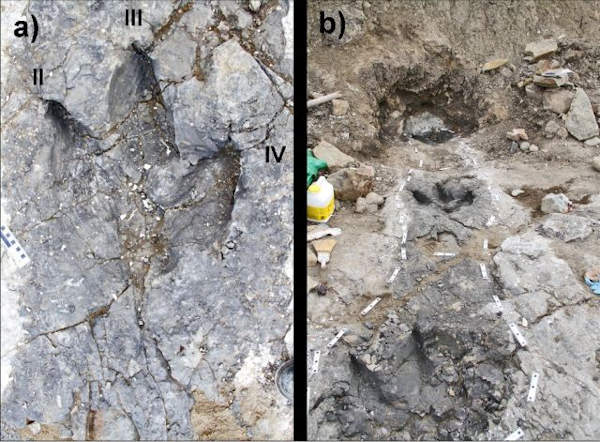
This is Figure 2 from McCrea et al., 2014. showing the Tyrannosaur trackway. The full article with more images is here: doi:10.1371/journal.pone.0103613.g002
In 2014 a paper was published by McCrea et al., discussing the first ever discovered trackway of a Tyrannosaurus. The interesting thing about this trackway is that it was made by 3 Tyrannosaurs next to each other at the same time (McCrea et al, 2014). This shows some kind of "gregarious" or social behavior, which lends credibility to Tyrannosaurs hunting in packs.
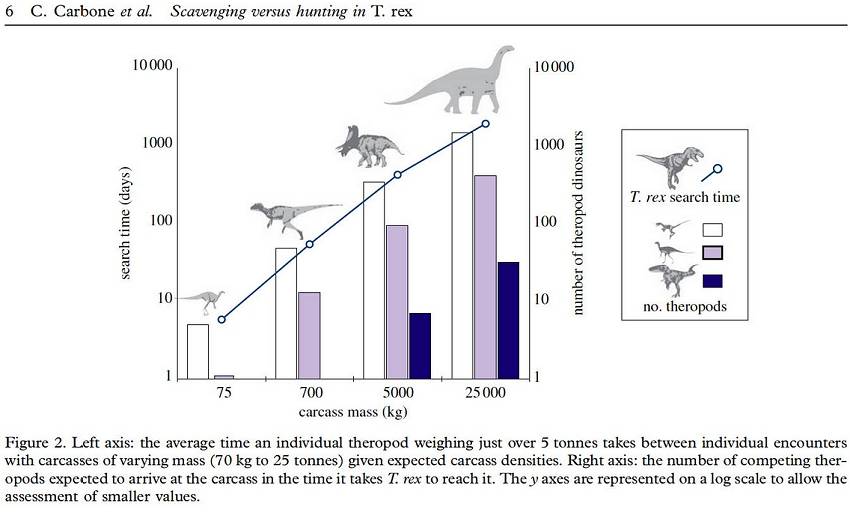
Figure 2 from Carbone et al (2011).
This shows the average time a T. rex would find a carcass compared to smaller dinosaurs. What it
shows is by time the T. rex found a carcass, it would already be scavanged by the many smaller dinosaurs.
Instead of looking at the actual fossils, another team (Carbone, et al. 2011) took a different approach to
the hunter vs scavenger debate. They looked
at T. rex in an ecological context, and studied the environmental conditions of the late cretaceous.
Carbone and his teams intensive study looked at the mass and abundance of each carnivore
and herbivore that coexisted with T. rex. They looked at their population densities and related it to a modern
day ecosystem to calculate number of large carcasses available for T. rex to eat. They contend that smaller,
more abundant carnivores would have quickly consumed carcasses, and that large carcasses would have been rare (Carbone, et al., 2011).
The results suggest T. rex would have been unable to
compete as a scavanger and would have had to hunt large prey (Carbone, et al., 2011). If T. rex wasn't
a predator, there would have to be another top apex predator. None have been found.
Predador vs Scavanger Conclusion:
Predatory evidence from studying the anatomy of T. rex, the healed hadrosaur vertebra, and the ecological study is hard to refute. In light of this research, it seems clear that T. rex was an active predator. However, like apex predators today, it probably exhibits both predatory and scavenging behaviors. Just how much T. rex hunted vs. scavenged will probably never be known, and it probably varied by the environmental conditions it lived in. What is known is that T. rex was at the top of the food chain in Western North America during the late Cretaceous.
Juvenile T. rex vs Adult T. rex vs Nanotyrannosaurus lancensis - More information required
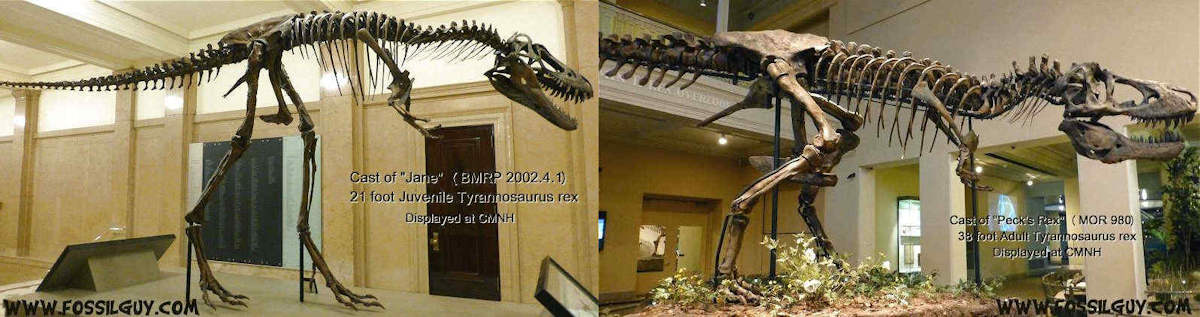
Casts of Jane, a nanotyrannosaurus, and Pecks Rex, a tyrannosaurus.
Juvenile vs Adult Dinosaurs
Today, paleontologists realize that juvenile dinosaurs do not look like their adult counterparts. Besides
the drastic size change, the skulls and other bones morphed and changed shape. Sometimes the
youngsters look nothing like the adults. This makes determining a juvenile species of a particular
dinosaur very difficult.
In the past when different looking skulls were found, they were named a new genus and or species. Now,
paleontologists have the daunting task of determining which species are valid and which species are simply
juveniles of an already known adult species. A good example is famous
ceratopsian, Triceratops.
Back in the day, there were 16 species of Triceratops. Today, there are only 2. The other 14 "species" turned out
to be juveniles in different stages of growth.
This juvenile vs adult issue might also be present in T. rex. The problem is there are not enough fossils to study.
Adult T. rex fossils are hard to come by, but it appears juveniles are even more difficult to find,
especially when no one is sure what they exactly look like.
The case of Nanotyrannosaurus lancensis
In 1946 Charles described a skull of a small theropod that was eventually named Nanotyrannosaurus lancensis. This
small skull was long and slender with many small sharp teeth. Later, in 2001, a nearly complete specimen of N. lancensis
was discovered. This specimen is called "Jane" (BMRP 2002.4.1).
The fact that no juvenile T. rex fossils had been discovered raised suspicions that Nanotyrannosaurus was actually a
juvenile T. rex. Some paleontologists took a second look at Nanotyrannosaurus. They studied the holotype and concluded
it was in fact a juvenile T. rex. Much of this was based on age determination of the fossil. Other paleontologists studied
the skull and came to the conclusion Nanotyrannosaurus was its own species and not a juvenile T. rex.
Much of this was based on the fact that a closely related species
(Tarbosaurus bataar of Asia)
did not lose teeth as they aged, but for N. lancensis to be a juvenile T. rex, it would have had to lose many teeth.
The debate still goes on today. The problem is there is simply not enough study material
to validate any assumption. Other "juvenile" specimens have been found. Unfortunately, they are in private collections and
are unavailable for study.
Juvenile T. rex's were obviously much smaller, and probably less robust than the adults. This means they
probably occupied a different ecological niche than their adults. But is Nanotryrannosaurus a juvenile T. rex?
For now, Nanotrannosaurus lancensis is officially a different species than Tyrannosaurus rex. The debate will not
be settled until new fossil specimens are found and studied.
Did T. rex have feathers? It was either fully scaled or mostly scaled.
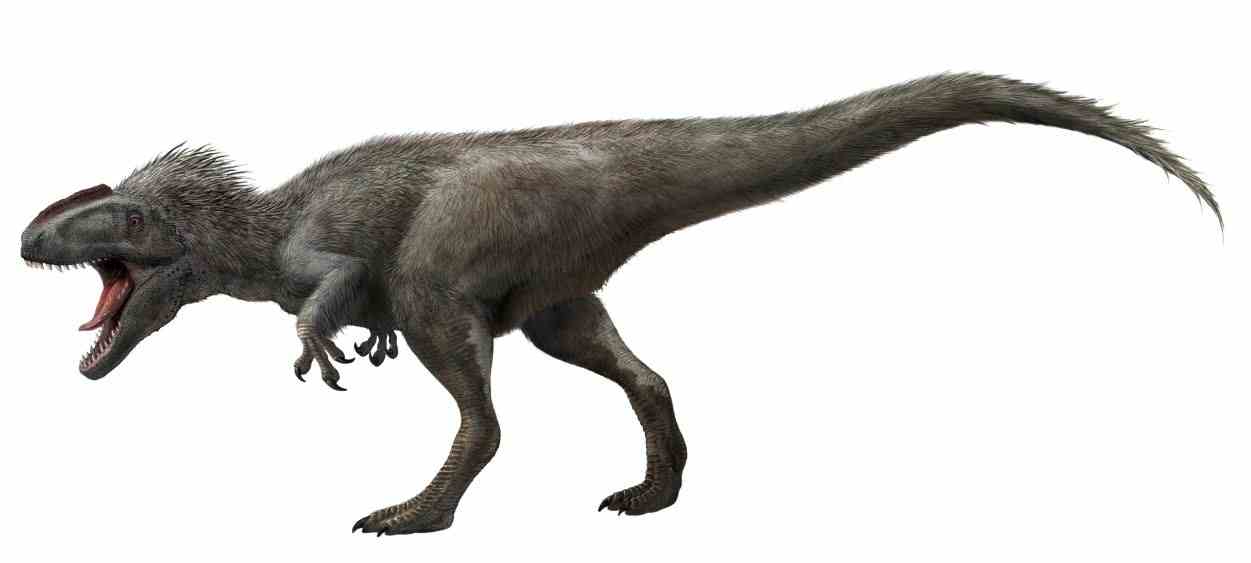
An illustration of Yutyrannus huali, the giant feathered tyrannosaur that lived in a colder climate and over 60 million years earlier than T. rex
Illustration by Lida Xing and Yi Liu.
Since the discovery of feathered dinosaurs in the 1990's, it has become clear that many families of theropod dinosaurs
had feathers, or at least, primitive feather like structures (protofeathers). Well known theropods such as velociraptor
and microraptor had protofeathers. Tyrannosaurus is a very large theropod, so could it have also had feathers?
To answer this question, one needs to look at the Tyrannosaur family and see if any of its relatives had feathers.
As it turns out, its relatives do have feathers. In 2004, a theropod named Dilong paradoxus was discovered in China (Xu X. et al 2004).
Dilong, a small 1.6 m theropod, was found to be covered in protofeathers; the "feathers" looked like hair
like strands (Xu X. et al 2004). Dilong is also considered to be a distant member of the Tyrannosaurid
family that lived 65 million years before T. rex. This means protofeathers are present in Tyrannosaurus' family tree.
Later, in 2012, Xu X. described another nearly complete feathered Tyrannosaur relative named Yutyrannus
huali (Beautiful Feathered Tyrant). This theropod is a little younger in age, about 125 million years old,
and is more closely related to T. rex than Dilong. What's interesting about Yutrannus is that it's 30 feet in length.
Although it's still smaller than T. rex, it's the largest feathered theropod yet discovered. The simple feathers on
Yutrannus are not well preserved, but they are up to 8 inches long and may have covered most of the body (Xu X. et al, 2012).
This discovery showed that even large theropods could be covered in feathers, or feather like structures.
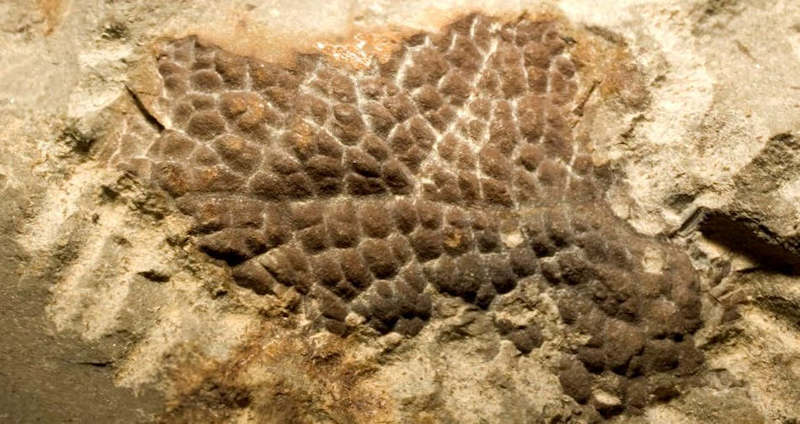
Image of a skin impression from the tail of "Wyrex" tyrannosaurus dinosaur (BHI 6230). As one can see, at least this part of the Tyrannosaurus rex had scales and not feathers.
However, as tantalizing as it is, one cannot conclude that T. rex had protofeathers. A well preserved T. rex
specimen found in 2002 named "Wyrex" (BHI 6230) was found with some small associated skin
impressions from the neck, hip, and upper tail. All of the impressions clearly show intricate scales. No feather or hair like structures are seen.
In places on the body where Yutrannus shows feather structures, T. rex only shows scales. So,
it can be concluded that T. rex was covered scales, not feathers.
One difference between Yutrannus and T. rex is the climate in which they lived. Yutrannus is from China
and lived in a colder climate with harsh winters (Amiot et al., 2011). Many dinosaurs in that region
had filaments and other protofeather like structures (Amiot et al., 2011). Perhaps Yutrannus needed protofeathers for insulation, whereas T. rex did not need it.
Another main difference is all of the related Tyrannosaurs that had feathers are much older than T. rex, they are all from the Early Cretaceous. Tyrannosaur relatives from the Late Cretaceous all have preserved skin impressions that clearly show scales (Bell et al. 2017). Perhaps Tyrannosaurs lost their feather like structures by the end of the Cretaceous.
Finally, Carr et al. (2017) took a different approach and studied the bony texture of a skull of a new species Daspletosaurus horneri (A closely related Tyrannosaur). The type of texture on the skull bones indicate they were covered in scales. Carr et al. concludes this dinosaur and other Tyrannosaurs had scaly faces.
Conclusion
What does this all mean? This shows that T. rex was either fully scaled or at least mostly scaled. The possibilility that T. rex supported feathers in only certain areas cannot be ruled out, or that babies and juveniles had feather structures but lost them as they aged. More skin samples are required before this question can be fully answered.
This video below from the American Museum of Natural History shows the behind the scenes story of the museums T. rex makeover. They give the adult T. rex feather like structures in a few select areas and also fully cover their baby T. rex in down. It looks so cute!
YOUTUBE VIDEO
AMNH Video showing the T. rex makeover and a baby feathered T. rex.
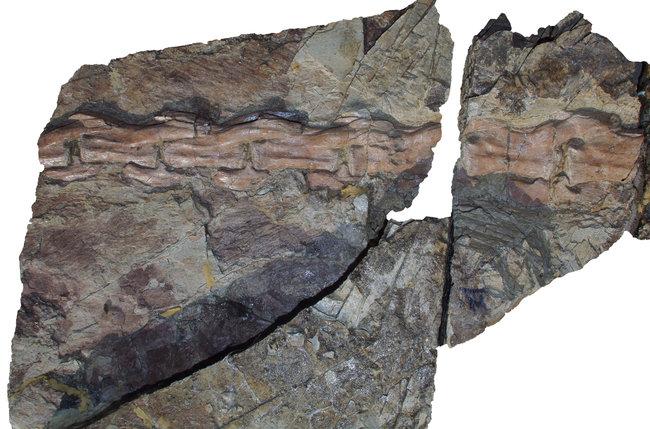
Specimen ZCDM V5000, the holotype Yutyrannus huali. This image shows part of the tail section of the fossil. The faint feather strcutures can be seen here. Image by Zang Hailong.
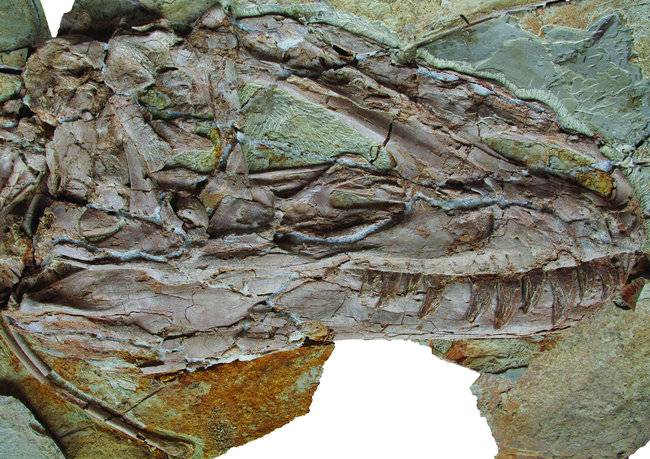
Specimen ZCDM V5000, the holotype Yutyrannus huali. This image shows the skull. Image by Zang Hailong.
What Sounds did T. rex make? Low frequency rumbles and chirps - No roars!
Although we will never know exactly what a T. rex sounded like, paleontologists can make educated guesses based on preserved fossil voice boxes, earbones, and making comparisons.
In 2017 Professor Julia Clark of Texas University recreated the sound of Tyrnnosaurus using a few pieces of information:
Closed-Mouth Sounds: She knew Tyrannosaurus probably made closed-mouth vocolizations, as in some birds, crocodiles, and other common ancestors of dinosaurs.
Low Frequencies: A bone in their middle ear called The Stapes, was fairly large, about the size of a matchstick. This shows their ears were tuned to listened
in low-frequency sounds, much like an elephant.
Related Animals: She used the calls of the Eurasian Bittern bird and a Chinese crocodile which have voice boxes and syrinxes roughly similar
to Tyrannosaurs. She then scaled these calls up to the size of a T-rex.
Combining all of this information, she came up with an educated guess at what T. rex actually sounded like; a series of low frequency rumbles and chirps. Listen below:
YOUTUBE VIDEO - TYRANNOSAURUS REX SOUNDS
The sounds start at the 5:32 mark in the video
Dinosaur Discovery Video showing what T rex sounded like with an explanation.
Recommended T. rex Dinosaur Books and Educational Items:

Tyrannosaurus Sue: The Extraordinary Saga of the Largest, Most Fought over T-Rex Ever Found
Steve Fiffer, 20000
This rare adult book on T. rex tells the true story of the famous Tyrannosaur "Sue," unfolding like a movie plot. It covers Sue's discovery and the battle over the fossil, engaging commercial fossil hunters, corporate giants, museums, law enforcement, government prosecutors, and a Native American tribe. Narrated by Peter Larson, it details the government raid on the Black Hills Institute, exposing corruption and ignorance in science. A compelling read for Tyrannosaur enthusiasts.


Tyrannosaurus rex, the Tyrant King (Life of the Past)
Peter L. Larson, Kenneth Carpenter , 2008
This is one of the best Tyrannosaurus rex books out there. It is a collection of everything T. rex, from it's range based on stratigraphy, why it has short arms, to soft tissue reconstruction. It includes many tables, drawings, and photographs. This is a wonderful resource for all things T. rex! The book is, however, very technical and not for the casual audience. If you are a T. rex enthusiast, this book is for you.

Nifeliz Dinosaur Fossils Building Kit
From 8 dinosaurs to choose from, including T-rex, The Nifeliz Dinosaur sets are nearly 500 pieces. They are a great gift for those 12+ who enjoy solo or group building with LEGOs. Constructing these models enhances hand-eye coordination and creativity. Perfect for family or friends, It's also compatible with existing LEGO pieces, facilitating the creation of a personalized toy museum! Check out the reviews!
Get An Authentic Tyrannosaurus rex Tooth:

T. rex is so popular it's hard to imaging you can actually have a real tooth from one! Tyrannosaurus teeth are not that common. Usually you can find teeth from its distant cousin Carcharodontosaurus for sale. However, Fossil Era has a selection of real Tyrannosaurus teeth. Check 'em out!
 Paleoadventures Dinosaur Digs
References / Works Cited
R. Amiot, X. Wang, Z. Zhou, X. Wang, E. Buffetaut, C. Lecuyer, Z. Ding, F. Fluteau, T. Hibino, N. Kusuhashi, J. Mo, V. Suteethorn, Y. Wang, X. Xu, F. Zhang. Oxygen isotopes of East Asian dinosaurs reveal exceptionally cold Early Cretaceous climates. Proceedings of the National Academy of Sciences, 2011; DOI: 10.1073/pnas.1011369108
T. Carr, D. Varricchio, J. Sedlmayr, E. Roberts, J. Moore. (2017). A new tyrannosaur with evidence for anagenesis and crocodile-like facial sensory system. Scientific Reports. 7. 44942. 10.1038/srep44942.
Farlow, O. James, Brett-Surman, M.K., Editors. (1997) The Complete Dinosaur. IN: Indiana University Press.
Fastovsky, E. David, Weishampel, B. David (1996). The Evolution And Extinction Of The Dinosaurs. NY: Cambridge University Press.
Bell P. R., Campione N. E., Persons W. S., Currie, P. J., Larson, P. L., Tanke, D. H., & Bakker, R. T. (2017). Tyrannosauroid integument reveals conflicting patterns of gigantism and feather evolution. Biology letters, 13(6), 20170092. DOI: doi/10.1098/rsbl.2017.0092
C. Carbone, S. T. Turvey, J. Bielby. (2011) Intra-guild competition and its implications for one of the biggest terrestrial predators, Tyrannosaurus rex. Proceedings of the Royal Society B: Biological Sciences; DOI: 10.1098/rspb.2010.2497
Cooper, S.M., Holekamp, K.E., Smale, K. (1999) A seasonal feast: long-term analysis of feeding behavior in the spotted hyaena. Crocuta crocuta (Erxleben). Afr. J. Ecol. 37, 149-160.
Andrew Allen Farke, Nicholas R. Longrich, John R. Horner, Gregory M. Erickson, Philip J. Currie. (2010) Cannibalism in Tyrannosaurus rex. PLoS ONE, 2010 5 (10): e13419 DOI: 10.1371/journal.pone.0013419
Forster Catherine A. (1996) Species resolution in Triceratops: cladistic and morphometric approaches. Journal of Vertebrate Paleontology, 16:259-270.
Lipkin, C., & Carpenter, K. (2008) Looking again at the forelimb of Tyrannosaurus rex. In: Tyrannosaurus rex, the tyrant king. Larson, P. & Carpenter, K. (eds.). Indiana University Press. Bloomington, IN. pp.167-190.
McCrea RT, Buckley LG, Farlow JO, Lockley MG, Currie PJ, et al. (2014) A 'Terror of Tyrannosaurs': The First Trackways of Tyrannosaurids and Evidence of Gregariousness and Pathology in Tyrannosauridae. PLoS ONE 9(7): e103613. doi:10.1371/journal.pone.0103613.g002
Ostrom J.H, Wellnhofer P. (1986) The Munich specimen of Triceratops with a revision of the genus. Zitteliana. 14, 111-158.
Sellers, William Irvin & Manning, Philip Lars. (Nov. 2007) Estimating dinosaur maximum running speeds using evolutionary robotics. Proceedings B, The Roal Society Full Article Here
Smith, Sean D., Persons, Scott W., Xing, Lida. (2016) A tyrannosaur trackway at Glenrock, Lance Formation (Maastrichtian), Wyoming. Cretaceous Research, Volume 61, June 2016, Pages 1-4 http://dx.doi.org/10.1016/j.cretres.2015.12.020
W. Scott Persons, Philip J. Currie. (2010) The Tail of Tyrannosaurus: Reassessing the Size and Locomotive Importance of the M. caudofemoralis in Non-Avian Theropods. The Anatomical Record: Advances in Integrative Anatomy and Evolutionary Biology; DOI: 10.1002/ar.21290
Rothschild, B. M. & Molnar, R. E. (2008) Looking again at the forelimb of Tyrannosaurus rex. In: Tyrannosaurus rex, the tyrant king. Larson, P. & Carpenter, K. (eds.). Indiana University Press. Bloomington, IN. pp.287-304.
Rothschild, B., Tanke, D. H., and Ford, T. L. (2001) Theropod stress fractures and tendon avulsions as a clue to activity: In: Mesozoic Vertebrate Life, edited by Tanke, D. H., and Carpenter, K. (eds.) Indiana University Press. Bloomington, IN. pp. 331-336.
S. Wroe, D. R. Huber, M. Lowry, C. McHenry, K. Moreno, P. Clausen, T. L. Ferrara, E. Cunningham6 M. N. Dean, A. P. Summers. (2008) Three-dimensional computer analysis of white shark jaw mechanics: how hard can a great white bite? Journal of Zoology. Volume 276, Issue 4, p. 336-342, December 2008.
Online PDF of Article
Xu X., Norell, M. A., Kuang, X., Wang X., Zhao Q., & Jia C. (2004) Basal tyrannosauroids from China and evidence for protofeathers in tyrannosauroids - Nature 431 (7009): 680-684.
Xu, X., Wang, K., Zhang, K., Ma, Q., Xing, L., Sullivan, C., Hu, D., Cheng, S. et al. (2012) A gigantic feathered dinosaur from the Lower Cretaceous of China. Nature 484: 92-95. (.PDF here)